

Indian-Soviet relations may have been cordial for close to half a century, but suspect foreign cultural practices -- even from an ally -- were not looked upon kindly.
"Yoga was banned during Soviet times, so most people had never seen anything like it," Kaushik recalls. "People were interested but suspicious, and in the beginning, classes were mostly empty halls."
After 10 years in Russia, Kaushik's attempts to interest Muscovites, as well as expatriates, in all things Indian have become considerably easier.
Since arriving in Moscow on a scholar exchange a decade ago, Kaushik has gradually moved away from biotechnology and bioethics research at the Academy of Sciences to become the full-time vice president of the nonprofit Russian-Indian Heritage Academy.
The group sponsors Indian cultural events around the city, offers language courses in Hindi, Urdu and Sanskrit as well as Russian and English and, through an associated organization, offers seminars and training sessions on business enterprise and business ethics.
Plans are even afoot to build a Moscow monument to Afanasi Nikitin, the 15th-century Russian explorer who traveled to India nearly 50 years before any other European, including Vasco de Gama.
Ironically, interest among Russians in Indian-related events has increased as the number of Indian expats has decreased. Kaushik says roughly 10,000 Indians live and work in Moscow, far fewer than during Soviet times.
"At one time, they came for education and jobs and stayed because there were better opportunities, but India's biggest cities can offer much the same today," he said.
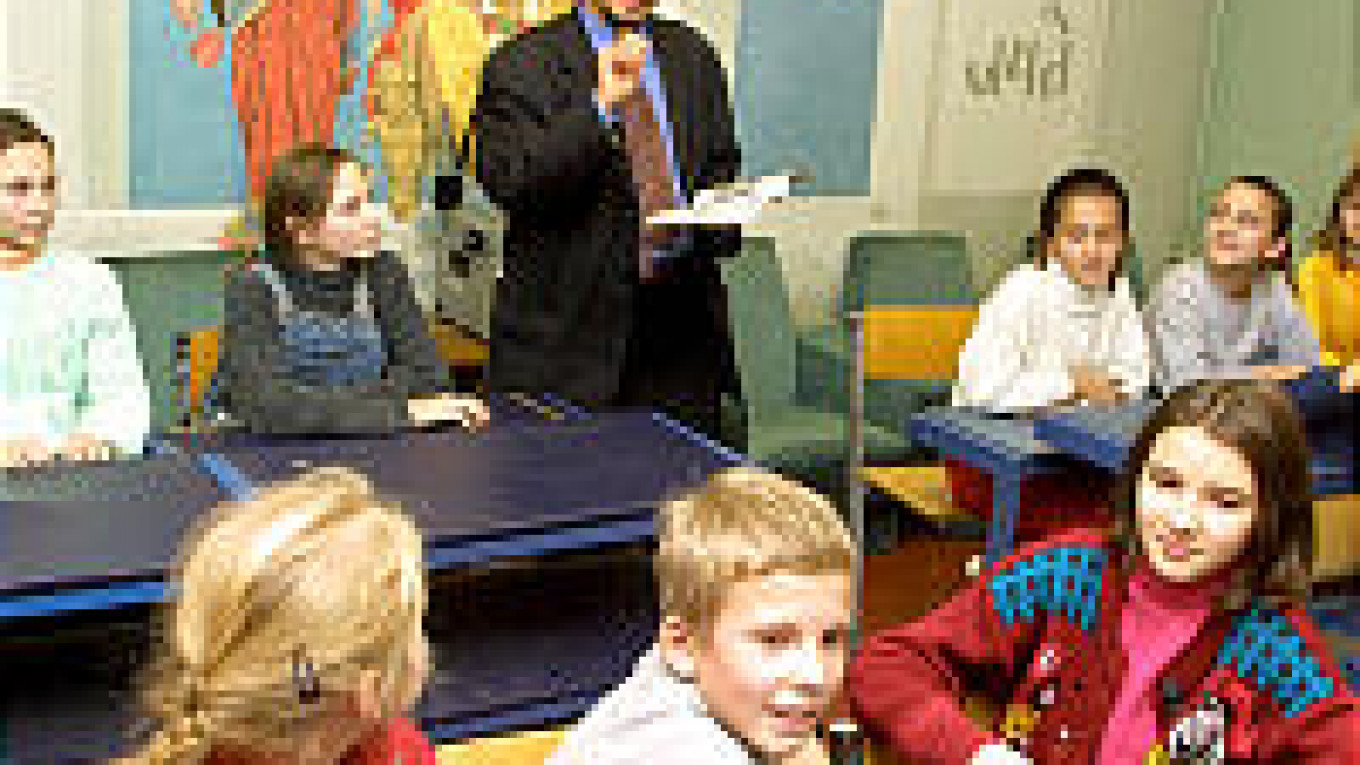
Today it is Russians, he says, who pack most of the academy's events. Even at Moscow's International Hindi Boarding School, where Kaushik teaches Hindi-conversation classes and periodically lectures, nearly all of the 450 students are Russian.
Founded in 1956 by India's first prime minister, Jawaharlal Nehru, the school was initially aimed at foreign students as well. Today, a top-notch foreign-language program attracts scores of people hoping to become diplomats or journalists, Kaushik said.
Olga Nadezhdina, 16, who began attending the school four years ago when her family moved from Murmansk to Moscow, hopes to one day use her near-fluent Hindi skills as foreign correspondent in India.
"It's not as difficult a language to learn as people think," Nadezhdina says.
"India is a country of colors, so different from all the gray around here," said Maria Mazouka, gesturing toward the Soviet apartment blocks seen through the window of the Hindi school.
Inside, the school is replete with images of India. Colorful murals of the Taj Mahal and Hindi gods grace the walls, and portraits of Mahatma and Indira Gandhi hang in Kaushik's office.
Mazouka, 26, got hooked on Indian dance as a teenager after seeing one of the many Indian films popular with Soviet audiences. She found a teach-yourself-Hindi book with two cassettes and set out to become fluent.
These days she works for a tourist agency that arranges Indian vacations. Her latest project is to organize an "oriental discoth?que" night in Moscow, complete with the latest rap and dance imports from Bombay and New Delhi, planned for December.
Other big-ticket events included a grand food and dance gathering at Moscow State University to celebrate the Indian Diwali Festival, a festival roughly equivalent to Christmas in the West.
Kaushik says that interest in yoga is the best way to gauge the academy's success. Last year, enthusiasm was so high that Kaushik helped select six of the best Russian yoga practitioners to compete in the International Yoga Championships in New Delhi. The Russians finished a respectable third, behind India and Argentina.
"To me, they even appeared more relaxed, more flexible than the Indian team," Kaushik said proudly. "I was even more surprised that the Russian team chose to use all Indian music for the artistic portion of the contest. Not all the foreign teams did this."
Many Russian converts consider yoga a welcome antidote to other all-too-typical habits -- vodka and cigarettes.
"It's a healthy habit, a good habit, and if you replace the bad with the good, it's harder to lapse back into old, bad habits," said Stanislav Chelyshkov, a 66-year-old yoga enthusiast.
Chelyshkov became fascinated by the physically demanding exercises and soothing meditation techniques in the 1960s when a friend showed him the ropes.
"I spend at least 15 minutes a day at yoga," he says. "And I haven't been sick once in the last 30 years."
For more information on the Russian-Indian Heritage Academy call 901-750-4423 or e-mail [email protected]. Events are open to all.
A Message from The Moscow Times:
Dear readers,
We are facing unprecedented challenges. Russia's Prosecutor General's Office has designated The Moscow Times as an "undesirable" organization, criminalizing our work and putting our staff at risk of prosecution. This follows our earlier unjust labeling as a "foreign agent."
These actions are direct attempts to silence independent journalism in Russia. The authorities claim our work "discredits the decisions of the Russian leadership." We see things differently: we strive to provide accurate, unbiased reporting on Russia.
We, the journalists of The Moscow Times, refuse to be silenced. But to continue our work, we need your help.
Your support, no matter how small, makes a world of difference. If you can, please support us monthly starting from just $2. It's quick to set up, and every contribution makes a significant impact.
By supporting The Moscow Times, you're defending open, independent journalism in the face of repression. Thank you for standing with us.

Remind me later.