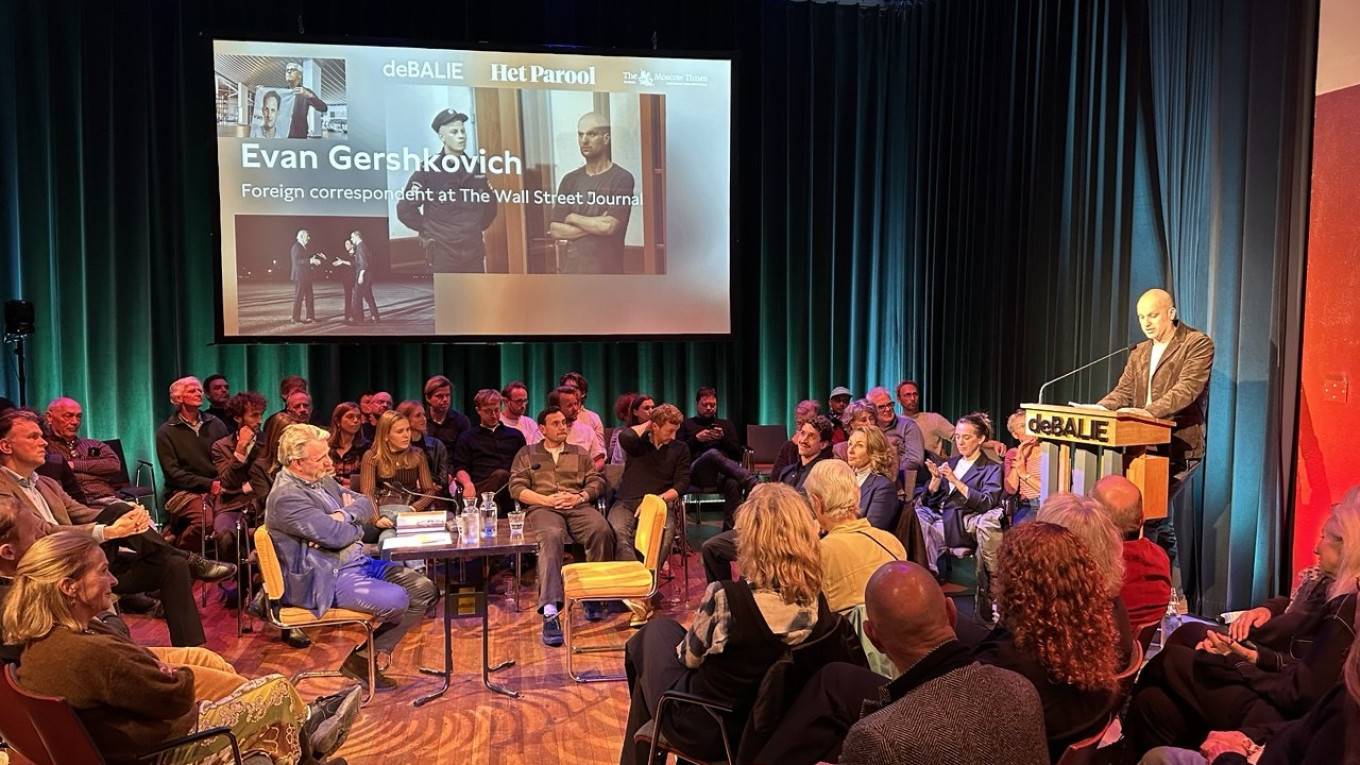
AMSTERDAM — Exiled Russian journalists are preserving the foundations of a future free press despite the Kremlin’s destruction of independent media at home, Wall Street Journal reporter Evan Gershkovich said Saturday at the inaugural lecture honoring The Moscow Times’ founder Derk Sauer.
Speaking at the De Balie cultural center, Gershkovich paid tribute to the publisher who helped launch his reporting career in Russia and supported him during his 16 months in Russian detention.
“Putin’s regime has wiped away the institutions that Derk helped build in a free Russia in the ’90s, but the seeds of the principles of independent journalism that he imparted remain,” Gershkovich said. Those principles, he added, are carried by journalists scattered around the world and “will flourish again when the right time comes.”
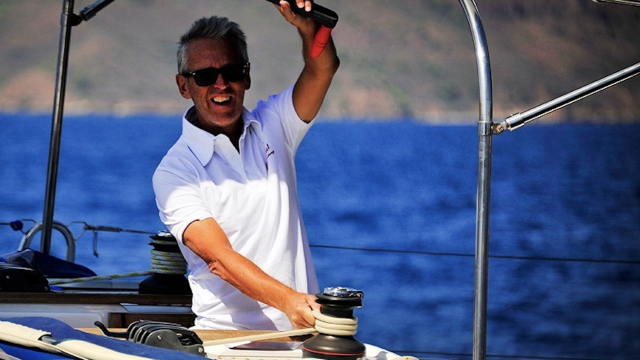
The lecture, organized by De Balie, Het Parool and The Moscow Times, took place on what would have been Sauer’s 74th birthday. The Dutch journalist and media entrepreneur died last year following a sailing accident.
The event was at once a tribute to Sauer’s role in building Russia’s independent media and a discussion of Gershkovich’s arrest, imprisonment and recovery after his release.
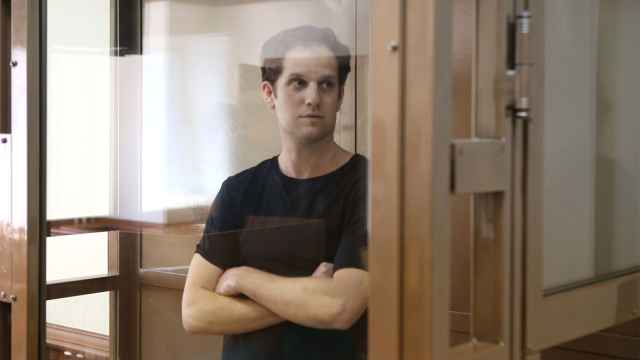
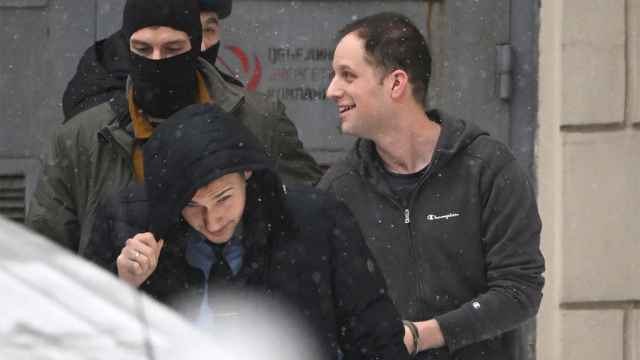
Gershkovich, who worked for The Moscow Times from 2017 to 2020, was arrested while reporting in the Urals city of Yekaterinburg in March 2023. He was sentenced to 16 years in prison on espionage charges that he, his employer and the U.S. government rejected as fabricated.
His account of his imprisonment and release in an August 2024 prisoner swap form the bulk of his memoir, “This Cursed Beautiful Land,” which was released in September.
When asked about his choice to stay in Russia after the full-scale invasion of Ukraine, Gershkovich said foreign correspondents had underestimated the risks of being imprisoned themselves, as foreign journalists had generally operated under a different set of rules than their Russian colleagues.
“My reasoning then was, if you’re a foreign journalist, you should try to be there if you can, because this country is becoming a black box,” he said.
Soon after his arrest, he came to understand that Russia intended to use him as a bargaining chip for a prisoner exchange with Washington. Despite accusing him of espionage, investigators did not put him through the intensive questioning he would have expected for such charges.
Nor did he face the harsh conditions, including torture, experienced by Russian political prisoners and Ukrainian civilians in Russian prisons.
He recounted how he tried to tried to maintain an emotional balance during his imprisonment, reading a steady diet of Russian literature, history and prison memoirs and practicing meditation. He would cook his own food using products delivered to him by his friends, improvising a way to make fresh pasta sauce using an electric kettle.
The psychological consequences of his ordeal would emerge after he returned home.
“In the beginning, I wasn’t sleeping. I had panic attacks, real anger that I took out on the people closest to me,” he said, but going to therapy and writing his memoir helped him process his trauma.
Gershkovich also credited the people who supported him in prison, including his Russian lawyers, whom he described as fighting for legal principles even as Russia’s conviction rate hovers around 100%.
He compared these lawyers’ work to Sauer’s legacy. Both preserve the knowledge and principles needed to rebuild institutions after a country emerges from authoritarianism.
Sauer founded The Moscow Times in 1992 and later helped establish the business newspaper Vedomosti. After the 2022 full-scale invasion, he facilitated the relocation of The Moscow Times, TV Rain and Meduza to the Netherlands so their journalists could continue to report from exile.
For Gershkovich, Sauer had been both a mentor who urged him to pursue more ambitious stories and a friend.
Sauer’s son Pjotr, a Guardian correspondent and former colleague of Gershkovich’s at The Moscow Times, read from one of the letters his father had written to Gershkovich while introducing the lecture.
“It’s all about the mind, Evan,” Sauer wrote. “So my friend, we have to deal with what life throws at us.”
Gershkovich recalled writing to Sauer before his death, joking that he might have taken his advice to be “a bit more rock and roll” in his reporting too far.
Even then, Sauer had kept his sense of humor, he said.
But his lasting contribution was the generations of journalists he had encouraged and trained, Gershkovich said.
“I believe that this is ultimately Derk’s legacy in Russia, too, and one all of us still involved in journalism have a duty to carry on.”
A Message from The Moscow Times:
Dear readers,
We are facing unprecedented challenges. Russia's Prosecutor General's Office has designated The Moscow Times as an "undesirable" organization, criminalizing our work and putting our staff at risk of prosecution. This follows our earlier unjust labeling as a "foreign agent."
These actions are direct attempts to silence independent journalism in Russia. The authorities claim our work "discredits the decisions of the Russian leadership." We see things differently: we strive to provide accurate, unbiased reporting on Russia.
We, the journalists of The Moscow Times, refuse to be silenced. But to continue our work, we need your help.
Your support, no matter how small, makes a world of difference. If you can, please support us monthly starting from just $2. It's quick to set up, and every contribution makes a significant impact.
By supporting The Moscow Times, you're defending open, independent journalism in the face of repression. Thank you for standing with us.

Remind me later.