
The recent government reshuffle, which sharply weakened Prime Minister Mikhail Mishustin, is generally interpreted as a financial maneuver designed to hand the Kremlin wild freedom to fund the war in Ukraine. While that is absolutely correct, it misses another, more important dimension.
The reshuffle is part of a broader political transformation: a generational turnover among the regime’s key managers, part of Putin’s redesign of the system as a whole.
The system of government Putin has built rests on his longtime associates, people he has known for decades and believes he can trust. Most are roughly his age, 74, give or take five years. As they are growing older, they are becoming less effective as managers.
The regime needs rejuvenation, a changing of the guard. Because Putin’s system has no built-in ability to renew its leadership, he manages the process personally, carrying out a transfer of power since 2024 that has largely escaped public attention.
The starting point of this transition can be traced to the appointments made immediately after the 2024 presidential election, although preparations began much earlier. One element was the decision in 2016-2017 to send several of Putin’s former adjutants and senior federal officials, including deputy federal ministers, to govern Russian regions.
Having been tested in these positions, some became central government figures, notably Alexei Dyumin and Dmitry Mironov. Others entered the reserve pool of candidates for senior government positions, including governors appointed to chair commissions of the State Council, whose political significance was greatly enhanced by the 2020 constitutional amendments.
Putin’s transition involves promoting trusted but relatively younger members of his team of functional vice presidents to key positions, transferring certain powers to them. Putin will evidently retain his current position beyond 2030, remaining the supreme leader, maintaining control over the security apparatus, and reserving the right to intervene whenever something goes wrong. These viceroys will take responsibility for everyday management and keeping the system on its established course.
In effect, Putin is preparing the system to operate on a kind of autopilot. By introducing greater specialization, he is extending its useful life while he himself remains at the top, like a Transformer acquiring additional mechanical arms and legs.
As in the run-up to the Medvedev-Putin tandem of 2008, a selection process is now underway. This time, however, Putin is choosing not one successor from a bunch but an entire constellation of avatars to represent him across different areas of government.
The decisive criteria are Putin’s personal trust in a candidate and that candidate’s loyalty to Putin alone, rather than to any institutional or corporate grouping. This explains the large number of former adjutants and close aides among the prospective vice presidents.
The mechanics of this quasi-transition are examined in greater detail in the report, “Transition Without a Successor: The Transformation of Putin’s Regime.”
Seen from this perspective, Mishustin’s dramatic weakening following the October reshuffle is less a surprise than the logical outcome of both the trends in 2026 thus far and a political transformation that has been proceeding under Putin’s close supervision for almost three years.
The transformation has two principal components. The first is a process of generational renewal, replacing the older generation with a younger one. The other is weakening government institutions, including informal ones like factions and power networks both in government and business.The government apparatus headed by Dmitry Grigorenko was one such power network — to a considerable extent, Mishustin’s personal domain as prime minister.
With the latest government reshuffle and the sweeping restructuring of the judiciary — now being completed through a package of bills under consideration in the State Duma — the transformation of the executive and judicial branches is approaching its conclusion. The Federal Assembly has so far been affected only marginally. A reconfiguration of both chambers appears likely soon.
The accelerated transformation of the political system is taking place largely through changes in what individual figures actually do, rather than in their formal positions. Detailed monitoring is therefore indispensable. Only by tracking these changes can we identify emerging trends and assess the relative standing of key players in real time.
Since January 2026, the NEST Center’s Transformation Laboratory has been conducting detailed monitoring of changes in Russia’s political system. We have identified 13 figures of note operating in different spheres:
- Andrei Belousov, Minister of Defense
- Alexei Dyumin, presidential aide and Secretary of the State Council
- Sergey Kirienko, First Deputy Chief of Staff of the Presidential Administration
- Igor Krasnov, Chairman of the Supreme Court
- Denis Manturov, First Deputy Prime Minister
- Dmitry Medvedev, Deputy Chairman of the Security Council
- Dmitry Mironov, presidential aide
- Mikhail Mishustin, Prime Minister
- Alexander Novak, Deputy Prime Minister
- Maxim Oreshkin, Deputy Chief of Staff of the Presidential Administration
- Dmitry Patrushev, Deputy Prime Minister
- Sergey Sobyanin, Mayor of Moscow
- Igor Shuvalov, Chairman of the state development corporation VEB.RF
We chose to focus on them because they have been mentioned by experts as potential successors or have already become his deputies, formally or in practice, within various structures and policy areas, including the Security Council or State Council.
Most received new appointments or expanded responsibilities after Putin’s re-election. Having spent 10, 20, or more years in Putin’s orbit, their loyalty is primarily personal rather than toward institutions.
The group encompasses two generations of Putin’s elite. Some members of the older generation will leave during the transition. But if an unplanned succession were suddenly triggered today, they would play a decisive role.
These 13 individuals stand at the forefront of the changes reshaping the regime. Shifts in their positions signal deeper movements in the political landscape. Monitoring them and the structures they control allows us to trace the direction of the transformation and perhaps even anticipate the onset of a crisis.
We assess the potential of each man across six dimensions: proximity to Putin and five types of “resources” — measures of administrative, security, financial, political and media influence and power. What matters is not only the importance of each individual resource but also how many different resources a figure commands simultaneously, and how that combination changes over time.
Our analysis of the 13 contenders from January to October 2026 reveals five major trends.
Over the ten months of observation, there has been a noticeable redistribution of resources. Younger figures with smaller initial resource bases are gaining ground, while older, more powerful players are losing it.
The largest losses were recorded by Mishustin (–1.9 points from a base score of 46) and Kirienko (–1.0 from 43). The most substantial gains went to Krasnov (+1.5 from 19), Manturov (+1.0 from 25), Novak (+0.7 from 19), and Oreshkin (+0.7 from 20).
Furthermore, the regime is becoming increasingly personalist. This is reflected in the declining aggregate security (–0.6) and administrative (–0.2) resources of the individuals studied, alongside increases in their political (+0.7) and financial (+0.8) resources and their proximity to Putin (+0.6).
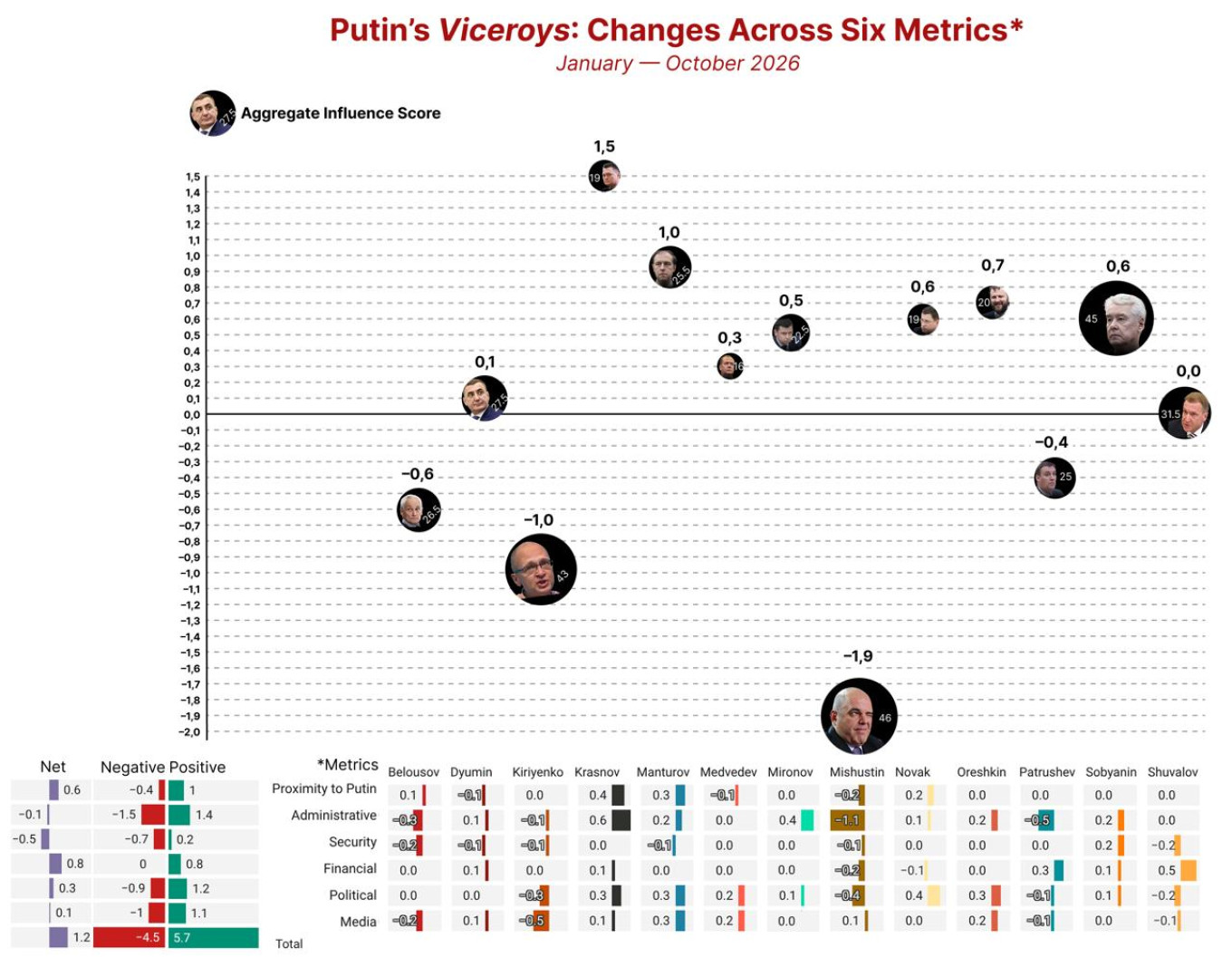
The uneven distribution of these resources is intentional. Anyone who simultaneously controls several major types is a potential independent actor. The response is to strip such figures of certain resources — or induce them to relinquish them themselves — as illustrated by Mishustin’s case.
For the same reason, the 13 figures include no heads of the major security agencies, except for the civilian defense minister Belousov, whose aggregate resource score is itself declining (–0.6).
Generational renewal is being driven by changes in responsibilities that do not necessarily involve personnel reshuffles. Those who received new appointments beginning in 2024 are on an upward trajectory and have substantially increased their resources during the observation period.
Finally, handling a greater share of resources means an individual is subject to increased scrutiny from the security services. One manifestation is the opening of criminal cases against members of a figure’s team, as in the cases of Kirienko and Shuvalov.
So far, Putin has been carrying out the political transformation consistently and, from his perspective, quite successfully despite the war in Ukraine and Russia’s diplomatic isolation.
Repression against members of the elite has helped. But like an anesthetic, repression must be carefully dosed: the patient needs to remain alive without interfering with the surgeon’s work. So far, the Kremlin has managed that balance. The most difficult part of the transformation still lies ahead: replacing the old bosses — old in every sense — who control the security agencies and major business corporations.
There is a prewar precedent in the shake-up of the Prosecutor General’s Office. The same political enforcer, Krasnov, is now overseeing the transformation of the judiciary. A changing of the guard at the top of the FSB also appears to have begun.
Time, however, is running short. By the 2030 election, Putin needs not only to rebuild the system but also to make sure that the entire enormous machine can function smoothly under its new arrangements.
If he succeeds, the governing model underpinning his regime could gain another 10 to 15 years of life. If he fails, Putin may quite literally outlive his own regime.
That would not necessarily mean the regime’s inevitable collapse. The technocracy within it operates quite effectively. And unlike Putin’s personalist system, it has its own mechanisms for reproducing power without reliance on any one mortal.
A Message from The Moscow Times:
Dear readers,
We are facing unprecedented challenges. Russia's Prosecutor General's Office has designated The Moscow Times as an "undesirable" organization, criminalizing our work and putting our staff at risk of prosecution. This follows our earlier unjust labeling as a "foreign agent."
These actions are direct attempts to silence independent journalism in Russia. The authorities claim our work "discredits the decisions of the Russian leadership." We see things differently: we strive to provide accurate, unbiased reporting on Russia.
We, the journalists of The Moscow Times, refuse to be silenced. But to continue our work, we need your help.
Your support, no matter how small, makes a world of difference. If you can, please support us monthly starting from just $2. It's quick to set up, and every contribution makes a significant impact.
By supporting The Moscow Times, you're defending open, independent journalism in the face of repression. Thank you for standing with us.

Remind me later.