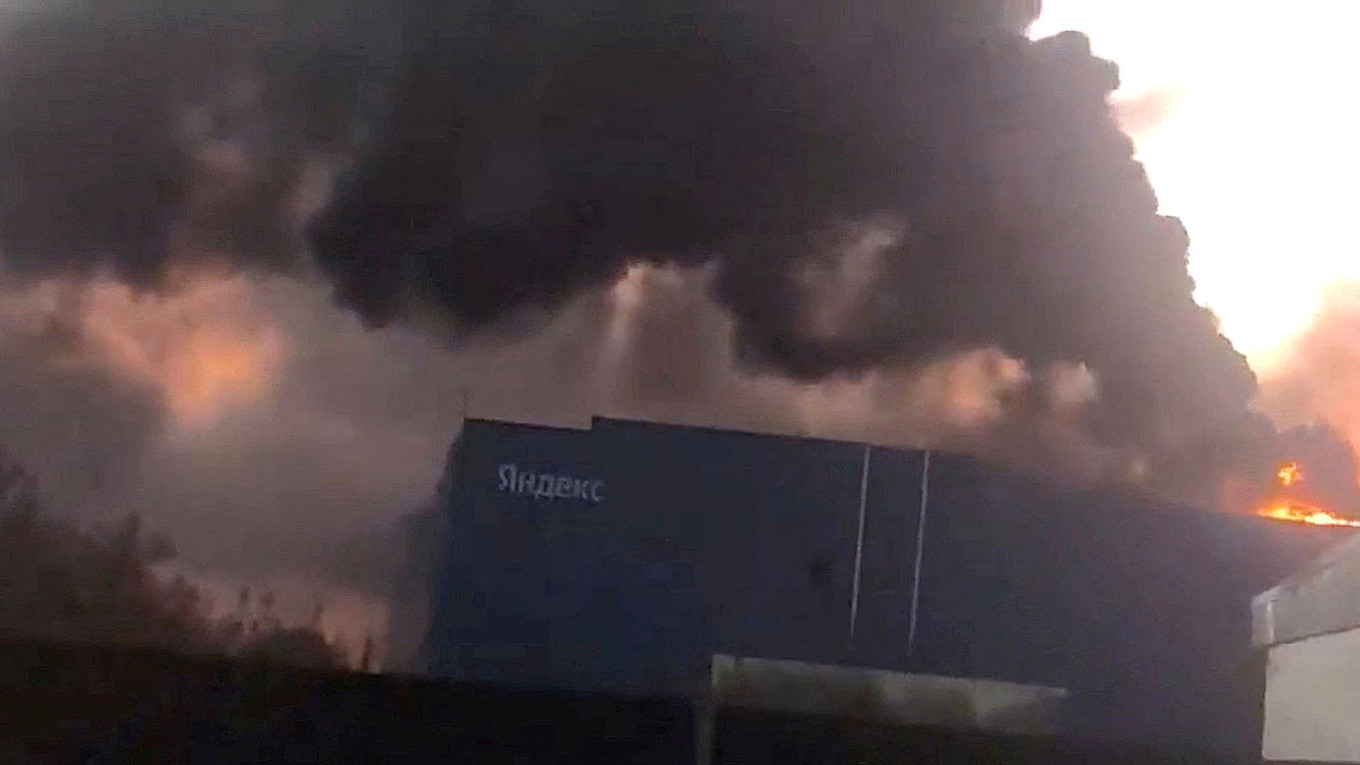
That the main events in Russia last week were once again shaped by Ukraine says a great deal about who is really setting the geopolitical agenda. Those events were United States President Donald Trump’s rather sudden announcement of an energy truce between Russia and Ukraine and Ukrainian drone strikes on Yandex’s most important data center.
Perhaps the Kremlin never agreed to the ceasefire in the first place because it has started to think that Ukrainian strikes on oil refineries are not the worst thing that could happen.
Of course, taking a hit to the wallet hurts and having ordinary people cursing Putin and his war while they queue for petrol isn’t ideal. But in recent days people have become far angrier after discovering that they cannot call a taxi, order a delivery or even access their own money.
When Ukraine struck a Yandex data center in the town of Sasovo in the Ryazan region on the night of October 7-8, it shut down two of the company’s three supercomputers, Chervonenkis and Lyapunov, which are used to train neural networks including YandexGPT and Alice AI. The company said it could not give a timeframe for when service would be restored.
A day later, a strike on Yandex’s largest data center, situated in the Kaluga region, disabled the company’s final, third supercomputer, Galushkin.
Then, a strike hit the data center in the Energetik district of the Vladimir region on October 10, taking the ru-central1-a availability zone offline. The Yandex Cloud platform was switched to emergency mode, while the remaining IT infrastructure was deemed “unstable.”
Alice smart speakers were not the only thing that went down. The ru-central1-b availability zone of the Yandex Cloud platform, which stores the data of numerous large firms, including Yandex itself, was taken offline.
Yandex Go taxi services stopped working not only in Russia but in neighbouring countries and even in some that do not border Russia at all. In Belgrade, for example, 32 of the city’s 33 taxi fleets operate through Yandex Go. Russian emigrants, accustomed to calling taxis through the app and pleased that they could even pay for the ride using a Russian bank card, discovered that the Serbs had not been so wrong after all to continue calling taxis by phone and paying in cash.
In Russia itself, almost every popular service began malfunctioning — from T-Bank to mobile operators, from Russian media websites to railway ticket-booking services. Never mind those services: Yandex Pay stopped working.
The problems are much more serious for those who stored their data in Yandex’s cloud. And many did. That included private users who feared losing access to Google Cloud and other foreign cloud-storage services, as well as almost the entire business sector, which the authorities had simply ordered to move all its data onto domestic servers.
Conveniently enough, the Russian authorities had forced Yandex to shut down its service center in “unfriendly” Finland. Now the company is frantically moving data onto third-party servers in Kazakhstan and Belarus. But Russian providers do not have much spare capacity to offer, while Kazakhstan is already concerned with moving its own services off Yandex servers and onto domestic ones. Everyone else will get whatever is left over.
Businesses do not currently even understand which of their databases have survived and can be restored from backups, which will be restored by Yandex and which have been lost forever. Accordingly, calculating the losses is also difficult, and it is unlikely to be done quickly.
The most pressing question, of course, is when everything will be fixed. Work to restore the services that had gone down began soon after the first attack and, as of Monday, some things had started working while others remained offline.
The main problems are with cloud services: Yandex Cloud Console and the API are available, Compute is partially available, IAM is available, while most other functions are restricted.
The company really is working around the clock to restore access. The state has promised assistance and perhaps the situation will get so dire that the ban on using foreign “unfriendly” facilities is lifted. It has reached the point of absurdity: Yandex support is operating through WhatsApp, while drivers are being advised to use Google Maps.
But as with the attacks on oil refineries, this is a developing situation. There were no attacks on the night from Sunday into Monday, but that does not mean they will not resume. Nor is there any guarantee that it will stop with Yandex’s data centres — of which it has two left. Rostelecom, for example, has 29 data centers. Because they are so sensitive, they may be better protected or out of the range of Ukrainian drones. But as the attacks on Yandex have shown, the way data centres are interconnected means that disruptions can affect the most unexpected areas.
Experts say that even this is not the main problem — the main problem is chips. The destroyed Yandex supercomputers used thousands of advanced Nvidia chips, which are under such strict export controls that it is nigh-on impossible to import them. Replenishing lost compute will take years. Without new chips, the company’s electronic brain will resemble that of an Alzheimer’s patient: it remembers this, forgets that, and everything else is jumbled up in its head. The Russian internet will be set back by at least 10-15 years, with all the consequences that would entail.
But I would point to an even more important issue. Many people were surprised by Ukraine’s choice of targets when they began smashing Wildberries warehouses. But after the attacks on Yandex’s data center, it became clear that Kyiv was striking at what it calculated to be the Achilles’ heel of the Russian economy.
Look at how Russia’s ecosystem of businesses is constructed. There is Wildberries — and several other, much smaller online marketplaces. For technology, there is Yandex — and several much smaller platforms. You can keep going: Aeroflot — and several smaller airlines; Sberbank — and several smaller banks.
Do you see the pattern? The Kremlin chooses an “anchor” representative for a given sector to which it gives maximum possible advantages, even arranging for state institutions to conduct most of their work through it. Several secondary players are allowed to exist to keep up some semblance of competition and to act as a reserve and to serve particular interests, both state and non-state.
This is not even a classic oligopoly. It is an exact replica of the hierarchical system of Putin’s rule, where nothing but a scorched field exists beyond the Kremlin’s inner circle. The system was assembled according to its creators’ own idea of how a properly organised state should work and what makes it easy to govern. It turns out that such a system is also an extremely convenient target if you want to disrupt the operation of entire sectors.
Perhaps that is precisely why, as of midday Monday, Russia had still not formulated a response to Trump’s energy truce. Both Kremlin spokesman Dmitry Peskov and Foreign Minister Sergei Lavrov came out with incoherent responses. Because it was stated quite clearly: the proposal concerns stopping strikes only on oil refineries. As for other targets in Russia, as Trump put it quite plainly: “do whatever you want.”
So perhaps right now they are sitting in the Kremlin trying to work out what will happen to the Russian internet if Ukraine continues striking data centers. Perhaps they have even got as far as wondering what will happen if they find a way to strike the banking system. Air travel? Any other sector organised according to this same hierarchical model?
Or perhaps they are not thinking about any of this at all yet. Perhaps they are too busy stamping on problems that keep springing up or trying to persuade Trump to give Russia something else useful.
Those problems, however, are not going anywhere because the main problem is the minds of those who govern Russia. Covering a building in protective netting won’t fix that. It isn’t a problem Trump can solve, either.
A Message from The Moscow Times:
Dear readers,
We are facing unprecedented challenges. Russia's Prosecutor General's Office has designated The Moscow Times as an "undesirable" organization, criminalizing our work and putting our staff at risk of prosecution. This follows our earlier unjust labeling as a "foreign agent."
These actions are direct attempts to silence independent journalism in Russia. The authorities claim our work "discredits the decisions of the Russian leadership." We see things differently: we strive to provide accurate, unbiased reporting on Russia.
We, the journalists of The Moscow Times, refuse to be silenced. But to continue our work, we need your help.
Your support, no matter how small, makes a world of difference. If you can, please support us monthly starting from just $2. It's quick to set up, and every contribution makes a significant impact.
By supporting The Moscow Times, you're defending open, independent journalism in the face of repression. Thank you for standing with us.

Remind me later.