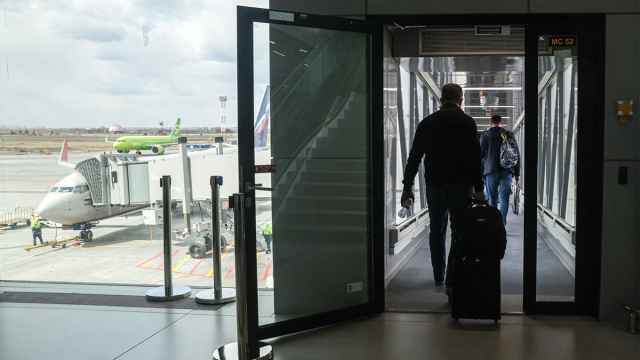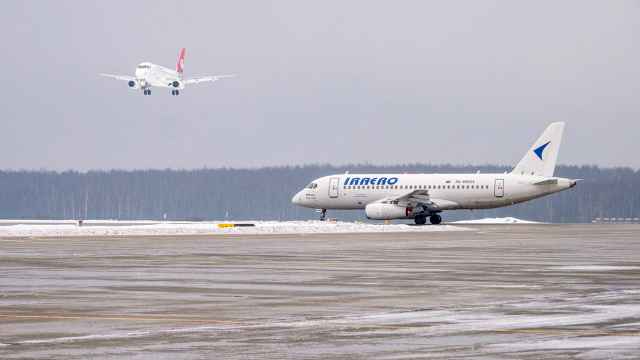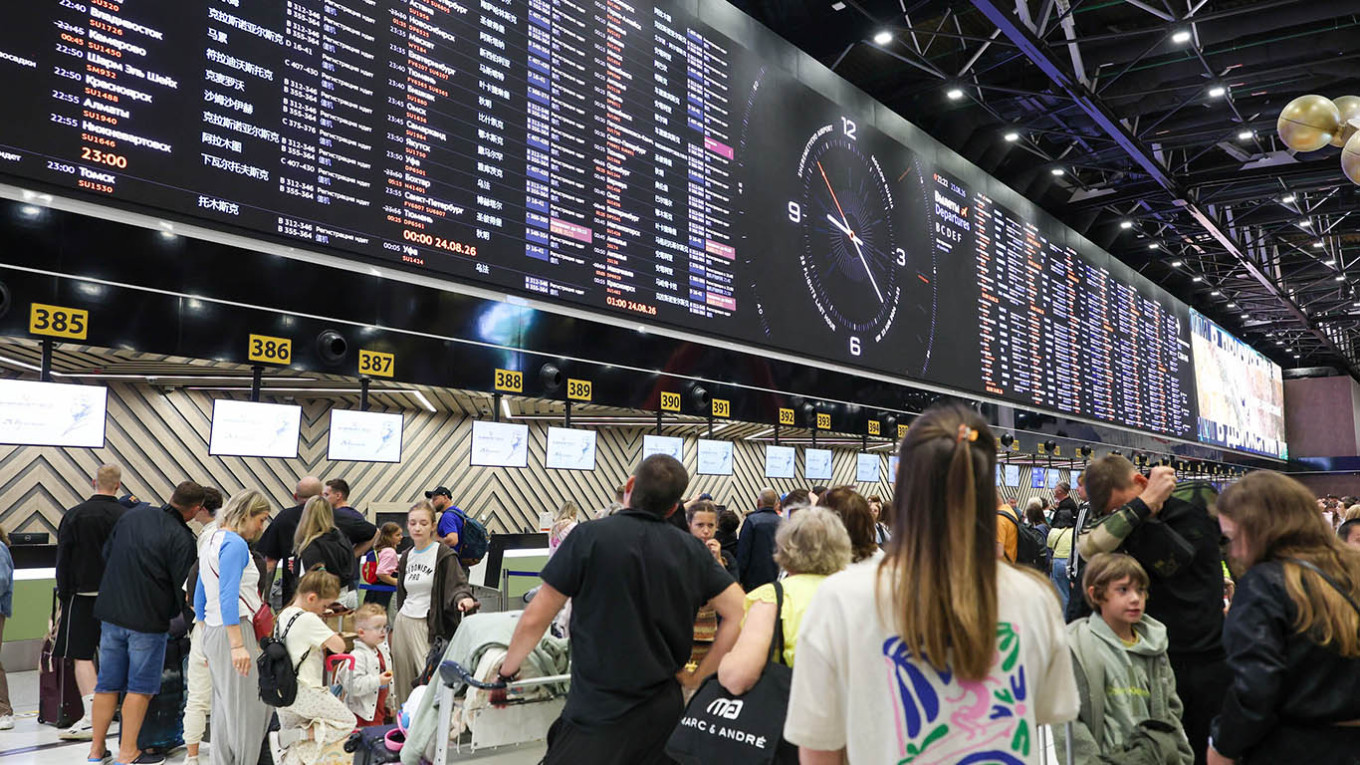
All four airports serving Moscow imposed temporary flight restrictions Friday afternoon amid a drone attack, Russia’s aviation regulator said, as new figures showed flight cancellations nationwide had doubled in the first nine months of 2026.
The restrictions at Vnukovo, Sheremetyevo, Domodedovo and Zhukovsky took effect at about 3:40 p.m. local time, Rosaviatsia said. Moscow Mayor Sergei Sobyanin said air defenses had destroyed 15 drones approaching the capital.
Residents in several southern Moscow districts reported explosions and air defense activity, the independent outlet Astra reported.
Vnukovo was the worst affected, according to flight-tracking service Flightradar24. More than 40% of its flights were delayed, with an average delay of 102 minutes, while another 10% were canceled.
Separately, authorities in the Yaroslavl region northeast of Moscow said small reconnaissance balloons launched from Ukraine had been shot down Friday. The regional security ministry said efforts to destroy the objects were continuing.
The afternoon restrictions followed overnight closures at Vnukovo, Domodedovo and Zhukovsky because of drone threats. Those restrictions were lifted by 7 a.m., though Zhukovsky subsequently suspended operations twice more.
More than 150 flights were delayed overnight.
The disruptions came as the Kommersant newspaper reported that flight cancellations in Russia doubled between January and September compared with the same period last year, citing insurer AlfaStrakhovanie.
The insurer linked the deterioration to airport restrictions imposed because of Ukrainian drone threats. Emergency flight restrictions have been imposed almost daily in southern and central Russia since late April, the newspaper said.
More than 7.6 million passengers waited over three hours to depart in the first nine months of 2026, 2.5 times the number a year earlier.
AlfaStrakhovanie tracks 30 major Russian airlines and about 60 foreign carriers accounting for roughly 97% of passenger traffic in Russia.
The number of flights delayed by more than an hour rose 70% to 128,000. Delays of at least two hours doubled to 77,000, while those lasting at least three hours rose 2.2-fold to 51,000.
Some 36,000 flights were delayed by four hours or more, 2.4 times the number a year earlier. The share departing within 15 minutes of their scheduled time fell from 57% to 52%.
Separate Transportation Ministry figures showed that 118,100 flights departed more than two hours late between January and August, up 20.3% year on year. Those figures cover a broader range of aviation, including small aircraft, cargo, charter and government flights.
Sources at four regional airports told Kommersant they wanted faster notification when emergency restrictions were lifted. Gelendzhik airport said timely Defense Ministry updates were particularly important for assisting passengers and clearing aircraft left on the apron during closures.
Rosaviatsia also cited weather and aircraft malfunctions as causes of delays and cancellations.
Industry sources have previously told Kommersant that frequent airport closures allow airlines to obscure problems with the condition of their fleets.
The Transportation Ministry said the share of delays attributed to technical problems fell from 12.7% to 10.1% year on year. Industry sources linked the decline to airlines operating fewer aircraft.
According to Kommersant, airlines had not brought 20% of their aircraft into service for the peak travel season. Among the top 10 carriers, excluding Aeroflot, roughly a third of their fleets were idle.
This article was translated with the help of artificial intelligence and was reviewed by a Moscow Times editor before publication. Learn more about our newsroom's AI policy here.
Read this article in Russian at The Moscow Times' Russian service.
A Message from The Moscow Times:
Dear readers,
We are facing unprecedented challenges. Russia's Prosecutor General's Office has designated The Moscow Times as an "undesirable" organization, criminalizing our work and putting our staff at risk of prosecution. This follows our earlier unjust labeling as a "foreign agent."
These actions are direct attempts to silence independent journalism in Russia. The authorities claim our work "discredits the decisions of the Russian leadership." We see things differently: we strive to provide accurate, unbiased reporting on Russia.
We, the journalists of The Moscow Times, refuse to be silenced. But to continue our work, we need your help.
Your support, no matter how small, makes a world of difference. If you can, please support us monthly starting from just $2. It's quick to set up, and every contribution makes a significant impact.
By supporting The Moscow Times, you're defending open, independent journalism in the face of repression. Thank you for standing with us.

Remind me later.