Russia’s labor shortage has become common knowledge. Even the Central Bank cites it when it explains why it cannot lower interest rates. Yet another group is growing increasingly vocal: people who have lost their jobs and cannot find new ones in their fields.
Many are experienced, highly qualified professionals from some of the most advanced sectors of the Russian economy. What is happening?
Russia’s official unemployment rate rose to 2.3% in September from 2.2%, according to the state statistics agency Rosstat. That remains well below the 3.5 to 4% generally considered a normal level and should indicate a severe shortage of workers.
But workers themselves say there are no jobs in their professions outside industries connected to the war or the state’s machinery of surveillance and control.
“I see people around me with more than 15 years of experience in their fields taking jobs in delivery services and warehouses, sorting and packing orders,” one woman wrote on a social network banned in Russia.
In August, the number of vacancies on Russia’s largest recruitment platform HeadHunter fell 13% from a year earlier, while the number of active résumés rose 25%. Competition among applicants reached its highest level in eight years.
Meanwhile, 93% of employers claim to face staff shortages, even as they reduce hiring. Companies say applicants lack the skills they need. That explanation becomes harder to accept when people with more than a decade of experience cannot secure an interview.
Experienced professionals are discovering that employers do not want them. In fact, employers increasingly seem reluctant to hire anyone. When they do seek workers, recruiters struggle to process the flood of applications.
“Are there any jobs left in Russia?” one senior software developer with more than 11 years of experience building complex projects and managing teams asked online. He had never had a problem finding work, he said, and so when his department was cut, he expected to find another position within two weeks. Three months later, he was still looking.
Social media is full of accounts like these. A marketing specialist described turning down offers in January, but by September, he was grateful merely to receive a reply from a recruiter. A public relations manager said she had sent thousands of applications and completed 12 interviews in two months without receiving any substantive feedback. She was considering retraining as an English teacher because, as she put it, she needed to eat.
What is most confusing to applicants is the utter lack of feedback. Many people have set up bots to apply for jobs as soon as they appear. Vacancies can attract so many responses that the listings disappear within half an hour. Applicants then receive an automatic rejection, sometimes almost immediately, or don’t hear back at all.
One recruiter offered an explanation. For a senior developer position, she wrote, eight of the first 15 applicants matched 95 to 100% of the requirements. The others matched between 85 and 90%. A manager would interview only three to five people, so the recruiter paused several vacancies because the volume of qualified applicants had become unmanageable.
Russia’s labor market reflects a global trend compounded by distinctly Russian hiring practices.
Firstly, the horror stories that artificial intelligence would take people’s jobs have become reality. Almost every post I reviewed notes that employers increasingly believe that one employee armed with AI can replace an entire department:
“Suppose a company needs a social media manager. Now that person is also expected to write copy, shoot and edit videos, create designs, launch advertising campaigns, work with influencers, develop strategy, analyze data, produce newsletters and, of course, use AI to churn out mountains of content in five minutes. The salary has stayed the same.”
“That’s exactly right. Employers don’t need experienced, skilled professionals because they won’t accept a mid-level salary, much less a junior one. Often, such a specialist is simply more experienced than their prospective manager and has opinions of their own. The more qualified you are, the narrower the range of suitable vacancies becomes.”
“The vacancies are almost all fake. However much the platforms try to remove them, most are simply there to monitor the market. Orders are declining, business owners are reluctant to invest and managers are clinging to their positions and fear competition. This is the result.”
These posts highlight the core problems of the Russian labor market. While businesses remain fascinated by the potential of AI, many have concluded that each department needs one relatively low-paid employee to enter prompts. They have yet to recognize that using AI effectively requires expertise, precise instructions and careful oversight. The work gets done, or appears to get done, and managers often lack the knowledge needed to assess its quality.
This enthusiasm has collided with a longstanding weakness of Russian corporate culture in which managers who face little accountability for quality tend to prioritize the appearance of success. They fear displacement by talented subordinates more than the loss of competitive advantage or profits.
Business owners also have fewer incentives to invest in quality. Competition increasingly takes place in government corridors instead of the marketplace. The state and state-connected companies have become the main clients, and political access matters more than innovation.
For everyone else, expansion carries serious risks. A company that becomes too successful may face nationalization on almost any pretext. One businessman explained why he had rejected a profitable project by invoking a Russian proverb: The quieter you go, the farther you will get.
“Nowadays, the ones who keep a low profile are the ones who win,” he told me.
And when you're keeping a low profile, you have no need for bright, talented employees.
The collapse is especially visible in technology. In 2023, after many IT companies and specialists left Russia, software developers were in extraordinary demand and received astonishing salary offers. Today, many of the projects launched during that period are barely surviving or have closed.
In a declining economy like Russia’s, the AI sector is becoming more simplistic because the system has little demand for sophisticated solutions. Consider Max, the state-backed messaging service. It may be clumsy and intrusive, yet officials are forcibly imposing it on institutions across the country. Its owners don’t care about building a profitable or appealing product. Their success depends on Kremlin support.
Administrative protection removes the incentive to hire people capable of producing something better.
Advertising, public relations and marketing face a similar decline. Russia is moving toward an economy of scarcity. Store shelves can remain full while prices place goods beyond the reach of many consumers. Producers operating in protected markets have little reason to promote or improve their goods.
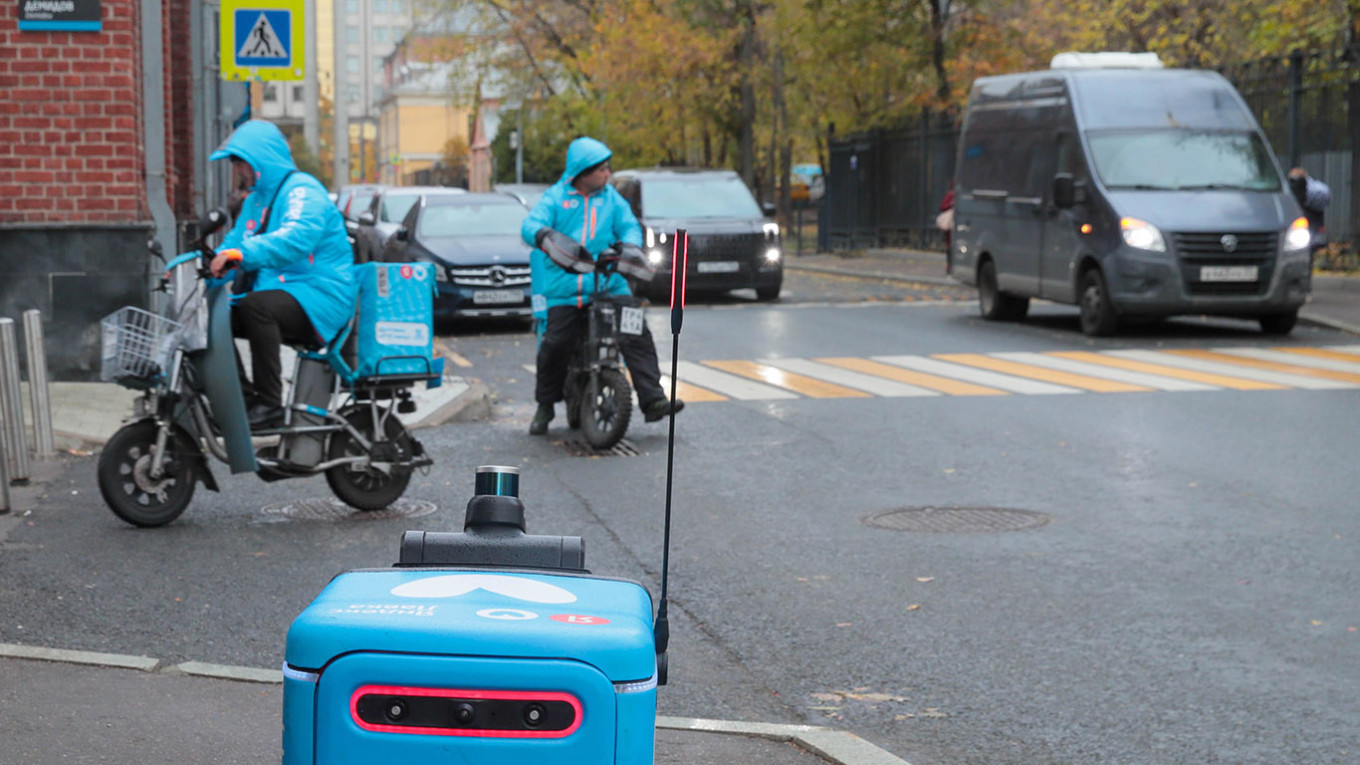
After three, six or 12 months without work, people exhaust their savings and turn to jobs that require little formal training. They deliver food, drive taxis or pack warehouse orders. Most work as self-employed contractors, sacrificing job protections and future pension benefits. Mortgages still have to be paid; children still need to eat.
Official statistics classify these people as employed. Russia’s economy is wasting their knowledge.
The consequences will outlast the current downturn. Skills deteriorate quickly when people cannot use them, particularly in technology. A country that loses momentum in this field may never catch up.
In the early 1990s, Russian engineers who had built rockets and satellites left their professions to sell goods in open-air markets or bring merchandise back from Turkey. Many earned more money than they had as engineers. Russia lost individual workers along with an engineering tradition that could not simply be recreated years later, the results of which we are still seeing today.
The same process is now unfolding in IT and other fields in which Russia once held a respectable position.
So where is the labor shortage?
HeadHunter’s data says that the greatest shortages are in retail. Employers need cashiers, warehouse workers, sales clerks, loaders and administrators. Doctors are also in short supply. The vacancies are concentrated among overworked physicians in ordinary hospitals and regional clinics, sometimes with base salaries of just 18,000 rubles ($213) a month. Employers also need cooks, bakers, mechanics, machine operators and electricians, often for wages that fail to reflect the difficulty of the work.
Russia has too few people willing to perform exhausting, poorly paid labor. It also has too few jobs that make meaningful use of its most qualified citizens.
A former marketer or programmer can retrain as a welder, just as a Soviet engineer could become a trader. The individual may even earn more. The country loses something much harder to replace.
That loss is occurring almost invisibly. A programmer who becomes a courier does not appear in unemployment statistics. Everyone is working. Many have even avoided a dramatic loss of income.
Their skills are disappearing. Those who have remained in Russia are being professionally erased.
A popular Soviet song once boasted, “But at least we make rockets.” Today, Russia struggles to make those well, too.
What will it no longer know how to make tomorrow?
This article was translated with the help of artificial intelligence and was reviewed by a Moscow Times editor before publication. Learn more about our newsroom's AI policy here.
Read this article in Russian at The Moscow Times' Russian service.
A Message from The Moscow Times:
Dear readers,
We are facing unprecedented challenges. Russia's Prosecutor General's Office has designated The Moscow Times as an "undesirable" organization, criminalizing our work and putting our staff at risk of prosecution. This follows our earlier unjust labeling as a "foreign agent."
These actions are direct attempts to silence independent journalism in Russia. The authorities claim our work "discredits the decisions of the Russian leadership." We see things differently: we strive to provide accurate, unbiased reporting on Russia.
We, the journalists of The Moscow Times, refuse to be silenced. But to continue our work, we need your help.
Your support, no matter how small, makes a world of difference. If you can, please support us monthly starting from just $2. It's quick to set up, and every contribution makes a significant impact.
By supporting The Moscow Times, you're defending open, independent journalism in the face of repression. Thank you for standing with us.

Remind me later.