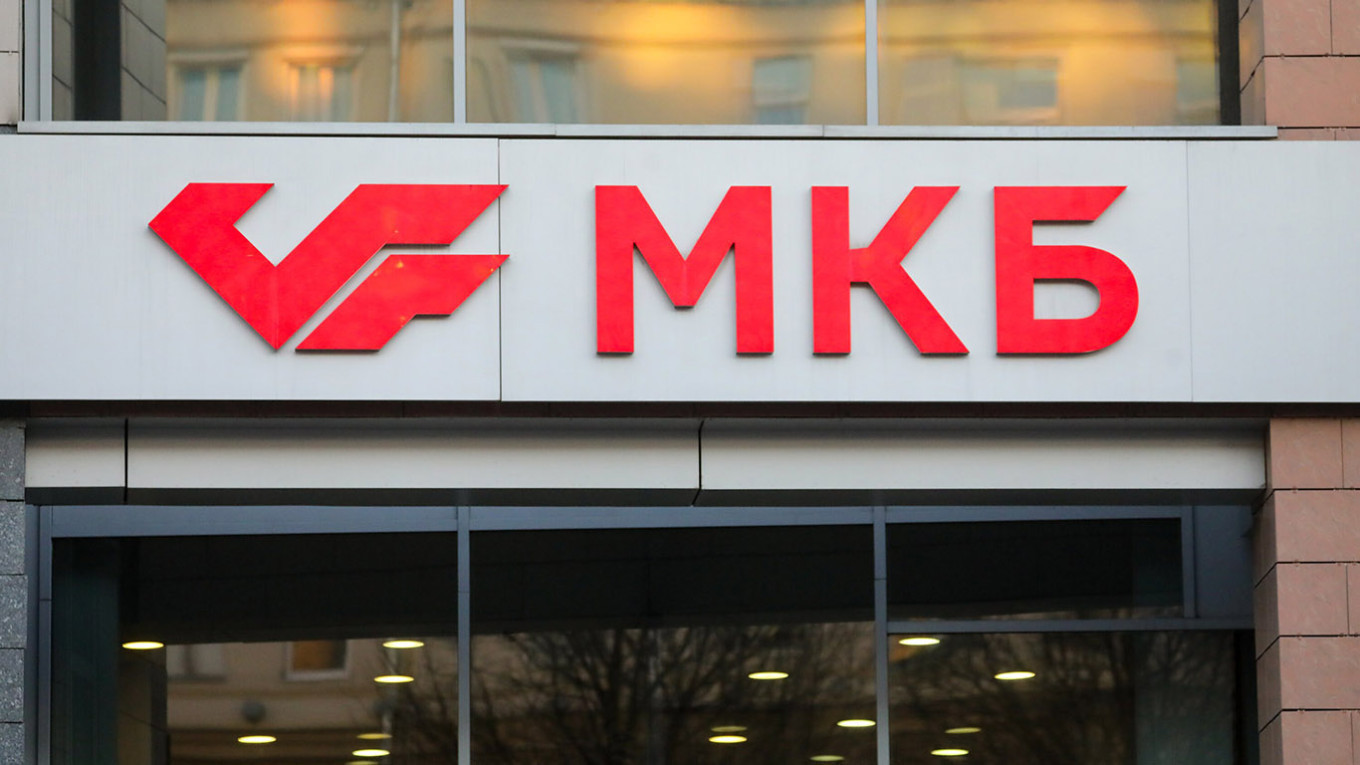
Moscow Credit Bank, one of Russia’s largest lenders, has seen a sharp rise in overdue loans, with borrowers missing payments on 277 billion rubles ($3.27 billion) as of July, according to financial statements published by Banki.ru.
Overdue loans accounted for 14.8% of the bank’s total loan portfolio, five times the Russian banking sector average. Moscow Credit Bank, or MKB, ranks among the country’s 10 largest banks by assets and is designated as systemically important by the Central Bank.
The figures point to mounting strains in Russia’s banking system as high interest rates and a slowing economy make it harder for companies to service their debts. Metals, coal, construction and real estate companies have been among those seeking to renegotiate loan terms in recent months, according to the Central Bank.
“MKB has a hole in its balance sheet,” analysts at InvestFuture wrote.
The value of MKB’s overdue loans has risen by 1,716% over the past year, according to the bank’s financial statements. The deterioration began last summer, with overdue debt jumping more than tenfold between August and December, from 15 billion rubles ($177 million) to 160 billion rubles ($1.89 billion).
It increased by another 117 billion rubles ($1.38 billion), or about 70%, between January and July this year.
It was not clear which borrowers were responsible for the missed payments. The Central Bank said metals, coal, construction and real estate companies had recently sought loan restructurings after struggling to meet their obligations.
MKB was founded by billionaire Roman Avdeev and came under Rosneft’s influence in 2017, when it faced financial difficulties alongside several other major privately owned lenders, including Otkritie, B&N Bank and Promsvyazbank.
Rosneft effectively rescued MKB by injecting capital and placing long-term deposits with maturities extending to 2066, Bloomberg reported in 2018. The state oil company also transferred hundreds of billions of rubles in reverse-repurchase transactions to the bank to help finance its operations.
A Central Bank inspection uncovered problems at MKB last year and was followed by changes in its management, the Kommersant newspaper reported, citing an unidentified source.
The bank’s controlling shareholder also changed in the summer of 2026, though the identity of its new owner has not been disclosed. Russian banks are currently permitted to withhold information about their controlling beneficiaries.
Across the Russian banking system, loans classified as bad accounted for 3.9% of total lending as of April 1, or about 3.5 trillion rubles ($41.3 billion), according to the Central Bank.
The broader share of problem loans was three times higher, at 11.6%, equivalent to 11.2 trillion rubles ($132.16 billion). That category includes loans whose terms banks were forced to ease because borrowers could no longer keep up with payments.
The Central Bank has estimated that 36 trillion rubles ($424.8 billion) in loans may be at risk of debt-servicing difficulties. The figure represents three-quarters of the total debt held by Russia’s largest companies.
Some major companies in the coal, construction, retail and engineering sectors are already in critical financial condition, the Central Bank has said.
This article was translated with the help of artificial intelligence and was reviewed by a Moscow Times editor before publication. Learn more about our newsroom's AI policy here.
Read this article in Russian at The Moscow Times' Russian service.
A Message from The Moscow Times:
Dear readers,
We are facing unprecedented challenges. Russia's Prosecutor General's Office has designated The Moscow Times as an "undesirable" organization, criminalizing our work and putting our staff at risk of prosecution. This follows our earlier unjust labeling as a "foreign agent."
These actions are direct attempts to silence independent journalism in Russia. The authorities claim our work "discredits the decisions of the Russian leadership." We see things differently: we strive to provide accurate, unbiased reporting on Russia.
We, the journalists of The Moscow Times, refuse to be silenced. But to continue our work, we need your help.
Your support, no matter how small, makes a world of difference. If you can, please support us monthly starting from just $2. It's quick to set up, and every contribution makes a significant impact.
By supporting The Moscow Times, you're defending open, independent journalism in the face of repression. Thank you for standing with us.

Remind me later.