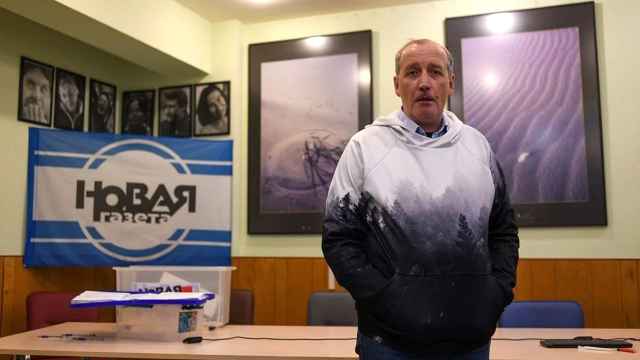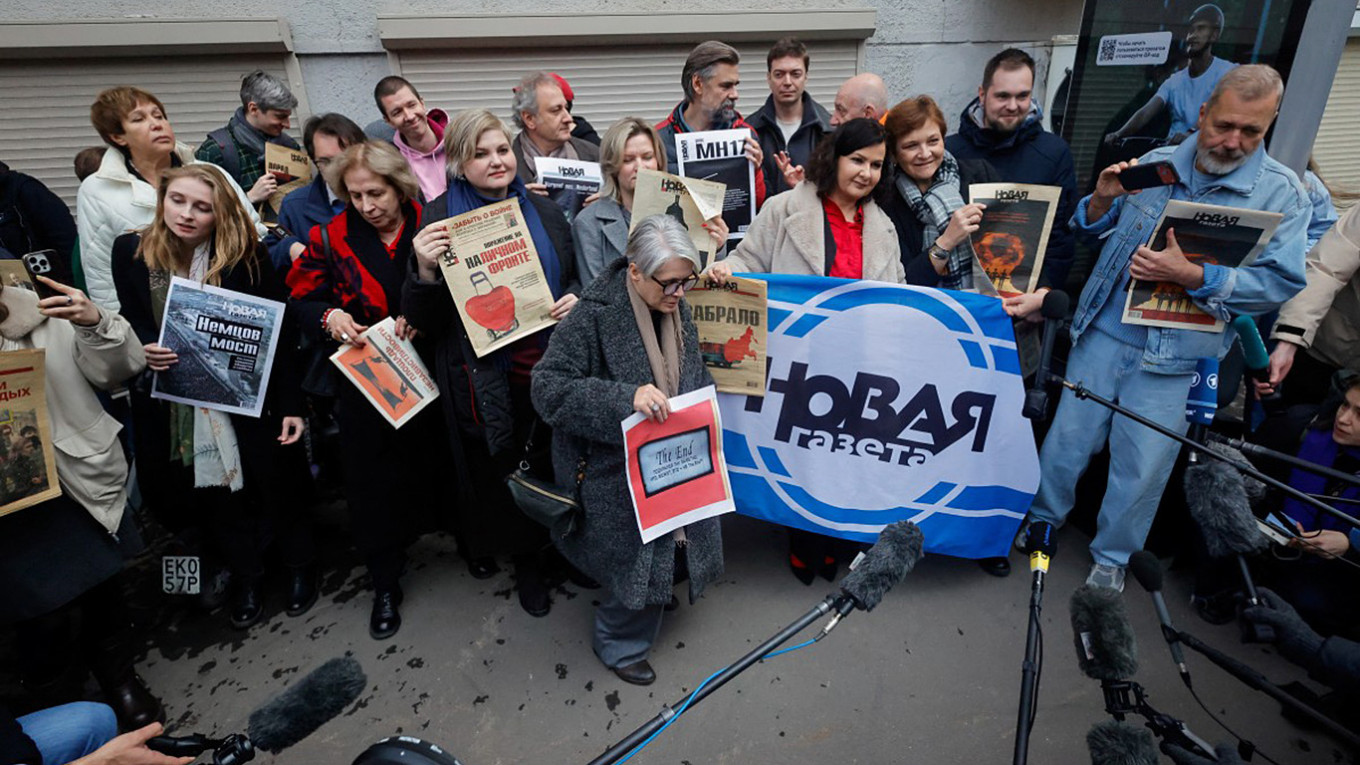
Today, Nov. 9, Novaya Gazeta — one of Russia’s most celebrated independent newspapers — will switch off the lights in its newsroom for the final time. For more than 30 years, its extraordinary courage has been an inspiration to journalists around the world.
That it withstood the pressure for so long is remarkable; that it has now been forced to close, following a relentless and ultimately insurmountable campaign to obstruct it, shows just how ruthlessly determined President Vladimir Putin is to cut off Russian citizens from all but Kremlin propaganda.
Famed for its hard-hitting investigations and its refusal to be cowed, even as six of its staff were killed, Novaya Gazeta has often been seen as a symbol of journalism’s power for good, as an exposer of wrongdoing and a cornerstone of a free society. When the paper’s then-editor Dmitry Muratov won the Nobel Peace Prize in 2021 for “efforts to safeguard freedom of expression,” he titled his Nobel lecture “Antidote Against Tyranny” and framed journalism in part as a quest for progress.
“‘Are you not afraid?’ is the most common question my colleagues get,” Muratov told the audience in Oslo. “But this is their mission. As governments continually improve the past, journalists try to improve the future.”
By then, Novaya Gazeta — set up in 1993 with the help of former Soviet leader Mikhail Gorbachev, who used part of his own Nobel Peace Prize to pay for salaries and computers — had already paid a very high price for pursuing that mission. Between 2000 and 2009, six colleagues were killed after working on sensitive topics, including high-level corruption and human rights abuses in the war in Chechnya: Igor Domnikov, beaten with a heavy object in 2000; Yuri Shchekochikhin, believed to have been poisoned in 2003; Anna Politkovskaya, shot in the elevator of her apartment building in 2006; Anastasiya Baburova and Stanislav Markelov, shot in downtown Moscow in 2009; and Natalia Estemirova, kidnapped and shot the same year. Other staff received death threats and there were wider intimidation attempts, such as a funeral wreath and a severed ram’s head, delivered to the office.
Journalism in Russia has a dark history. Our data at the Committee to Protect Journalists (CPJ) shows that at least 60 journalists have been killed in Russia because of their work since we began keeping records in 1992, with another 24 killings suspected to have been work-related. Some deaths occurred during dangerous assignments, most notably the war in Chechnya. But we have also documented at least 40 targeted murders. In the vast majority of those cases, no one has been held accountable to date.
Murdering journalists is the crudest way to silence them, and impunity increases the risk of further killings. But ultimately, it was not the loss of colleagues that finished Novaya Gazeta off. It nearly did: Muratov, when awarded CPJ’s International Press Freedom Award in 2007, described how hard it had been to continue. “Frankly speaking,” he said, “I wanted to shut down the newspaper … I wanted to say: ‘To hell with all of this!’” But understanding the importance of what they did, the staff convinced him to double down, and for almost two decades more that’s exactly what the newspaper did.
Ultimately, it was a web of legal and bureaucratic attacks that spelled Novaya Gazeta’s end, part of an arsenal of tools that the Kremlin has energetically deployed since the war in Ukraine heightened its need to shut critics down. Since 2022, Novaya Gazeta has been stripped of its license, had its website blocked and its printing press seized. It was designated a “foreign agent.” Its offices were raided. Columnist Oleg Roldugin was placed under house arrest and faces up to six years in jail.
Against all the odds, the newspaper kept trying. When it could no longer print, it persisted online; when it faced draconian censorship, it refused propaganda and published white spaces instead of euphemisms. But when it recently learned it would be evicted and cut off from online donations, it finally ran out of road and was finally “killed.” Their story, the journalists said, is the story of the systematic crushing of Russia and its society.
It is also a story of how the Kremlin’s tactics have evolved, particularly since the full-scale invasion of Ukraine. Today’s hybrid repression is both online and offline, physical and mental; it masquerades as justice and relentlessly invents new and asphyxiating forms of regulation and control. It blocks access to webpages as well as throttling the source and sets aside 30 million euros weekly for state propaganda. It has forced dozens of outlets into exile, a flow that began a decade ago but has also accelerated over the past five years.
As in other undemocratic states, new and adapted laws are being strategically used to weaken or destroy perceived opponents: a tactic known as “lawfare.” A foreign agent law, introduced in 2012 and expanded since, has seen hundreds of journalists and media outlets labeled “foreign agents,” a term which implies they are traitors, excludes them from aspects of public life and forces them to comply with a range of prohibitive reporting requirements or risk fines or jail.
Other changes to laws and regulations since 2022 mean outlets can be fined, jailed or have their licence withdrawn for spreading “false” information, while the labeling of organizations — including CPJ — as “undesirable” puts anyone who interacts with them at risk of prosecution.
While the number of killings in Russia has, thankfully, fallen to three work-related deaths confirmed in the past 12 years, the number of journalists in jail has hit a new high. As of today, at least 31 journalists are imprisoned in Russia and Russian-occupied territories, more than at any time since CPJ started tracking data. The charges against them are deliberately broad, and include sharing fake information, cooperation with a foreign organization, terrorism and espionage. Eleven have sentences of over 10 years. One, Ivan Safronov, was sentenced to 22 years for treason, in a trial held in secret. Such is the opacity of the judicial process that some have yet to face charges at all.
Nor does repression stop at international borders. Russia is a well-known perpetrator of transnational repression. At CPJ we have heard from exiled Russian journalists who have been sentenced in absentia, designated “foreign agents,” targeted by surveillance, harassment, vandalism, digital attacks and more. Their families in Russia have been intimidated and pursued.
Such multi-pronged campaigns can, over time, be chillingly effective, as the fate of Novaya Gazeta shows. But the strong community of exiled journalists also offers hope. They represent the best chance of holding the line and ensuring that Russia — whatever Putin’s designs — does not become an information black hole. They have the best knowledge, networks and expertise to report for audiences in Russia who are still able to seek out objective facts for the large community of Russians abroad and for a global audience.
But to keep holding the line, they urgently need support. As governments everywhere wake up to the growing threat of disinformation, they must also realize that a free, empowered media is a critical defense. Trusted, independent journalism is — just as Muratov said — a powerful antidote to tyranny. Why else would Putin have gone after Novaya Gazeta? The newspaper’s Moscow days may have come to an end, but its spirit lives on wherever journalists scrutinize power. We must do all we can to nurture and protect it. Because we cannot let Putin’s version of history prevail.
A Message from The Moscow Times:
Dear readers,
We are facing unprecedented challenges. Russia's Prosecutor General's Office has designated The Moscow Times as an "undesirable" organization, criminalizing our work and putting our staff at risk of prosecution. This follows our earlier unjust labeling as a "foreign agent."
These actions are direct attempts to silence independent journalism in Russia. The authorities claim our work "discredits the decisions of the Russian leadership." We see things differently: we strive to provide accurate, unbiased reporting on Russia.
We, the journalists of The Moscow Times, refuse to be silenced. But to continue our work, we need your help.
Your support, no matter how small, makes a world of difference. If you can, please support us monthly starting from just $2. It's quick to set up, and every contribution makes a significant impact.
By supporting The Moscow Times, you're defending open, independent journalism in the face of repression. Thank you for standing with us.

Remind me later.