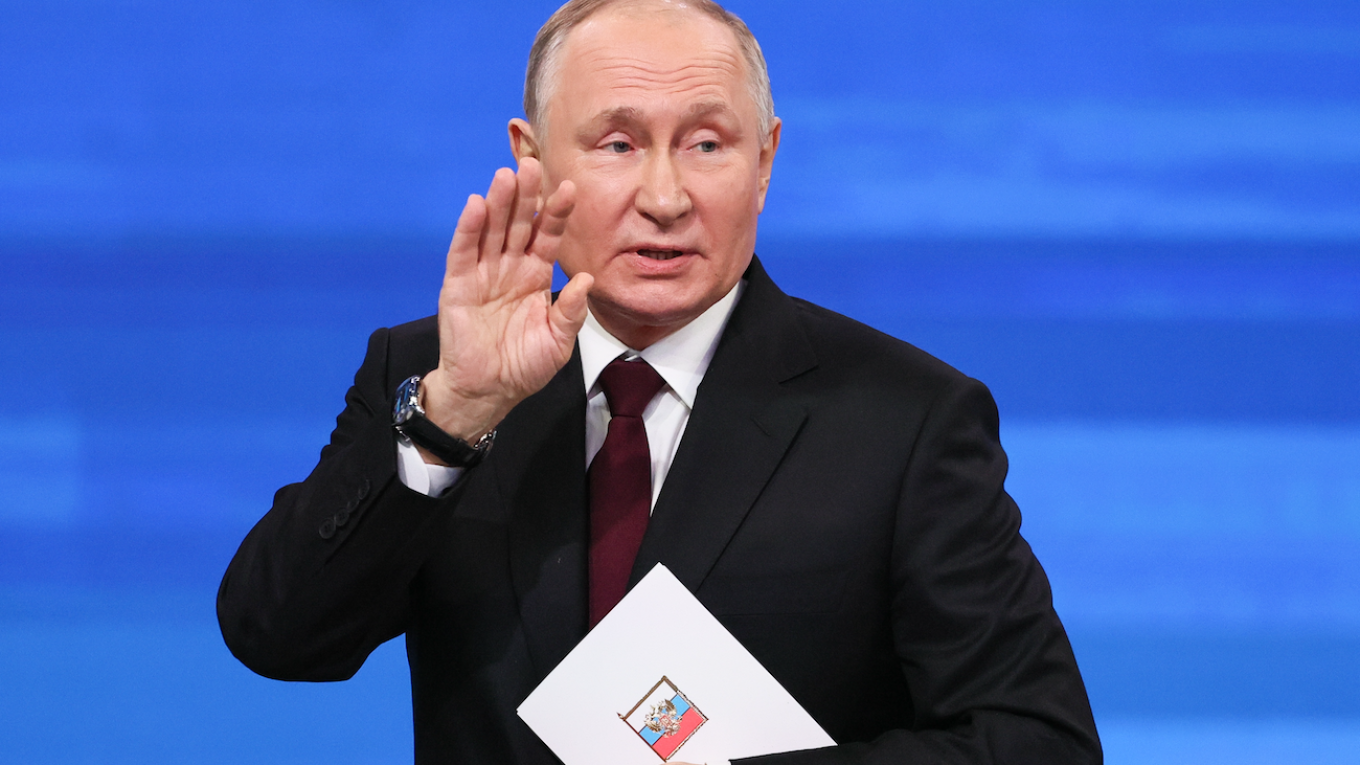
President Vladimir Putin called on Russian companies to help accelerate the development of advanced technologies as declining state funding and falling patent applications hamper the Kremlin’s push for technological self-sufficiency.
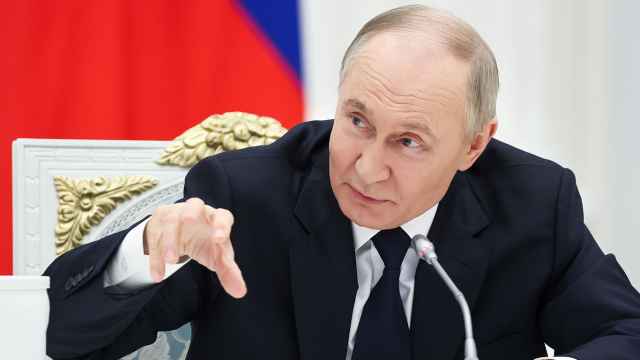
Speaking at a meeting of the Council for Science and Education in the Siberian city of Novosibirsk, Putin said Russia must “significantly accelerate” the development of “technologies of the future” to safeguard its sovereignty, economy and defense capabilities.
“Without any exaggeration, literally everything in the modern world depends on the speed at which innovations are created and, of course, introduced: our sovereignty, economic development and the fulfillment of both civilian and critical defense tasks, which today are closely intertwined technologically,” Putin said.
He said Russia should focus its “strategic scientific assets” on the effort and called for the “maximum concentration of efforts” by everyone involved in the country’s scientific and technological development.
Putin’s appeal comes as Russia seeks to reduce its dependence on foreign technology amid Western sanctions imposed over the war in Ukraine. But federal funding for civilian research has declined in real terms, while patent applications remain well below prewar levels and the inflow of foreign technology has fallen sharply.
Putin said Russian businesses should become direct customers for breakthrough research and commit to turning new technologies into commercially successful products.
“We need to organize our work so that Russian businesses and enterprises become direct customers for breakthrough scientific solutions and technologies,” Putin was quoted as saying by state news agencies RIA Novosti and TASS. “They should make clear commitments to use them to create successful, competitive products.”
Russia’s federal budget allocated 792.1 billion rubles ($9.6 billion) to civilian science last year, according to calculations by the Higher School of Economics’ (HSE) Institute for Statistical Studies and Economics of Knowledge.
That amounted to just 2.5% of total federal spending and was 22 times less than the 17.8 trillion rubles ($215.4 billion) spent on the military and security agencies combined.
Although nominal spending on civilian science rose by 11% year on year, it remained 14% below prewar levels when adjusted for inflation. Compared with 2013, real spending on science has fallen by one-quarter.
Science funding stood at 0.35% of gross domestic product in 2024 and 0.37% in 2025, among the lowest levels recorded in at least 15 years.
Projects announced by Putin as part of Russia’s drive for “technological leadership” were also left underfunded last year after the federal budget deficit widened to 5.6 trillion rubles ($67.8 billion).
The Space Activities project received none of the 10 billion rubles ($121 million) initially earmarked for it. Funding for the Means of Production and Automation robotics initiative was cut fourfold, while allocations for the New Materials and Chemistry and Industrial and Transport Mobility projects were reduced by 40%.
Russia’s Federal Intellectual Property Service, or Rospatent, received 26,400 patent applications last year, nearly one-quarter fewer than the 34,900 submitted in 2020, according to the Higher School of Economics.
The number of applications filed by foreign companies has fallen to its lowest level since at least the 1990s. Foreign applicants registered 4,700 inventions in Russia last year, down from 11,400 in 2021.
Applications from Russian researchers rose by just 1.4% last year to 21,700. That was 9% below the 2020 level and one-quarter lower than in 2010.
Russia now accounts for 0.8% of global patent applications, according to HSE calculations. That compares with 4.5% for Germany, 11.8% for Japan, 14.8% for the United States and 46.5% for China.
This article was translated with the help of artificial intelligence and was reviewed by a Moscow Times editor before publication. Learn more about our newsroom's AI policy here.
Read this article in Russian at The Moscow Times' Russian service.
A Message from The Moscow Times:
Dear readers,
We are facing unprecedented challenges. Russia's Prosecutor General's Office has designated The Moscow Times as an "undesirable" organization, criminalizing our work and putting our staff at risk of prosecution. This follows our earlier unjust labeling as a "foreign agent."
These actions are direct attempts to silence independent journalism in Russia. The authorities claim our work "discredits the decisions of the Russian leadership." We see things differently: we strive to provide accurate, unbiased reporting on Russia.
We, the journalists of The Moscow Times, refuse to be silenced. But to continue our work, we need your help.
Your support, no matter how small, makes a world of difference. If you can, please support us monthly starting from just $2. It's quick to set up, and every contribution makes a significant impact.
By supporting The Moscow Times, you're defending open, independent journalism in the face of repression. Thank you for standing with us.

Remind me later.