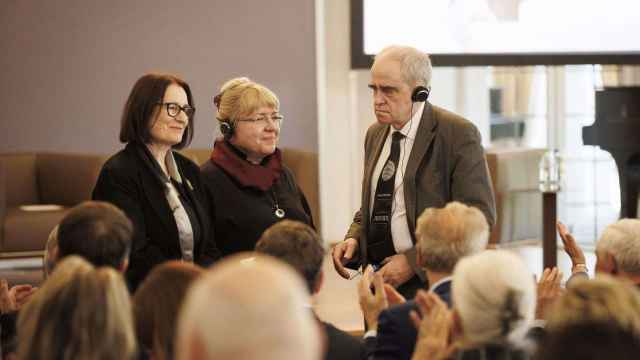

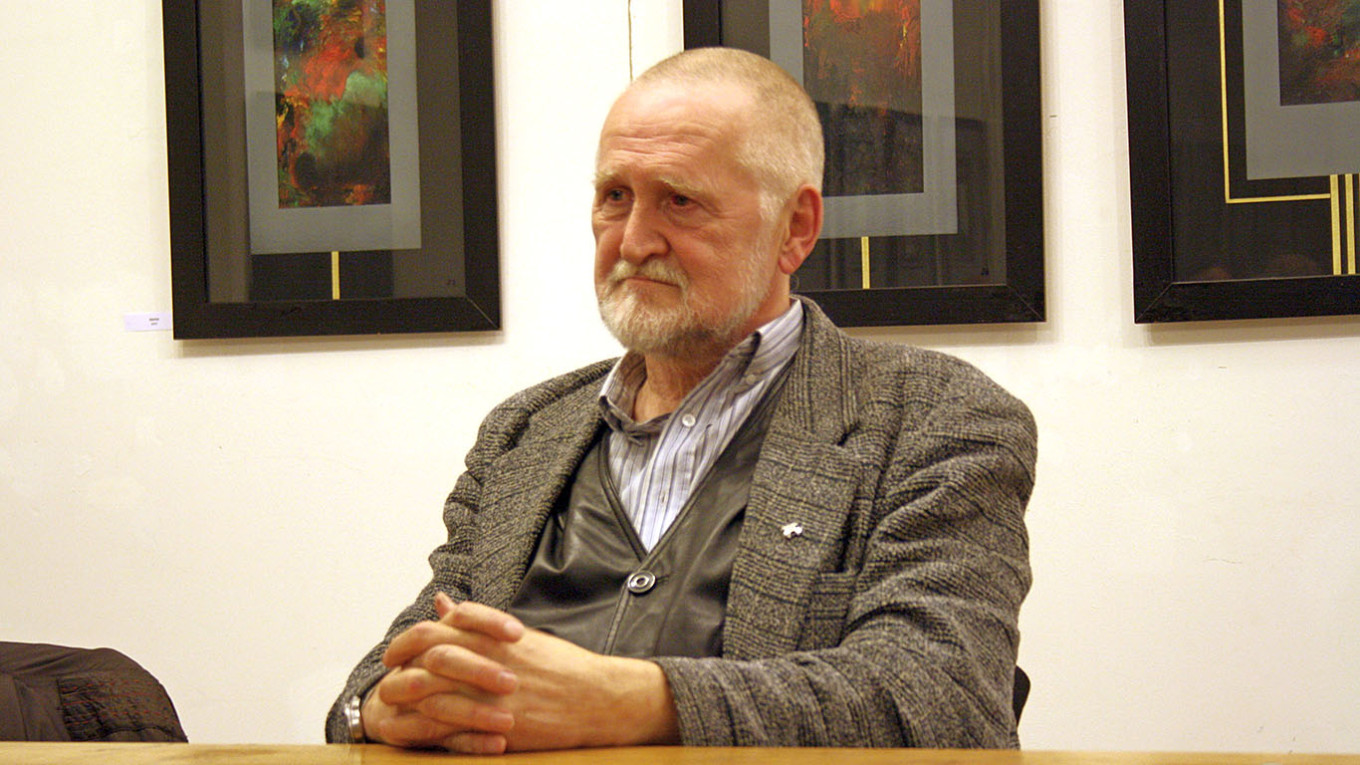
Yuly Rybakov is a Soviet-era dissident artist, human rights activist and former Russian lawmaker whose life has been shaped by his country’s history.
Born in 1946 in a labor camp settlement, Rybakov, 80, came from a family of St. Petersburg naval officers persecuted by the Soviet authorities. He studied art and became part of the nonconformist art movement, a community of artists who rejected official state-approved aesthetics.
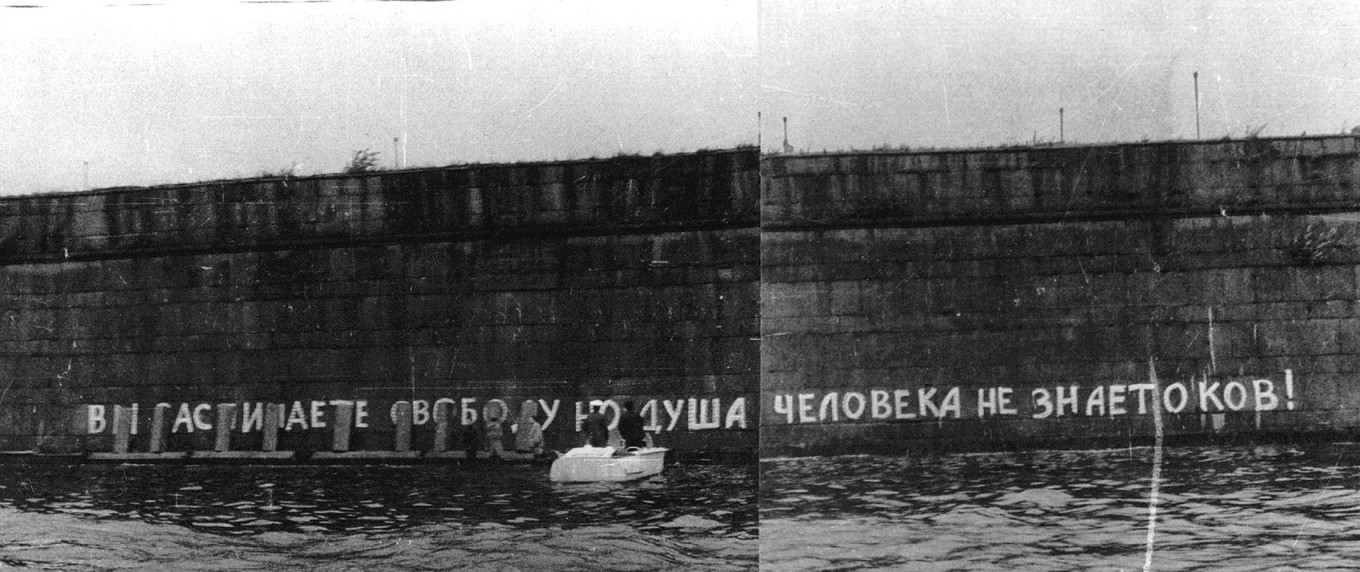
Fifty years ago, Rybakov and his fellow dissident artist Oleg Volkov painted an inscription on the wall of the Peter and Paul Fortress that would become one of the most powerful symbols of resistance to Soviet rule: “You may crucify freedom, but the human soul knows no shackles.”
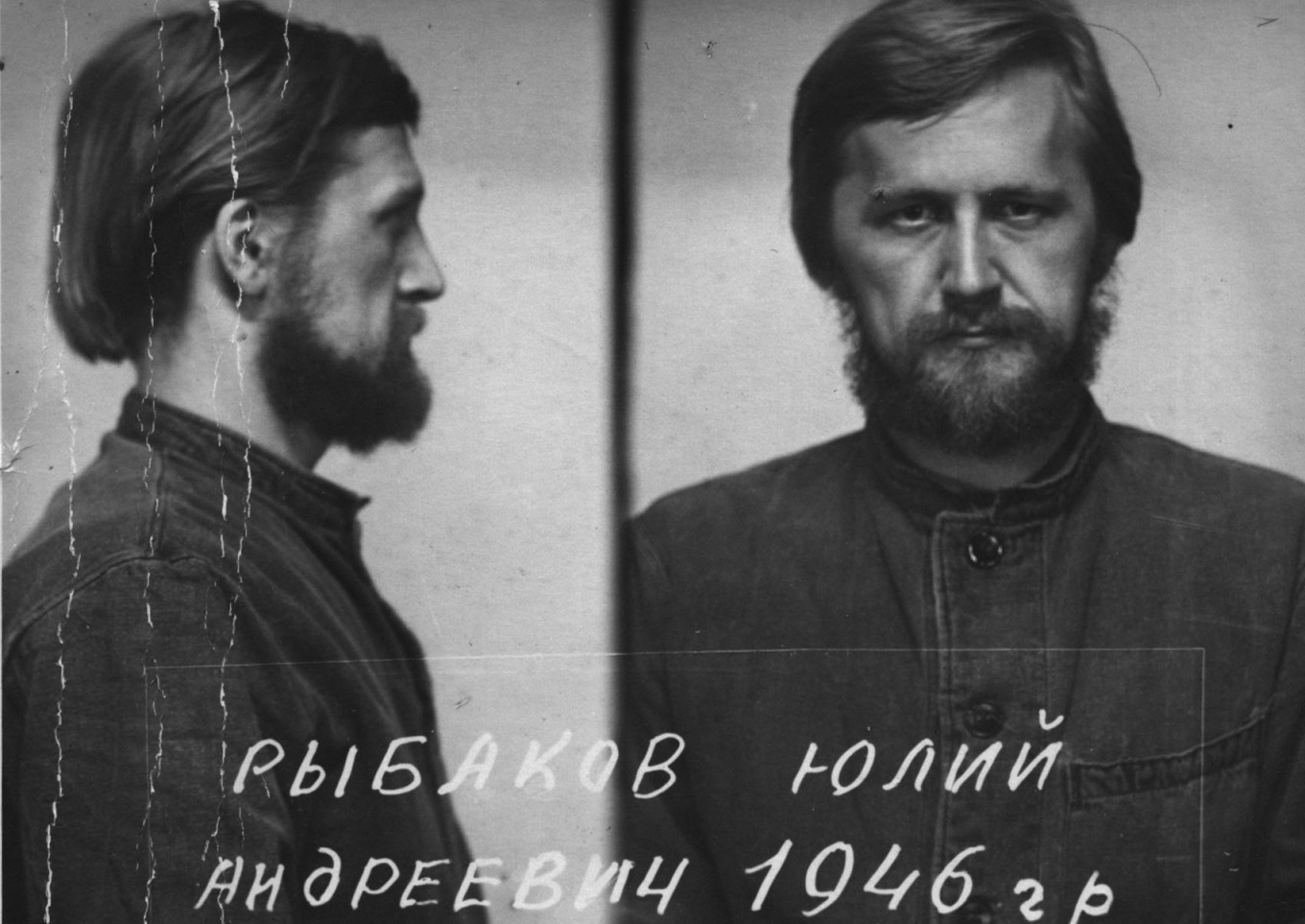
This artistic protest and their distribution of Soviet dissident Alexander Solzhenitsyn's books would see Rybakov and Volkov arrested and sentenced to six and seven years, respectively, in gulag labor camps. One of the KGB officers who carried out the search as part of the case was then-lieutenant Vladimir Putin.
Less than a decade after his release, Rybakov was elected to the Leningrad City Council in 1990 and established Russia’s first state human rights commission. He later served as a State Duma lawmaker for 10 years.
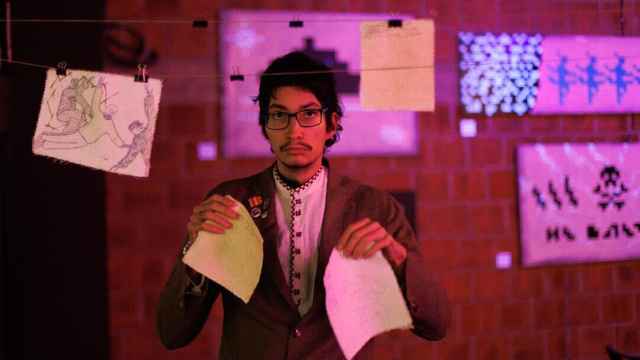
Rybakov’s art will be displayed at “Memory Remains,” the third and final edition of Artists Against the Kremlin that confronts the Kremlin’s erasure of historical memory and runs from Aug. 14-Sept. 6 at De Balie in Amsterdam.
In an interview with The Moscow Times, Rybakov reflects on the role of art in resisting state repression and why he believes Russia has slid back toward the darkest chapters of its Soviet past.
The Moscow Times: Looking back 50 years later, how do you view your act of artistic protest today?
Yuly Rybakov: What we did back then was necessary first and foremost, for ourselves, because we lived in a world where words of truth and an honest description of the reality we lived in were never spoken openly or were spoken only in secret, somewhere in a kitchen. We wanted to say that we were living in the greatest prison in human history, to say that freedom was being crucified there, but that the human spirit must remain free — and is free, if it chooses to be. That was an inner necessity for us.
It was also connected with the circumstances that led us to take this step. At the time, I was one of the St. Petersburg — then still Leningrad — nonconformist artists. We were trying to defend our right to independent and free artistic expression. To some extent we succeeded, but in the end our exhibitions were completely banned. Moreover, the authorities began repressing artists themselves.
The final event that led to the creation of this slogan was the death of fellow artist Yevgeny (Zhenya) Rukhin, one of the most talented artists of that time. Zhenya Rukhin was not only a gifted artist but also an excellent organizer. He tried to find like-minded people in Moscow and organize a nationwide exhibition of independent art. He met with diplomats and foreign journalists, which by Soviet standards was already bordering on criminal behavior. Apparently, the guardians of the Soviet regime had grown tired of this.
He appears to have died as a result of the KGB’s actions. After returning from Moscow following one of these meetings, he stayed overnight in his studio with friends. A fire was deliberately set, trapping everyone inside. The only escape was through a window leading to the neighboring roof. Zhenya helped his friends escape, but in the end he remained inside, suffocated and died. When we learned what had happened and understood the circumstances, we decided to organize a protest exhibition in his memory. We made two attempts to hold it, both were broken up by the KGB. We then declared a collective hunger strike. During the hunger strike, while I was at home, I received a phone call. An unknown man said: ‘Are you starving yourselves? If you die, it'll only make things easier for us.’

After that, my friend and fellow artist Oleg Volkov and I went to the Peter and Paul Fortress and painted the inscription there: ‘You may crucify freedom, but the human soul knows no shackles.’
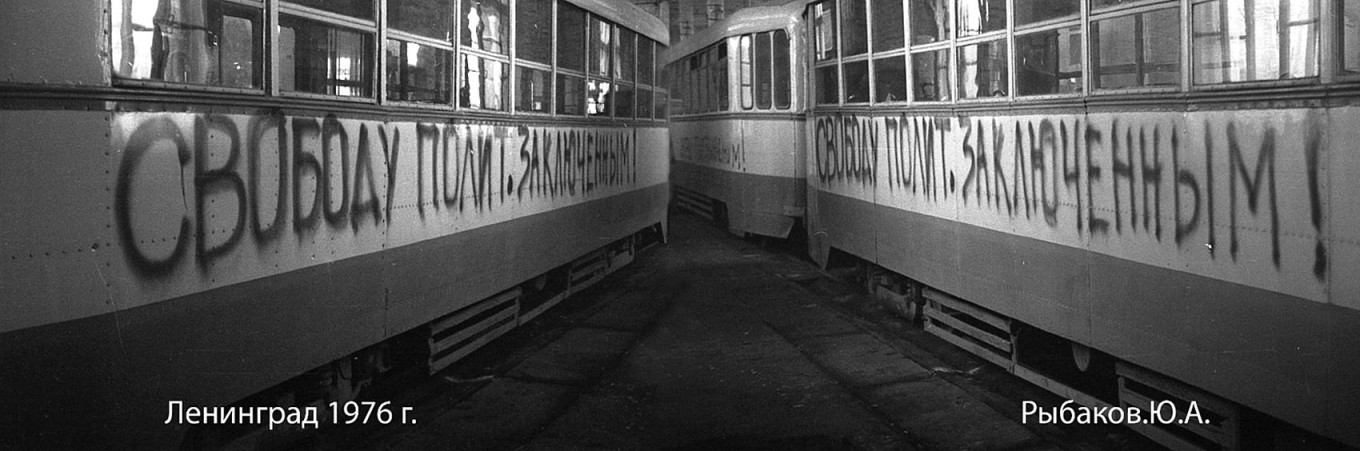
It was not the only inscription we ever made. I was the organizer of a small underground dissident group that produced banned literature. It was technically demanding and exhausting work. From time to time we allowed ourselves to go out into the streets and leave slogans on trams, buses and in crowded public places about the true nature of Soviet power. We painted slogans such as ‘The CPSU [Communist Party of the Soviet Union] is the enemy of the people,’ ‘The U.S.S.R. is a prison of nations,’ ‘Freedom for political prisoners’ and many others. We painted slogans on trams at night while they were parked in the depot. The next morning, those trams went out and had to travel all across the city carrying our messages. The inscription about freedom on the fortress wall was another such action, but on a much larger scale — 40 meters long and 1.5 meters high. It could be seen from the opposite bank of the Neva River, was noticed by many people and remained in their memory.
MT: How widely did news of your action spread throughout the Soviet Union?
YR: Over the years, I have heard many times from people who saw the inscription or heard about it. They told me it inspired them, if not to active resistance, then at least to inner moral resistance. In addition, the BBC, Radio Liberty and Deutsche Welle all reported that we had been arrested for this action. Everyone who listened to those stations learned about it.
MT: Why do you think the authorities, then and now, consider art to be so dangerous?
YR: Art, if it is sincere, always tells the truth. Even when it does not express that truth directly, it still awakens in people a sense of dignity, a desire for freedom and hope for an open future. That is why it is dangerous to those who want society to remain blinkered, unable to look around and understand where it truly stands.
MT: Nowadays in Russia, people paint slogans such as ‘No to war’ or calls to support political prisoners on walls. How much does that resonate with the past?
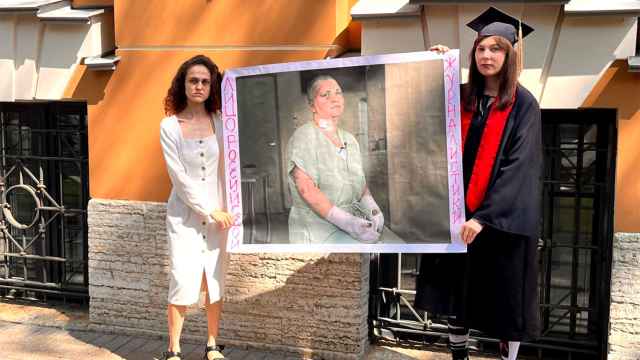
Yuly Rybakov: Our slogan reappeared in St. Petersburg decades later. I found out about it completely by accident. It turned out that a group of young artists had recreated it on another embankment in the city. As far as I know, it has also appeared in other Russian cities and abroad — there have also been people who repeated this inscription among those forced to leave Russia in the current wave of political emigration.
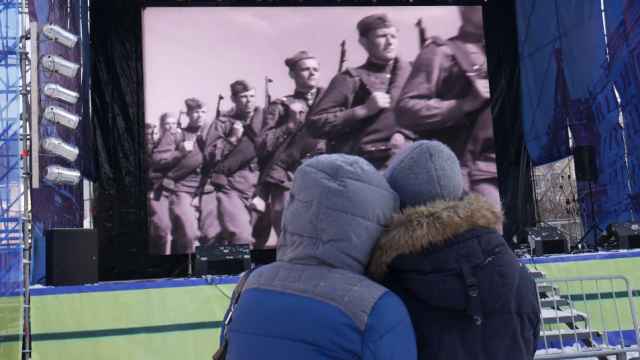
As for the situation in Russia today, unfortunately everything has come full circle and perhaps in an even worse form than it was at the end of the 1980s. The political repression and censorship we see today are, in my opinion, even more severe than during the [Soviet leader Leonid] Brezhnev-era stagnation against which we protested. Today it is harsher, more frightening and more dangerous for our society, which is essentially suffocating from the lack of truthful information about what is happening in the country. At the same time, society is subjected to the overwhelming psychological influence of Russian state television, which presents a picture of the world that bears little relation to reality while convincing enormous numbers of people that they live in a prosperous country. In my view, Russia is sliding toward catastrophe.
MT: In a past interview, you said that after your release from the labor camp, you began to wonder whether people actually needed freedom at all. What do you think now? Do people in Russia need freedom?
YR: Those who have become victims of Kremlin propaganda and do not understand what is happening do not need it — they believe they already possess enough freedom. But that is not true. Sooner or later their eyes will open. Perhaps it will happen too late. That is why the sooner they understand where the truth lies and where the lies are, the sooner they will free themselves from the spell of this propaganda machine. That will be better both for them and for Russia as a whole.
MT: When you served in the State Duma, did you feel that it was still possible to change Russia?
YR: I devoted 10 years of my life to active participation in politics — as a deputy of the Leningrad City Council, chairman of the first human rights commission in Russia’s history and as a lawmaker in the first three convocations of the State Duma. Despite all the difficulties of carrying out reforms, those were years of hope. They were years when we increasingly believed that society would free itself from its old restraints, habits and ways of thinking and would truly become an open and free society. Neither I nor virtually any of my friends and colleagues in the democratic movement expected what would happen beginning in the 2000s. We believed that breaking with the past would prove easier, faster and shorter. Unfortunately, we were mistaken.
Of course, we made many mistakes that may have changed the future we are living in today. If, after the failed coup of 1991, we had managed to convince [former President] Boris Yeltsin of the need for lustration — the removal from political life of those who had served the totalitarian regime, especially members of the repressive security apparatus — then, according to [assassinated politician] Galina Starovoitova's proposal, they would have been barred from elections and legislative office for 10 to 15 years. Had that happened, democrats would not permanently have been in the minority in the Congress of People's Deputies or the State Duma.
We never made up more than one-third of Russia's legislative bodies. Communists, former security officers and imperial nationalists were always in the majority, and they sabotaged all the reforms of the 1990s. Had lustration been carried out, the reforms would have taken three or four years instead of 10. Society would not have grown weary of waiting and we would have moved forward along an entirely different path — not the one Russia ultimately followed, when an exhausted populace longed for ‘a strong leader who would restore order.’
In the end, society placed its trust in the security services and in the chekists — who always remain chekists after all.
MT: How do you see Russia's future today?
YR: Russia faces a very difficult road ahead. If we do not fall into the abyss toward which the chekist regime is pushing us today, if there are still forces capable of stopping this destructive process, then what follows will be long, difficult years of recovery.
I believe that this is possible. But it will be anything but easy.
A Message from The Moscow Times:
Dear readers,
We are facing unprecedented challenges. Russia's Prosecutor General's Office has designated The Moscow Times as an "undesirable" organization, criminalizing our work and putting our staff at risk of prosecution. This follows our earlier unjust labeling as a "foreign agent."
These actions are direct attempts to silence independent journalism in Russia. The authorities claim our work "discredits the decisions of the Russian leadership." We see things differently: we strive to provide accurate, unbiased reporting on Russia.
We, the journalists of The Moscow Times, refuse to be silenced. But to continue our work, we need your help.
Your support, no matter how small, makes a world of difference. If you can, please support us monthly starting from just $2. It's quick to set up, and every contribution makes a significant impact.
By supporting The Moscow Times, you're defending open, independent journalism in the face of repression. Thank you for standing with us.

Remind me later.