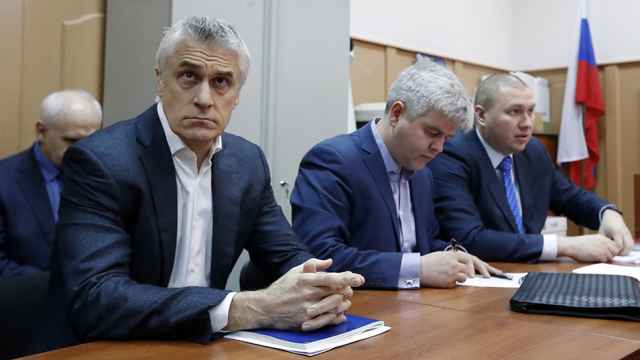
A Moscow court on Wednesday sentenced three former executives of the state-owned nanotechnology company Rusnano to prison for abuse of power and ordered them to pay 52 billion rubles ($629 million) in damages, the Russian Legal Information Agency reported.
The Gagarinsky District Court sentenced former executive director Boris Podolsky to five years in prison, former tax and reporting director Marina Kasenkova to six and a half years and former managing director for finance Artur Galstyan to seven and a half years. All three denied wrongdoing.
Investigators said the executives falsified Rusnano’s financial statements in 2017 to conceal debts and losses, allowing the company to retain state guarantees and raise fresh funding.
The Russian government provided more than 43 billion rubles ($520 million) in support to Rusnano between 2022 and 2024. It allocated 130 billion rubles ($1.57 billion) to establish the company’s predecessor in 2007. In January 2025, Rusnano estimated that financial misconduct had cost it 200 billion rubles ($2.42 billion) in damages and lost profits.
Russian authorities have opened criminal cases against at least 20 Rusnano executives, employees and business partners in recent years, including former CEO Leonid Melamed. Russian courts have issued arrest warrants in absentia for several of those who are abroad.
In separate proceedings, Russian bailiffs were seeking to recover nearly 20 billion rubles ($242 million) from former Rusnano chief Anatoly Chubais as of October. The claims relate to Rusnano’s investments in Plastic Logic, which developed flexible tablets, and the microelectronics project Crocus. Chubais disputes the claims.
Chubais ran Rusnano and its predecessor from 2008 to 2020 before becoming a special envoy to President Vladimir Putin. He resigned and left Russia shortly after the country launched its full-scale invasion of Ukraine in 2022.
Putin said in September 2023 that Chubais may have left because he feared criminal prosecution, adding that an “enormous financial hole” had been discovered at Rusnano.
This article was translated with the help of artificial intelligence and was reviewed by a Moscow Times editor before publication. Learn more about our newsroom's AI policy here.
Read this article in Russian at The Moscow Times' Russian service.
A Message from The Moscow Times:
Dear readers,
We are facing unprecedented challenges. Russia's Prosecutor General's Office has designated The Moscow Times as an "undesirable" organization, criminalizing our work and putting our staff at risk of prosecution. This follows our earlier unjust labeling as a "foreign agent."
These actions are direct attempts to silence independent journalism in Russia. The authorities claim our work "discredits the decisions of the Russian leadership." We see things differently: we strive to provide accurate, unbiased reporting on Russia.
We, the journalists of The Moscow Times, refuse to be silenced. But to continue our work, we need your help.
Your support, no matter how small, makes a world of difference. If you can, please support us monthly starting from just $2. It's quick to set up, and every contribution makes a significant impact.
By supporting The Moscow Times, you're defending open, independent journalism in the face of repression. Thank you for standing with us.

Remind me later.