
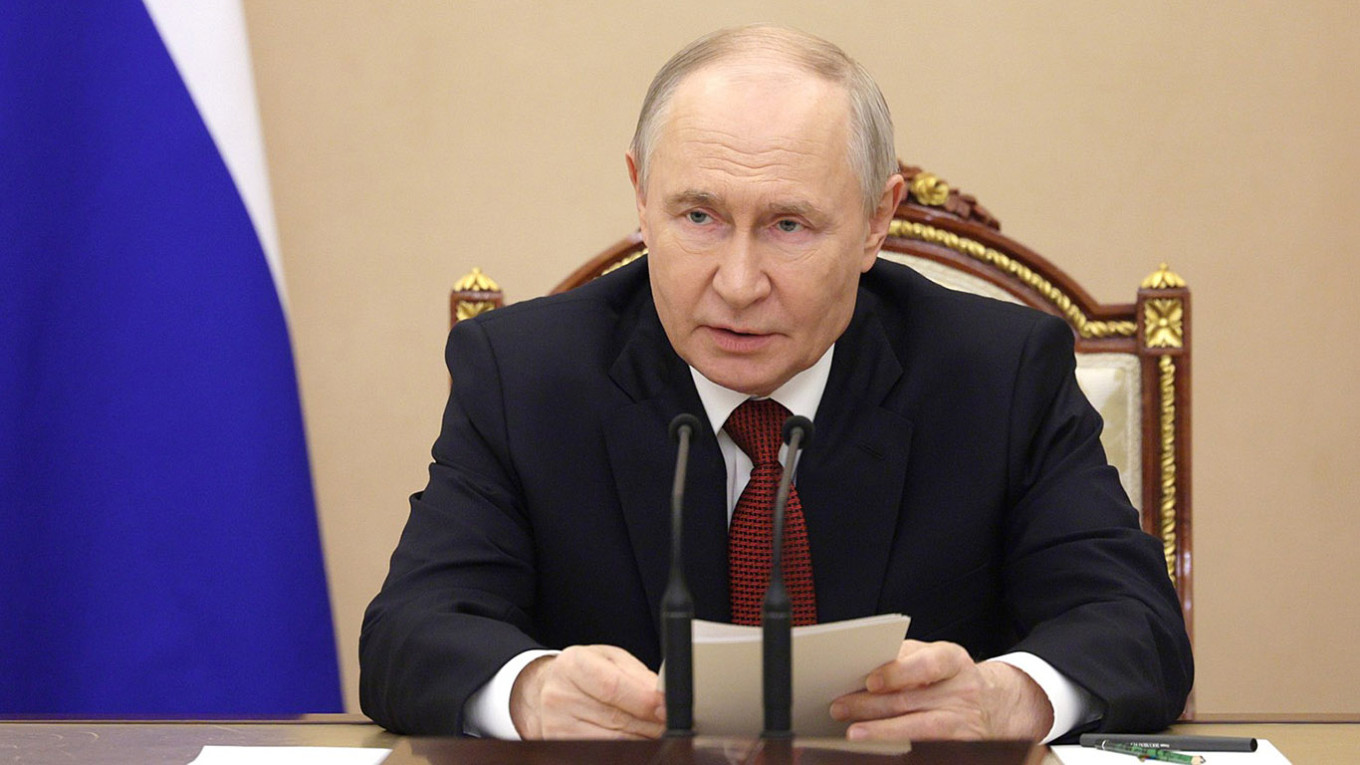
President Vladimir Putin acknowledged Sunday that Russia is facing a "certain shortage" of fuel following a wave of repeated Ukrainian strikes targeting oil refineries and domestic supply lines.
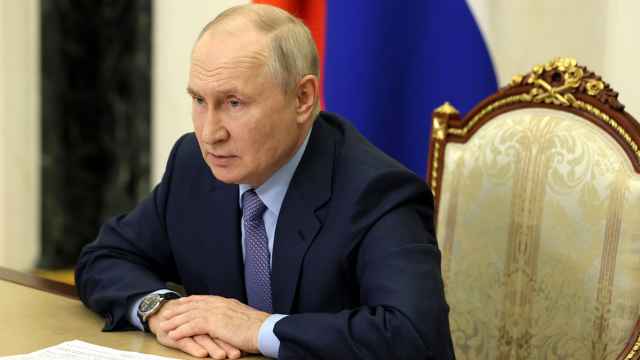
"As for strikes against critical infrastructure in general, and energy infrastructure in particular, of course, these attacks on our infrastructure facilities create problems," Putin said in a Kremlin-published interview. "That's obvious."
"Right now we're observing a certain shortage, but it's not critical," he added.
The government's primary focus, Putin said, was to improve Russian air defense system capabilities and to ensure that fuel supplies reach consumers, especially in annexed Crimea, where local authorities declared a state of emergency last week.
A few hours earlier, in a speech at the congress of the ruling United Russia party, Putin had vowed to restore security and overcome mounting challenges as Ukraine intensifies its retaliatory strikes against Russia.
"Yes, we see the problems, we are aware of them and are responding to them, but we will certainly ensure the security of both the country and our citizens, as well as the inviolability of Russia's borders," Putin told party members.
"We will undoubtedly overcome all the challenges facing us today, including terrorist attacks on our territory and infrastructure facilities," he added.
In the Kremlin interview, Putin also said he expects White House special envoy Steve Witkoff and U.S. President Donald Trump's son-in-law Jared Kushner to visit Moscow after the "active phase" of the war in the Middle East passes.
Witkoff and Kushner have travelled to Russia several times over the past year as part of U.S.-mediated talks to end the Ukraine war.
"We are ready to continue negotiations... and discuss all the details," Putin said in response to a question about the trajectory of U.S.-Russia relations following the G7 summit in France, where Trump called on Russia to "make a deal with Ukraine."
A Message from The Moscow Times:
Dear readers,
We are facing unprecedented challenges. Russia's Prosecutor General's Office has designated The Moscow Times as an "undesirable" organization, criminalizing our work and putting our staff at risk of prosecution. This follows our earlier unjust labeling as a "foreign agent."
These actions are direct attempts to silence independent journalism in Russia. The authorities claim our work "discredits the decisions of the Russian leadership." We see things differently: we strive to provide accurate, unbiased reporting on Russia.
We, the journalists of The Moscow Times, refuse to be silenced. But to continue our work, we need your help.
Your support, no matter how small, makes a world of difference. If you can, please support us monthly starting from just $2. It's quick to set up, and every contribution makes a significant impact.
By supporting The Moscow Times, you're defending open, independent journalism in the face of repression. Thank you for standing with us.

Remind me later.