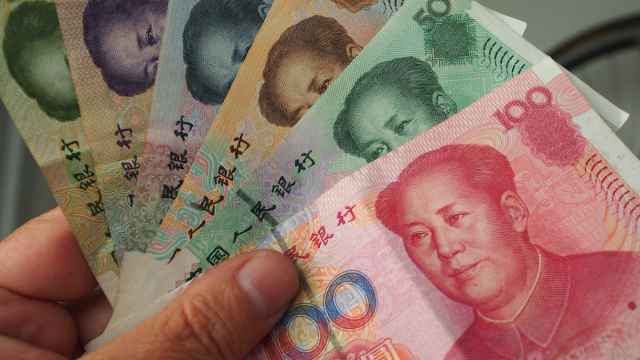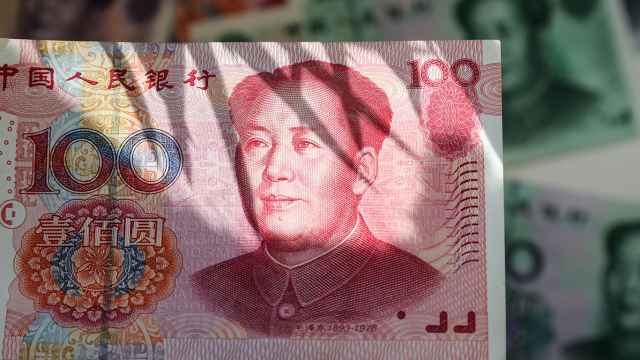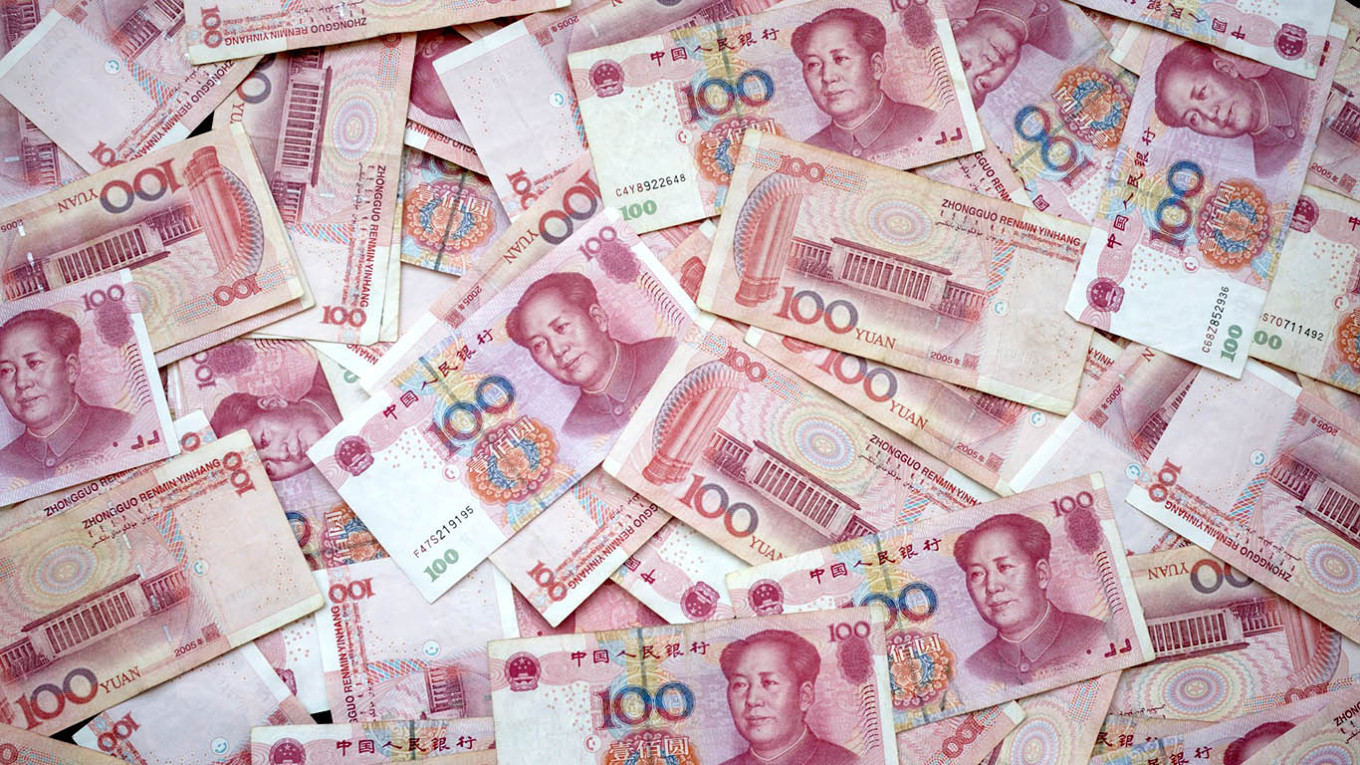
Russia's Finance Ministry is preparing to issue a new tranche of yuan-denominated government bonds to help plug a widening budget deficit that reached nearly 6 trillion rubles ($84 billion) in the first four months of the year, underscoring Moscow's growing reliance on debt financing and Chinese currency instruments as Western sanctions continue to constrain its options.
The ministry announced Thursday that it would begin collecting investor orders for the new yuan-denominated OFZ sovereign bonds, one day after President Vladimir Putin returned from a visit to Beijing.
Orders will be accepted through May 28, while the bonds are scheduled for placement on June 3. The securities will have a 10-year maturity. Investors will be able to receive returns either in Chinese yuan or Russian rubles.
The offering suggests Moscow is doubling down on yuan financing as sanctions constrain access to Western capital markets.
But the strategy delivered mixed results in its debut last year, when investor demand fell well short of the Finance Ministry's expectations despite lower yields than comparable ruble debt.
Under the current budget law, authorities forecast a deficit of 3.8 trillion rubles ($53.2 billion) and plan to finance it entirely through borrowing.
Russia first issued yuan-denominated sovereign debt in December last year, launching two tranches maturing in 2029 and 2033.
Sources told Reuters at the time that the Finance Ministry had hoped to raise 300-400 billion rubles ($4.2 billion-$5.6 billion).
In practice, however, it sold 219 billion rubles ($3.1 billion), equivalent to 20 billion yuan.
Russian authorities spent more than a decade attempting to issue yuan bonds directly in China but failed to secure terms acceptable to both sides.
China's central bank only permits so-called panda bonds, which prevent issuers from transferring the proceeds outside the country.
For the Russian government, yuan bonds offer a cheaper way to finance budget needs than borrowing in rubles, analysts say.
"Interest rates on foreign-currency instruments are lower than on ruble instruments, making it cheaper for the state to borrow in foreign currency than in rubles at higher yields," Natalia Milchakova, a leading analyst at Freedom Finance Global, said.
The yuan OFZ bonds issued in December carried yields of 6-7%, compared with 13.5-15% on comparable ruble-denominated government debt.
Russia's public debt is expected to continue growing in the coming years. Authorities plan to increase state debt by 3.8 trillion rubles ($53.2 billion) this year, by 3.79 trillion rubles ($53.1 billion) in 2027 and by another 4.57 trillion rubles ($64 billion) in 2028.
Read this article in Russian at The Moscow Times' Russian service.
A Message from The Moscow Times:
Dear readers,
We are facing unprecedented challenges. Russia's Prosecutor General's Office has designated The Moscow Times as an "undesirable" organization, criminalizing our work and putting our staff at risk of prosecution. This follows our earlier unjust labeling as a "foreign agent."
These actions are direct attempts to silence independent journalism in Russia. The authorities claim our work "discredits the decisions of the Russian leadership." We see things differently: we strive to provide accurate, unbiased reporting on Russia.
We, the journalists of The Moscow Times, refuse to be silenced. But to continue our work, we need your help.
Your support, no matter how small, makes a world of difference. If you can, please support us monthly starting from just $2. It's quick to set up, and every contribution makes a significant impact.
By supporting The Moscow Times, you're defending open, independent journalism in the face of repression. Thank you for standing with us.

Remind me later.