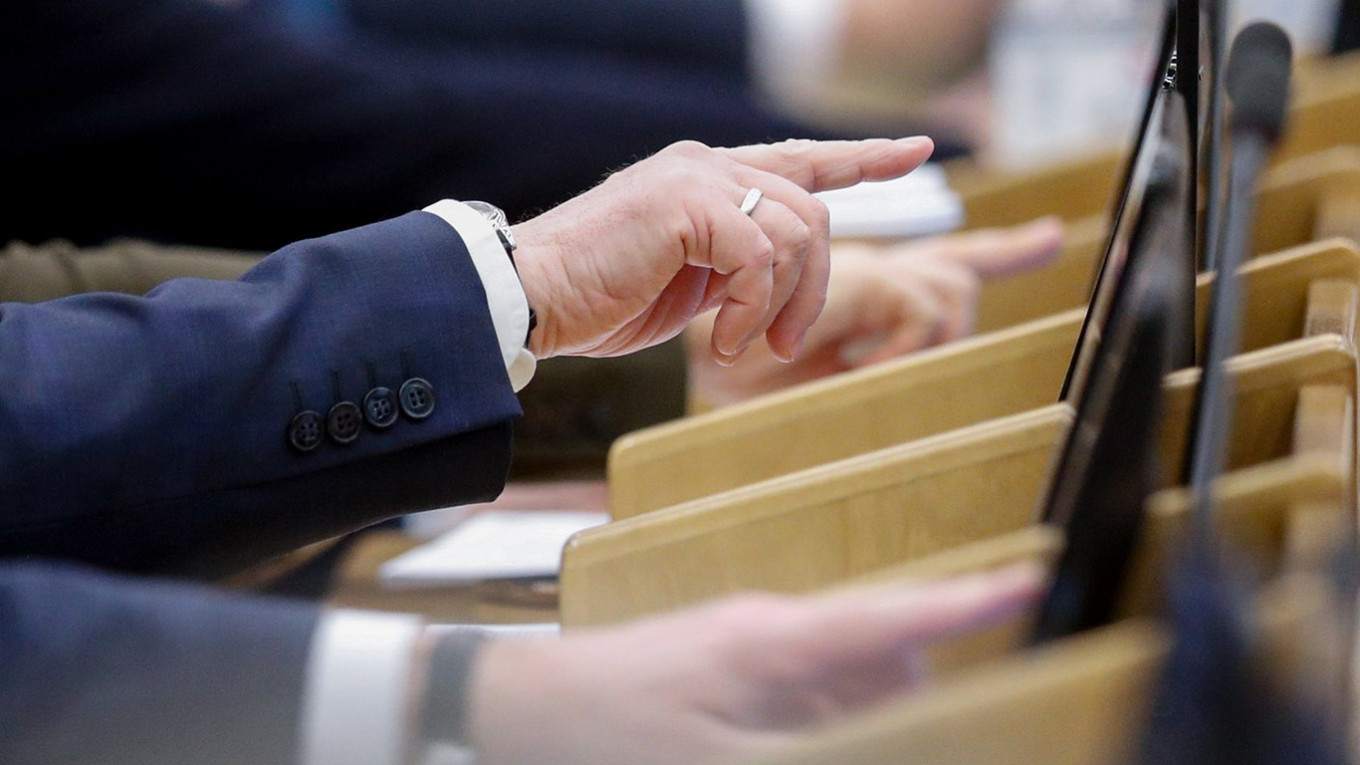
Lawmakers in Russia’s lower-house State Duma on Tuesday passed a bill that would make it a criminal offense to deny what authorities describe as the “genocide of Soviet people” during World War II.
State Duma Speaker Vyacheslav Volodin said the legislation was needed to “protect historical memory” at a time when “Western politicians are trying to rewrite history.”
“Countering the falsification of history and protecting the truth about the events of the Great Patriotic War are among the most important tasks of State Duma deputies,” Volodin said, referring to the Eastern Front of World War II.
If approved by the upper-house Federation Council and signed by President Vladimir Putin, the bill would amend Russia’s law on the “rehabilitation of Nazism.”
The new offense would broadly cover denying that a genocide of Soviet citizens took place, endorsing such actions or publicly desecrating the memory of those regarded as its victims. It would carry a maximum sentence of three years in prison.
The bill also amends legislation on the destruction or damage of cultural heritage sites, extending protections to burial sites linked to alleged victims of the Soviet genocide. Violations would carry a maximum sentence of five years in prison.
Alexander Bastrykin, head of Russia’s Investigative Committee, has been a prominent advocate of the bill, according to independent journalist Farida Rustamova. Since 2019, the agency has launched at least 34 criminal probes related to Nazi Germany.
Putin has frequently invoked World War II in justifying Russia’s invasion of Ukraine, arguing it is aimed at “denazifying” the country and preventing alleged “genocide” against Russian-speaking populations. Ukraine and its Western allies reject those claims.
Around 27 million Soviet citizens are estimated to have died during World War II.
A Message from The Moscow Times:
Dear readers,
We are facing unprecedented challenges. Russia's Prosecutor General's Office has designated The Moscow Times as an "undesirable" organization, criminalizing our work and putting our staff at risk of prosecution. This follows our earlier unjust labeling as a "foreign agent."
These actions are direct attempts to silence independent journalism in Russia. The authorities claim our work "discredits the decisions of the Russian leadership." We see things differently: we strive to provide accurate, unbiased reporting on Russia.
We, the journalists of The Moscow Times, refuse to be silenced. But to continue our work, we need your help.
Your support, no matter how small, makes a world of difference. If you can, please support us monthly starting from just $2. It's quick to set up, and every contribution makes a significant impact.
By supporting The Moscow Times, you're defending open, independent journalism in the face of repression. Thank you for standing with us.

Remind me later.