Moscow’s Tverskoy District Court on Monday designated the exiled feminist protest group Pussy Riot an “extremist” organization, effectively banning its activities in Russia and putting anyone associated with the group at risk of criminal prosecution.
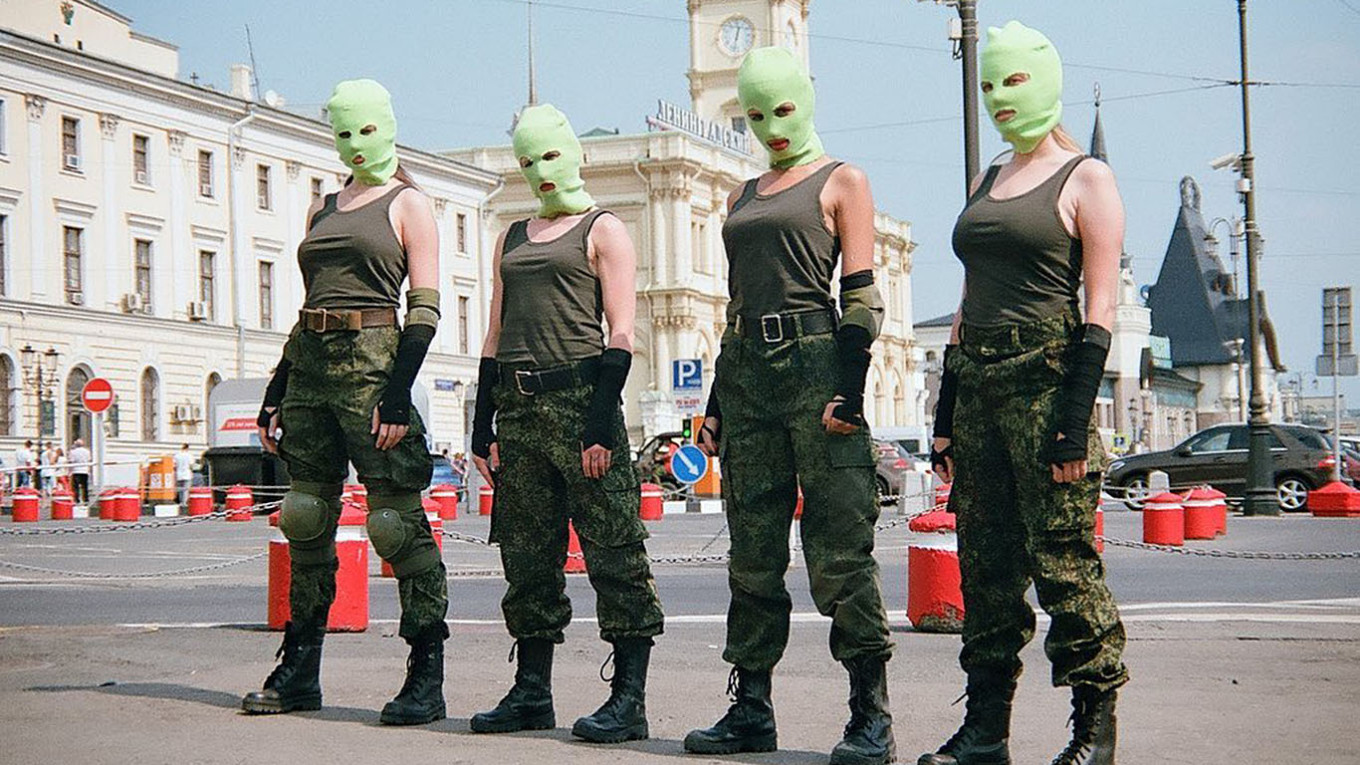
Founded in Moscow in 2011, Pussy Riot became known for provocative performances and protests targeting the Kremlin, state censorship and human rights abuses. The collective gained international attention in 2012 after staging an impromptu protest inside Moscow’s Christ the Savior Cathedral, criticizing President Vladimir Putin and the Russian Orthodox Church.
“It was only a matter of time — sooner or later it was bound to happen anyway,” Pussy Riot activist Alexander Sofeev told The Moscow Times when asked to comment on the Tverskoy District Court’s ruling.
“The terrorists have labeled us extremists. I can’t say that I’m particularly upset by a decision coming from people like that. For me, these are completely illegitimate institutions that do not represent my interests in any way,” Sofeev said.
“As for our activities, all the participants are now, fortunately, outside Russia, so I don’t think there will be any major changes,” he added.
Nadya Tolokonnikova, one of the group’s founders, said the court decision was intended to “erase Pussy Riot from the minds of the Russian people.”
“A balaclava under your pillow, our song on your computer or even a ‘like’ on our [social media] post can lead to prison time… Pussy Riot has essentially become the name that cannot be spoken in Russia,” Tolokonnikova told the exiled news outlet The Insider.
Three Pussy Riot members, including Tolokonnikova, were sentenced to prison terms over their 2012 protest inside Moscow’s Christ the Savior Cathedral and released in December 2013 under a broad amnesty.
Following Russia’s full-scale invasion of Ukraine in 2022, several Pussy Riot activists fled the country and were later placed on Russia’s wanted list. Many members of the group are now based in Tbilisi, Georgia.
Russian courts have designated a number of entities as “extremist” in recent years, ranging from Facebook parent Meta to the non-existent “international LGBT public movement” and “Anti-Russian Separatist Movement.”
A Message from The Moscow Times:
Dear readers,
We are facing unprecedented challenges. Russia's Prosecutor General's Office has designated The Moscow Times as an "undesirable" organization, criminalizing our work and putting our staff at risk of prosecution. This follows our earlier unjust labeling as a "foreign agent."
These actions are direct attempts to silence independent journalism in Russia. The authorities claim our work "discredits the decisions of the Russian leadership." We see things differently: we strive to provide accurate, unbiased reporting on Russia.
We, the journalists of The Moscow Times, refuse to be silenced. But to continue our work, we need your help.
Your support, no matter how small, makes a world of difference. If you can, please support us monthly starting from just $2. It's quick to set up, and every contribution makes a significant impact.
By supporting The Moscow Times, you're defending open, independent journalism in the face of repression. Thank you for standing with us.

Remind me later.