

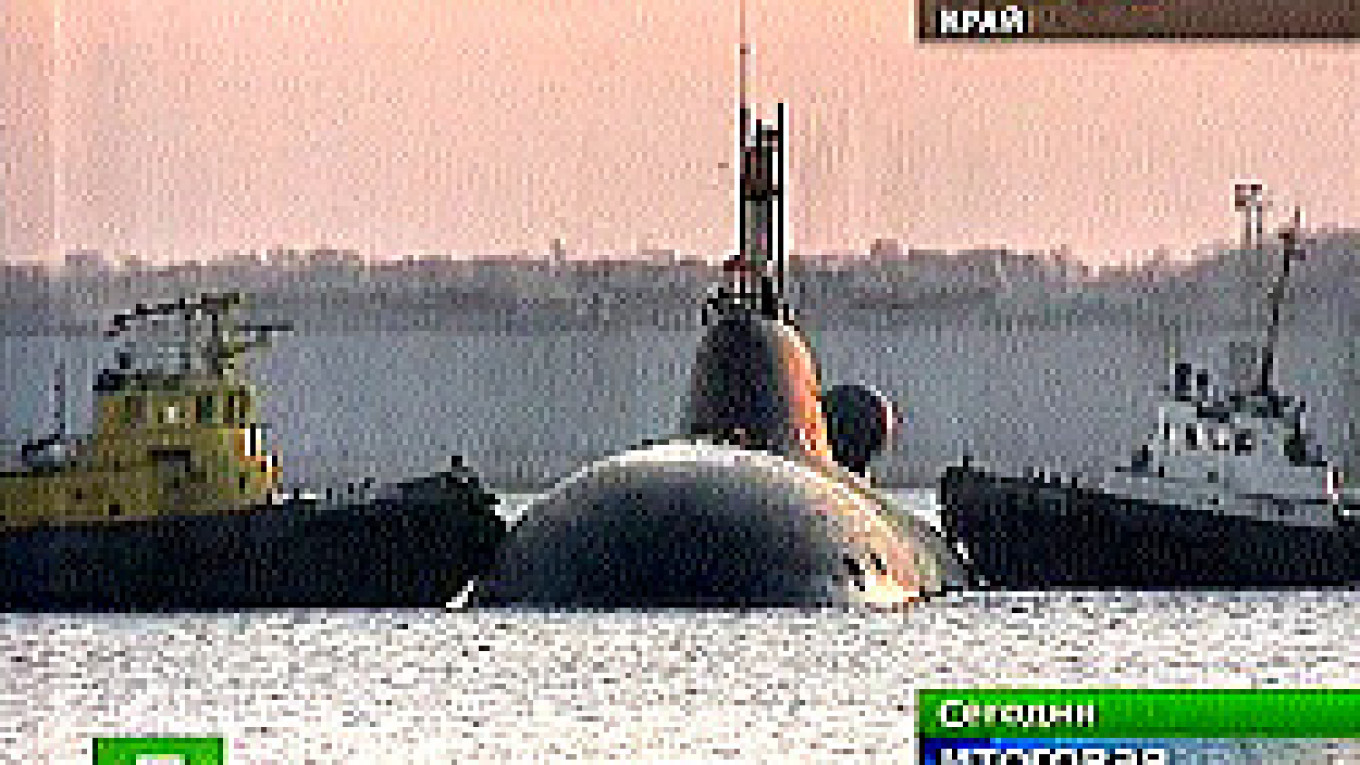
A fire-extinguishing system on the submarine began pumping Freon gas into a section of the submarine, which was undergoing testing in the Sea of Japan. Seventeen of the 20 people killed were civilians.
"It's possible there weren't enough breathing apparatuses," a member of the defense and security committee of the Federation Council, former Black Sea Fleet Commander Vladimir Komoyedov, said Monday, RIA-Novosti reported. He called the accident the result of "the greatest lack of professionalism and negligence."
"No one should board a submarine without a portable breathing apparatus. Crew members literally sleep in them," former Northern Fleet Commander Vyacheslav Popov said, Interfax reported. "It's another matter that the civilians were not able, or did not have the opportunity to put on this breathing apparatus."
Civilians are supposed to undergo training on safety procedures, but "it is usually limited to some formal instructions," Igor Kudrin, a former submarine captain, told Kommersant. He speculated that someone lighting a cigarette near a safety gauge might have triggered the fire system.
While older generations of submarines had fire safety systems that were activated on the captain's command, new submarines have systems that switch on automatically, said another former submarine captain, Nikolai Markovtsev, Kommersant reported.
An engineer at the shipyard in Bolshoi Kamen, in the Primorye region, where the submarine was being tested, told Interfax that the fire extinguishing system activated in the summer without cause, but the problem seemed to have been solved.
The Investigative Committee of the State Prosecutor's Office released a list of the dead on Monday. Among the three naval dead was the head of the submarine's chemical systems, Alexander Podbornov. The 17 civilians dead included the shipyard engineer in? charge of the tests, Viktor Druzhinin.
A further 21 people, mainly civilians, remained in a naval hospital, RIA-Novosti reported.
Pacific Fleet military prosecutors are investigating the accident. One of the investigators told RIA-Novosti that they plan to hold a reconstruction of the events on the submarine in the next few days.
The submarine was due to be leased to the Indian government next year under a $650-million deal, Vedomosti reported Monday. It quoted an unidentified shipping industries official as saying the submarine was intended for India's navy, which has already named it the Chakra.
Indian naval spokesman Commander Nirad Sinha would not confirm whether there was an agreement to lease the vessel, and said no Indians were on board the submarine when the accident occurred.
"It's a Russian submarine, and any concerns are Russian concerns," Sinha said, The Associated Press reported.
The governor of the Primorye region, Sergei Darkin, announced that Tuesday would be a day of mourning and that the region would give 100,000 rubles ($3,700) to the family of each victim.
(MT, AP, Reuters)
A Message from The Moscow Times:
Dear readers,
We are facing unprecedented challenges. Russia's Prosecutor General's Office has designated The Moscow Times as an "undesirable" organization, criminalizing our work and putting our staff at risk of prosecution. This follows our earlier unjust labeling as a "foreign agent."
These actions are direct attempts to silence independent journalism in Russia. The authorities claim our work "discredits the decisions of the Russian leadership." We see things differently: we strive to provide accurate, unbiased reporting on Russia.
We, the journalists of The Moscow Times, refuse to be silenced. But to continue our work, we need your help.
Your support, no matter how small, makes a world of difference. If you can, please support us monthly starting from just $2. It's quick to set up, and every contribution makes a significant impact.
By supporting The Moscow Times, you're defending open, independent journalism in the face of repression. Thank you for standing with us.

Remind me later.