

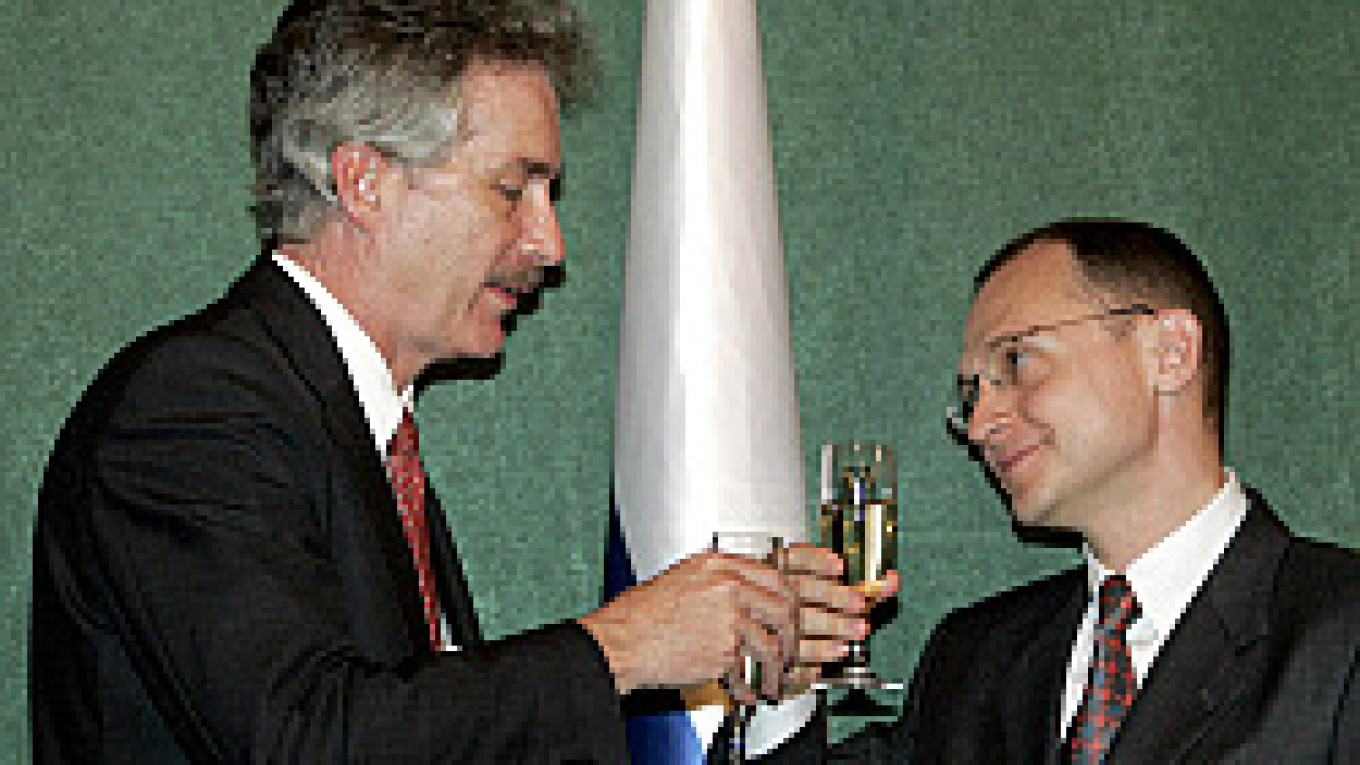
The deal, signed on President Vladimir Putin's last full day in office, establishes the legal basis for Russian and U.S. companies to trade in nuclear materials. It could also give the United States access to Russian technology and hand Russia lucrative contracts to store spent nuclear fuel.
Russian and U.S. officials lauded the agreement, signed in Moscow by U.S. Ambassador William Burns and Sergei Kiriyenko, head of the state-run nuclear corporation Rosatom.
"The United States and Russia were once nuclear rivals," Burns said after the signing ceremony, Interfax reported. "Now we are partners."
The agreement "opens up huge possibilities for us," Kiriyenko said. "Both sides will benefit from it," he said, Interfax reported.
The U.S. Embassy said the agreement would give the two countries "a framework to develop nuclear energy for peaceful purposes and to advance nuclear energy worldwide, while enhancing our joint leadership in preventing nuclear proliferation."
It was no coincidence that the deal was signed before President-elect Dmitry Medvedev is sworn in as president on Wednesday, Rosatom spokesman Sergei Novikov said.
"The two sides did not want to postpone this agreement any further, to leave it for another administration," Novikov said. "We waited 20 years for it."
Work on the agreement began after Putin and U.S. President George W. Bush promised to increase nuclear cooperation at the G-8 summit in St. Petersburg in 2006.
Alexander Pikayev, a nuclear-security expert with the Institute of World Economy and International Relations, said Bush likely "did not want to say goodbye to [Putin] without fulfilling any of his promises."
"This is one of the most important agreements to develop Russian-U.S. relations signed under the Bush administration," Pikayev said.
The deal was also a swan song of sorts for Burns, who is leaving Moscow to take the No. 3 post in the U.S. State Department. Burns said at a farewell reception Tuesday evening, however, that the timing of the agreement was in no way connected to his departure.
The Bush administration hopes to send the pact to the U.S. Congress this month for ratification, but concerns in Washington that Iran is trying to build an atomic bomb while Russia assists in building Iran's Bushehr nuclear plant could lead to strong resistance from U.S. lawmakers, a U.S. congressional aide told Reuters last week.
The agreement could help Russia establish a uranium-enrichment center, which Putin has said would discourage Iran and other countries from building nuclear facilities. The pact could allow the import of spent nuclear fuel from the United States, which controls a majority of such fuel in the world.
The proposal to build the uranium enrichment center has outraged Russian environmentalists.
Staff Writer Andrew McChesney contributed to this report.
A Message from The Moscow Times:
Dear readers,
We are facing unprecedented challenges. Russia's Prosecutor General's Office has designated The Moscow Times as an "undesirable" organization, criminalizing our work and putting our staff at risk of prosecution. This follows our earlier unjust labeling as a "foreign agent."
These actions are direct attempts to silence independent journalism in Russia. The authorities claim our work "discredits the decisions of the Russian leadership." We see things differently: we strive to provide accurate, unbiased reporting on Russia.
We, the journalists of The Moscow Times, refuse to be silenced. But to continue our work, we need your help.
Your support, no matter how small, makes a world of difference. If you can, please support us monthly starting from just $2. It's quick to set up, and every contribution makes a significant impact.
By supporting The Moscow Times, you're defending open, independent journalism in the face of repression. Thank you for standing with us.

Remind me later.