

Medvedev signed a decree relieving General Valentin Korabelnikov, 63, of his post as director of the GRU, a Kremlin statement said. Korabelnikov had held the position since 1997 and was replaced by Lieutenant General Alexander Shlyakturov, a first deputy in the organization.
The dismissal of the respected spymaster is one of Medvedev's highest-profile dismissals since he became president in May 2008, and the Kremlin gave no explanation for the decision.
The GRU, created in 1918 under Leon Trotsky, is controlled by the General Staff of the armed forces and reports directly to the president. It is Russia's largest spy agency and has a dense global network of agents. It also has thousands of special forces troops inside Russia, some of whom were deployed in Georgia last year.
Korabelnikov had criticized reforms that the Kremlin says aim to turn Russia's outdated army into a mobile fighting force. Under the reforms, the number of generals will be slashed and the armed forces will be cut to 1 million from more than 1.1 million.
Independent military analyst Pavel Felgenhauer said Korabelnikov clashed with Defense Minister Anatoly Serdyukov over plans to carve up the GRU and strip it of special units over which it wielded control. "This is the beginning of a major reform of Russia's military intelligence," Felgenhauer said.
He added that the Defense Ministry was positioning to bring the GRU under more direct control, effectively weakening the General Staff.
Another analyst, Alexander Golts, said Korabelnikov was too transfixed on traditional enemies such as the United States and failed to identify a steady buildup of weapons in Georgia before a short war with Russia in August.
Both said Korabelnikov's replacement, Shlyakturov, was less likely to resist the reforms.
A Defense Ministry spokesman said Korabelnikov had been dismissed because he was already three years over the maximum age ceiling of 60 for generals, news reports said.
To remain in service after 60, the president must either sign a decree to extend their contract or fire them. Medvedev on Friday ordered that Korabelnikov be decorated for his service to the state and named him an adviser to the General Staff.
The GRU has no web site or spokespeople, unlike the smaller Foreign Intelligence Service, known as SVR, and the Federal Security Service, or FSB.
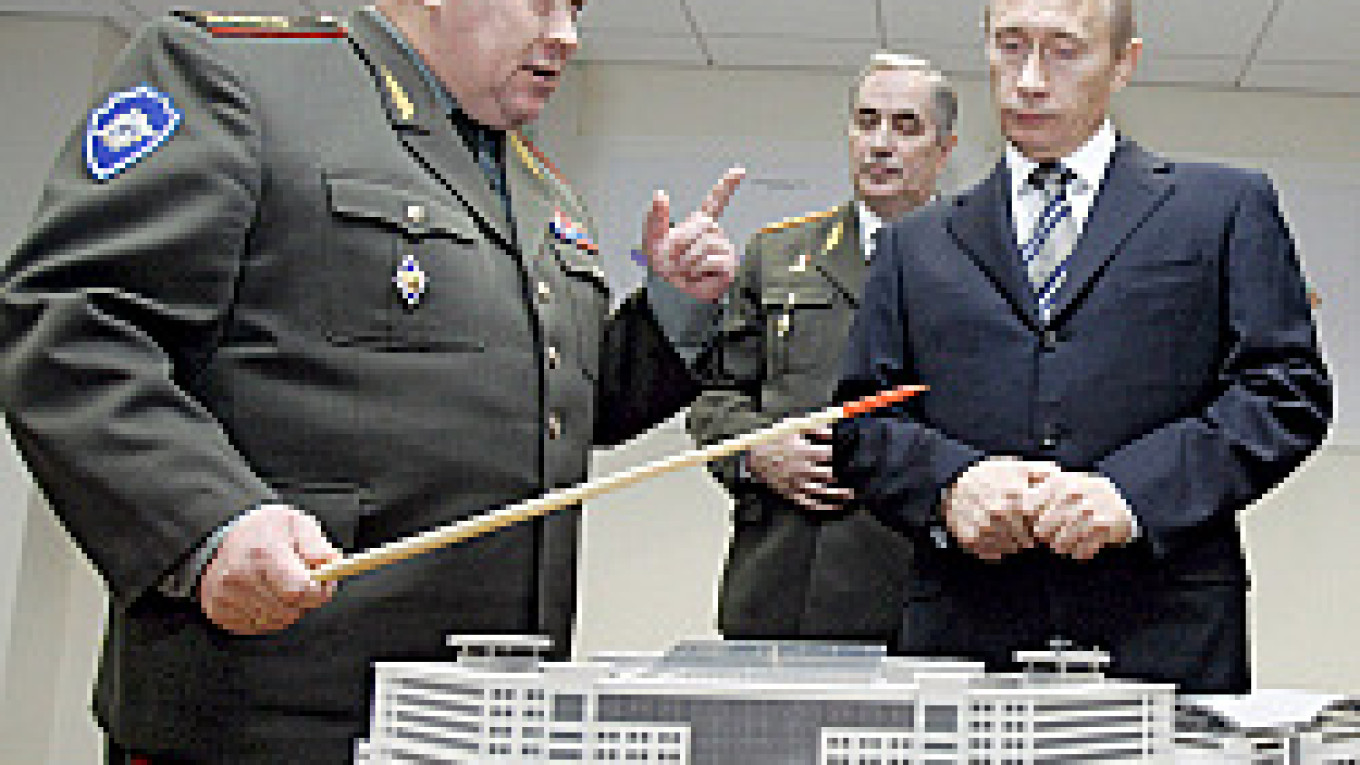
The public was given a rare chance to see parts of GRU's Moscow headquarters when Putin visited it in 2006 and was shown taking part in shooting practice.
A Message from The Moscow Times:
Dear readers,
We are facing unprecedented challenges. Russia's Prosecutor General's Office has designated The Moscow Times as an "undesirable" organization, criminalizing our work and putting our staff at risk of prosecution. This follows our earlier unjust labeling as a "foreign agent."
These actions are direct attempts to silence independent journalism in Russia. The authorities claim our work "discredits the decisions of the Russian leadership." We see things differently: we strive to provide accurate, unbiased reporting on Russia.
We, the journalists of The Moscow Times, refuse to be silenced. But to continue our work, we need your help.
Your support, no matter how small, makes a world of difference. If you can, please support us monthly starting from just $2. It's quick to set up, and every contribution makes a significant impact.
By supporting The Moscow Times, you're defending open, independent journalism in the face of repression. Thank you for standing with us.

Remind me later.