

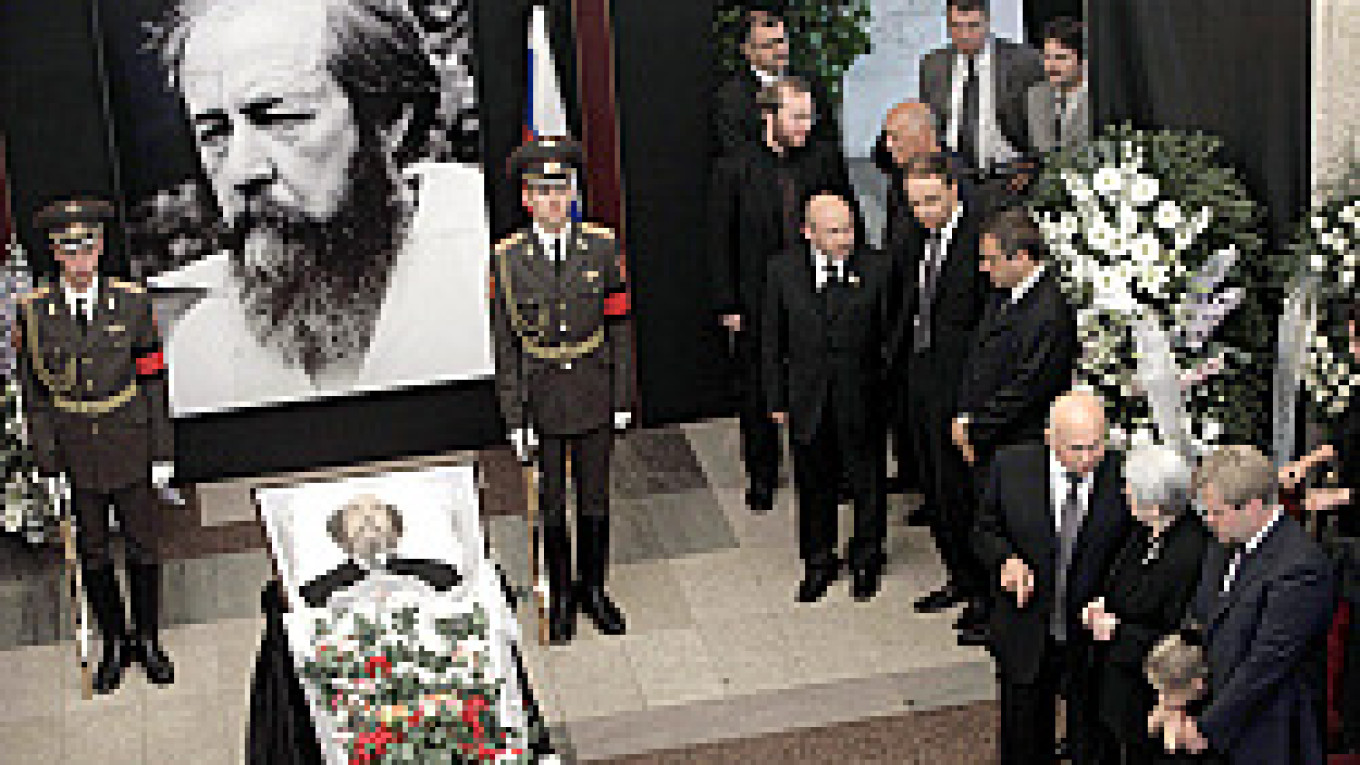
Slowly, his wife Natalya approached the coffin, resting her hand gently atop his crisp black suit jacket. She whispered a few short words and then returned to her family. Like everyone, she had come here to remember and to say goodbye.
"I wanted to come here in memory of all those who were detained and who died," said Dmitry Sakharov, 59, whose parents, like Solzhenitsyn, were prisoners of the gulag. "It was a terrible time for Russia, and Solzhenitsyn was a beacon for us."
Hundreds of mourners, including Prime Minister Vladimir Putin, flocked to the Russian Academy of Sciences in southwest Moscow on Tuesday to pay their respects to Nobel Prize winner Alexander Solzhenitsyn, one of the 20th century's towering literary and cultural figures, who died from heart failure at age 89 on Sunday.
Solzhenitsyn, a former prisoner in Stalin's gulag, shocked the world with his graphic descriptions of life in Soviet prison camps. His book, "One Day in the Life of Ivan Denisovich," and his masterpiece, "The Gulag Archipelago," are considered among the most important works of literary protest ever written.
The wake, held in a large marble hall on the grounds of the elite scientific institute, of which Solzhenitsyn was a member, was an elegant and understated affair.
Putin, who arrived shortly after midday, walked briskly into the hall, stopping at the feet of the writer to cross himself and lay a bouquet of red roses. Fittingly, his was the largest bouquet.
Putin then spent several minutes speaking with Solzhenitsyn's widow. Putin, whose mood appeared somber, briefly paid his respects to the author's two sons before departing, flanked by a heavy security detail.
A steady procession of mostly elderly mourners marched slowly past the writer, his iconic gray beard lying atop a striped gray and black tie. Many crossed themselves and prayed softly, a few stooping to kiss the coffin.
Some described the wake as a chance not only to pay their respects to a visionary writer but also a contemporary and fellow-sufferer.
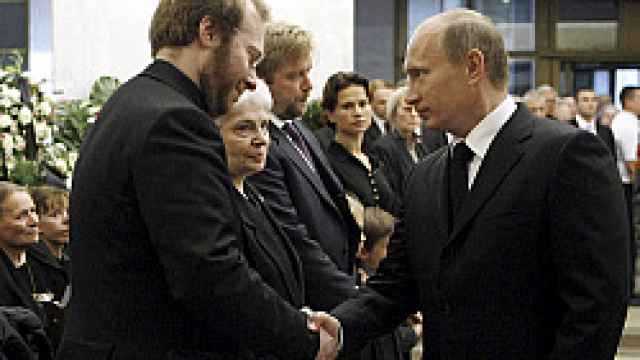 Ria-novosti / AP Putin offering condolences to Solzhenitsyn's son Stepan, left, Natalya Solzhenitsyn, second left, and son Yermolai. |  |
| |
"He was a luminary," she said. "He loved Russia, and I love Russia. He survived the camps, and I survived the camps. Our fates were intertwined."
At times, the subdued mood in the hall became emotional. One elderly man, his bright red face framed under a shock of white hair, broke into uncontrolled sobs as he came into sight of the author. Unable to regain his composure, he was helped away by an usher.
The Kremlin appears to be going to great lengths to mark Solzhenitsyn's passing. An ardent nationalist in his later years, Solzhenitsyn was a supporter of Putin, whom he credited with restoring Russia to its former glory.
In addition to the honor guard keeping a stationary watch over the coffin, a procession of soldiers, gripping rifles affixed with gleaming bayonets, marched slowly around the coffin every 15 minutes.
State television interrupted scheduled programming on Monday evening to air documentaries about Solzhenitsyn. President Dmitry Medvedev is scheduled to attend his funeral on Wednesday.
Still, despite the high-profile guests, attendance at the wake was somewhat sparse. A system of queues ringing the building stood mostly empty at midday, although that may have been because of the heavy rains that fell across Moscow on Tuesday.
Compared with the thousands of mourners who waited in line for hours outside the Christ the Savior Cathedral to pay their respects to former President Boris Yeltsin in 2007, the steady trickle of mourners, no more than a few hundred in total, was underwhelming.
Praise of Solzhenitsyn continued to pour in from around the world on Tuesday. U.S. Secretary of State Condoleezza Rice expressed her sadness over the writer's death in a statement.
"Solzhenitsyn was a great writer and a moral witness bringing the evils of the gulag to the attention of the world," said Rice, herself a student of Russian history. "His brave and arduous life's journey, which included surviving the gulag, internal and external exile, made him one of the 20th century's most important voices in the struggle against the tyranny of totalitarian regimes."
Solzhenitsyn's body lay in state at the Academy of Sciences throughout the day Tuesday. On Wednesday morning, he is to be buried at the Donskoi Monastery in central Moscow.
A Message from The Moscow Times:
Dear readers,
We are facing unprecedented challenges. Russia's Prosecutor General's Office has designated The Moscow Times as an "undesirable" organization, criminalizing our work and putting our staff at risk of prosecution. This follows our earlier unjust labeling as a "foreign agent."
These actions are direct attempts to silence independent journalism in Russia. The authorities claim our work "discredits the decisions of the Russian leadership." We see things differently: we strive to provide accurate, unbiased reporting on Russia.
We, the journalists of The Moscow Times, refuse to be silenced. But to continue our work, we need your help.
Your support, no matter how small, makes a world of difference. If you can, please support us monthly starting from just $2. It's quick to set up, and every contribution makes a significant impact.
By supporting The Moscow Times, you're defending open, independent journalism in the face of repression. Thank you for standing with us.

Remind me later.