

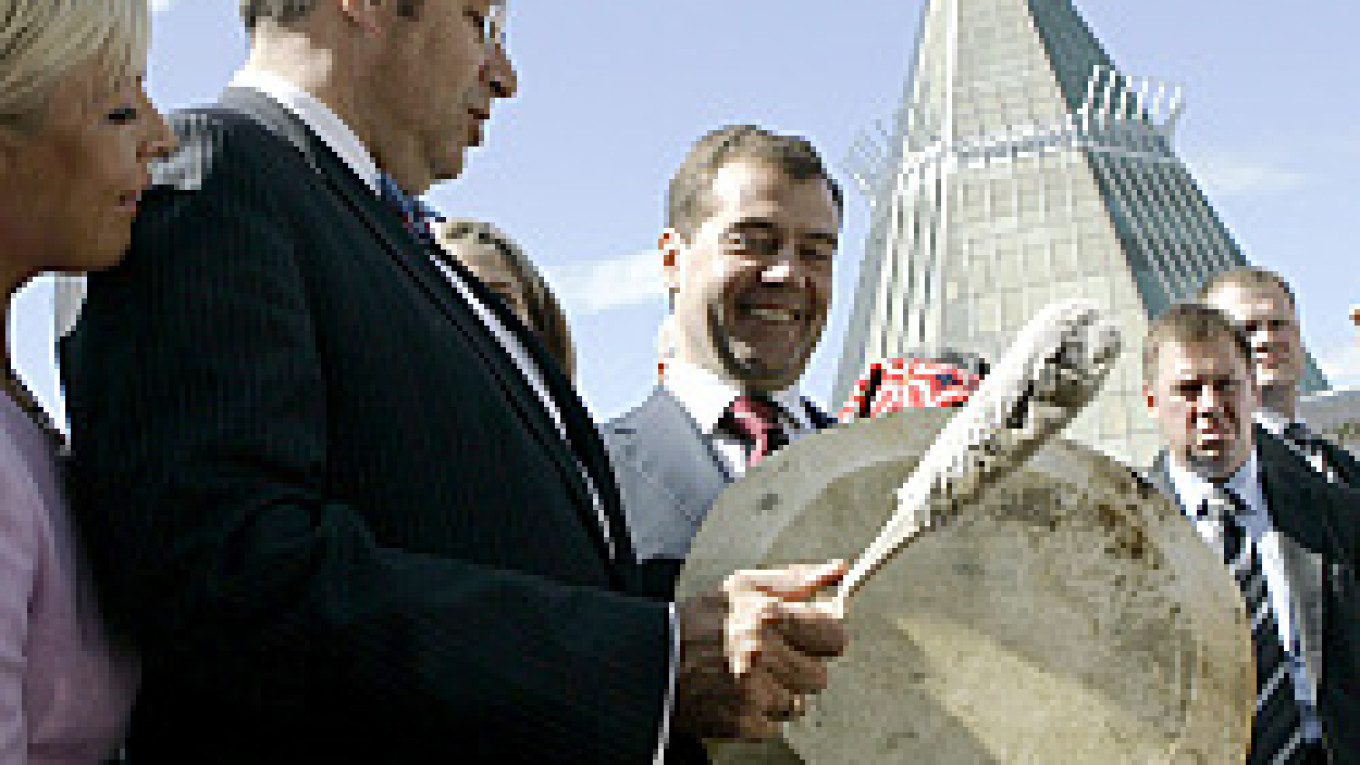
Estonian President Toomas Ilves rankled Russian officials on Saturday when he told a three-day conference in Khanty-Mansiisk that some Finno-Ugric people have embraced democracy but that others have yet to taste freedom.
At a hastily called briefing for Russian reporters, a State Duma deputy accused Ilves of trying to foment unrest and promote his own political agenda. When the deputy criticized Estonia at the conference Sunday, Ilves' delegation walked out, smiling and waving.
Ilves also held rare talks with President Dmitry Medvedev.
Ties with Estonia, which have been strained since the Soviet collapse, sank to a new low last year when Estonia moved a World War II memorial to Soviet soldiers from central Tallinn to a military cemetery, sparking rioting there and harsh condemnations from Moscow.
The Kremlin did not invite Estonia's leader to the last Finno-Ugric gathering, held shortly after the memorial dispute, but it did welcome the leaders of Finland and Hungary, the other two main Finno-Ugric countries.
Ilves was not invited because the event last year was not an official conference but a festival for Russia's friends, Kremlin aide Sergei Prikhodko told reporters Friday. "We have nothing to be ashamed of," he said.
The conference is aimed at celebrating the culture and identity of the Finno-Ugric people. It opened Saturday in the same hall where Medvedev and EU leaders announced the start of the talks on a new partnership agreement a day earlier.
Medvedev, who spoke first at the conference, said the gathering represented "evidence of a sincere and deep desire to develop our cooperation."
Ilves, who spoke last and wore a long black coat and is the only head of state to don traditional dress, spoke about how democracy would benefit the Finno-Ugric people.
"Many Finno-Ugric people have yet to make this choice," Ilves said. "Once you have tasted freedom, you will realize how much of it is sacrificed in the name of surviving or just getting by."
Ilves appeared to speak on behalf of not only Estonia but also Finland and Hungary, saying all three countries had chosen European values, and he called for the removal of "emotional or artificial barriers" between the nations.
Ilves finished by saying: "As a start, freedom and democracy, and by extension Europe, are not at all bad basic values. And, to be honest, there's really no alternative."
As soon as the conference's opening session ended, the authorities called a briefing at which State Duma Deputy Konstantin Kosachyov denounced Ilves' remarks as being laced with "geopolitics" and unworthy of a head of state.
"Instead of speaking of the issues of the [Finno-Ugric] people, which are of interest to the common folk, he spoke about issues that are of interest to the Estonian state," said Kosachyov, head of the Duma's International Affairs Committee.
He accused Ilves of trying to foment unrest by calling Russia's Finno-Ugric population to choose "the happy path" of Estonia. More than 2 million Finno-Ugric people, including the Khanty, Mansi and Setu, live in Russia.
Kosachyov also took issue with the fact that Ilves delivered his speech in English, while Finnish President Tarja Halonen and Hungarian President Laszlo Solyom spoke in their native tongues.
At the start of his speech, Ilves apologized for the choice of English, saying no Estonian interpreter was available.
A spokesman for Ilves, Toomas Sildam, said Kosachyov had misinterpreted the Estonian president's remarks. Estonian officials released a transcript of the speech to reporters Sunday.
At the end of Ilves' speech, one woman cried out "bravo," but many participants expressed confusion. An official with the Finnish delegation said she did not quite understand what Ilves had meant, while a Latvian delegate said the speech was open to interpretation.
The atmosphere at the conference grew so tense that the Estonian delegation walked out when Kosachyov criticized Tallinn's ethnic policies Sunday, RIA-Novosti reported. The Estonian officials smiled and waved at the people in the audience, many of whom clapped. Kosachyov said he would choose to interpret the clapping as participants' support of his criticism of Estonia's policies.
Medvedev made no public comment about the Estonian incident. He did not speak after Ilves' speech on Saturday, and he did not attend the conference Sunday.
But the flap cast a cloud over cautious hope for a post-summit improvement in ties between Russia and the EU, of which Estonia is a member.
Ilves, meeting with Medvedev several hours before the conference Saturday, noted several times that Estonia had not blocked the start of talks on the new EU-Russia partnership agreement, said Prikhodko, the Kremlin aide. The talks, scheduled to start in Brussels on July 4, had been blocked for 18 months, first by Poland and then by Lithuania.
Ilves also called for a toning down of rhetoric on both sides, Prikhodko said.
Medvedev suggested that the Finno-Ugric conference would provide an opportunity to improve ties.
"We rarely meet, and this has to do with a considerable amount of problems accumulated in our relations," Medvedev said in comments published on the Kremlin's web site.
Ilves agreed that the conference was a chance to mend fences, adding: "There is a lot of work ahead. We'll use this opportunity."
The last meeting between the heads of state took place in 2005, when then-President Vladimir Putin held informal talks with then-Estonian President Arnold Ruutel.
Also at Saturday's meeting, Ilves said he was prepared to restart the work of an intergovernmental commission on economic issues, his office said in a statement.
The talks aimed at giving impetus to bilateral ties, but Moscow also wanted to see concrete steps in the improved treatment of Estonia's Russian-speaking population, Prikhodko said.
Sildam, Ilves' spokesman, described the meeting as a "very good start."
Medvedev also held separate meetings with the Hungarian and Finnish presidents.
After the one-on-one talks, Medvedev took the presidents to a fair showcasing the craftsmanship of the indigenous peoples. The leaders walked from stand to stand in Khanty-Mansiisk's central square, talking with people dressed in their traditional costumes. Wearing his trademark bow tie and accompanied by his wife, Ilves and the other three presidents went into a chum, a teepee-like structure where the Northern people live.
"I hope they are practicing witchcraft in there," joked Medvedev's spokeswoman Natalya Timakova, reflecting the light mood at the start of the festivities earlier Saturday.
Khanty and Mansi participants at the fair praised the conference but said more state support was needed. Albina Sopochina said she was a pure Khanty and like her forefathers lived with her family in a forest. She said, however, that part of the year her family of 12 had to live in a shabby, three-room apartment without a bathroom.
"Other people live normally," said Sopochina, 58. "We also want a normal life."
A Message from The Moscow Times:
Dear readers,
We are facing unprecedented challenges. Russia's Prosecutor General's Office has designated The Moscow Times as an "undesirable" organization, criminalizing our work and putting our staff at risk of prosecution. This follows our earlier unjust labeling as a "foreign agent."
These actions are direct attempts to silence independent journalism in Russia. The authorities claim our work "discredits the decisions of the Russian leadership." We see things differently: we strive to provide accurate, unbiased reporting on Russia.
We, the journalists of The Moscow Times, refuse to be silenced. But to continue our work, we need your help.
Your support, no matter how small, makes a world of difference. If you can, please support us monthly starting from just $2. It's quick to set up, and every contribution makes a significant impact.
By supporting The Moscow Times, you're defending open, independent journalism in the face of repression. Thank you for standing with us.

Remind me later.