

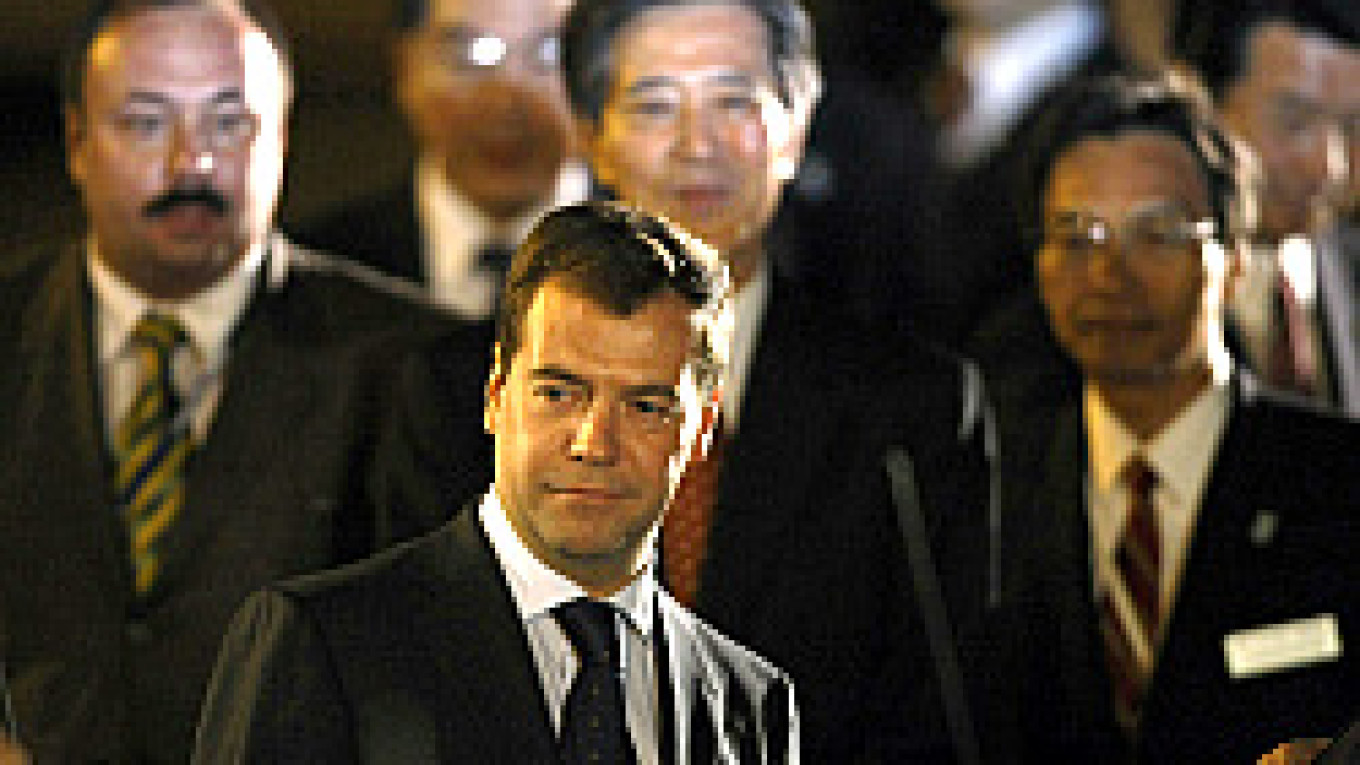
Leaders from the Group of Eight -- Britain, Canada, France, Germany, Italy, Japan, Russia and the United States -- began gathering in the northern Japanese resort village of Toyako on Sunday for three days of meetings among themselves and with heads of African nations and rapidly developing countries such as China.
President Dmitry Medvedev arrived for the summit Sunday and was greeted at the airport by local regional officials and Russia's Ambassador to Japan, Mikhail Bely, Interfax reported.
The G8 summit -- Medvedev's first -- comes at the end of a seven-day foreign trip for the president that has already included stops in Azerbaijan, Turkmenistan and Kazakhstan.
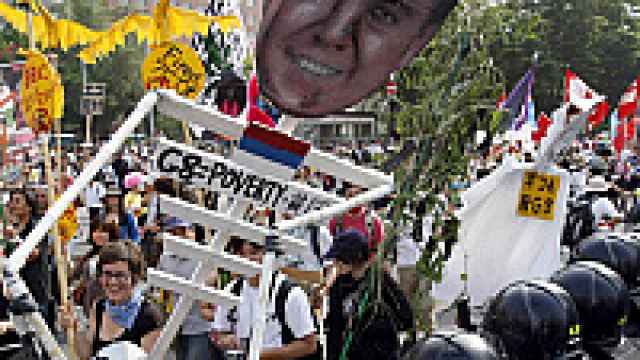 Issei kato / Reuters Police blocking protesters Saturday. |  |
| |
The summit also coincides with demanding foreign policy issues, such as the effort to strip North Korea of its nuclear weapons, mounting international pressure on Iran to stop its uranium enrichment program, and the threat of UN Security Council sanctions on Zimbabwe over its recent one-sided presidential election runoff.
| ||||||
Despite the demanding agenda, concerns were high that the political uncertainties in some member countries -- particularly the United States, where President George W. Bush is 200 days away from the end of his term -- could prevent decisive action. The leaders of France, Japan and Britain also face domestic problems.
Bush on Sunday urged his fellow leaders to push forward stalled talks on world trade in the so-called Doha Round and to pour more aid into Africa, after a bilateral meeting with Japanese Prime Minister Yasuo Fukuda.
"It's an opportunity for us, Mr. Prime Minister, to promote free and fair trade, and it's going to be an essential part of the development agenda," Bush said. "The truth of the matter is we can give grants, but the best way to help the impoverished around the world is through trade, it's a proven fact."
Climate change was a top agenda item for the summit. UN-led talks aimed at forging a new global warming accord by the end of 2009 have stalled because of deep disagreements over what targets to set for greenhouse gas reductions and how much developing countries such as China and India should be required to participate.
As of Sunday, it was still unclear whether nations would be able to agree to a goal of cutting their emissions by 50 percent by 2050. A more ambitious goal of setting nearer-term targets for 2020 was considered well beyond reach.
"I don't think they're going to do much. They're going to kick the can down the road," said Alden Meyer, a climate change expert with the Union of Concerned Scientists, suggesting real progress would have to wait for a new U.S. president in January.
With global oil prices surging, the G8 leaders are expected to urge major oil producers to increase supplies, while also calling for steps to improve energy efficiency and develop alternative sources of energy within their own economies. Oil spiked to a record $145.85 a barrel last Thursday.
It was unclear how effective a call by the G8 to boost oil production would be when the group does not include Saudi Arabia, the world's largest exporter of crude, or any OPEC members.
The summit also is to extend the G8's emphasis on Africa. Eight African leaders headed to Japan, and the summit faced rising expectations that it would address key problems, such as food supplies, infectious diseases and economic development.
In a measure of expectations on the group, Pope Benedict XVI on Sunday urged the G8 to help the world's poor.
"Many voices have been raised asking [G8 leaders] to realize the commitments made at previous G8 appointments and to courageously adopt all necessary measures to conquer the plagues of extreme poverty, hunger, disease, illiteracy," Benedict said while addressing pilgrims at the papal summer residence in the hill town of Castel Gandolfo, near Rome.
Politics were also getting attention.
German Chancellor Angela Merkel, scheduled to arrive in Japan on Monday, said the G8 leaders would discuss how they could toughen sanctions on Zimbabwe after President Robert Mugabe's widely denounced presidential election victory.
"I hope that we will also get support from our African colleagues here," Merkel said in her weekly video message.
The European Union already has travel bans and an asset freeze in place on Mugabe and other senior Zimbabwean officials. The United States is also seeking international sanctions against Mugabe and his top aides.
AP, MT
A Message from The Moscow Times:
Dear readers,
We are facing unprecedented challenges. Russia's Prosecutor General's Office has designated The Moscow Times as an "undesirable" organization, criminalizing our work and putting our staff at risk of prosecution. This follows our earlier unjust labeling as a "foreign agent."
These actions are direct attempts to silence independent journalism in Russia. The authorities claim our work "discredits the decisions of the Russian leadership." We see things differently: we strive to provide accurate, unbiased reporting on Russia.
We, the journalists of The Moscow Times, refuse to be silenced. But to continue our work, we need your help.
Your support, no matter how small, makes a world of difference. If you can, please support us monthly starting from just $2. It's quick to set up, and every contribution makes a significant impact.
By supporting The Moscow Times, you're defending open, independent journalism in the face of repression. Thank you for standing with us.

Remind me later.