

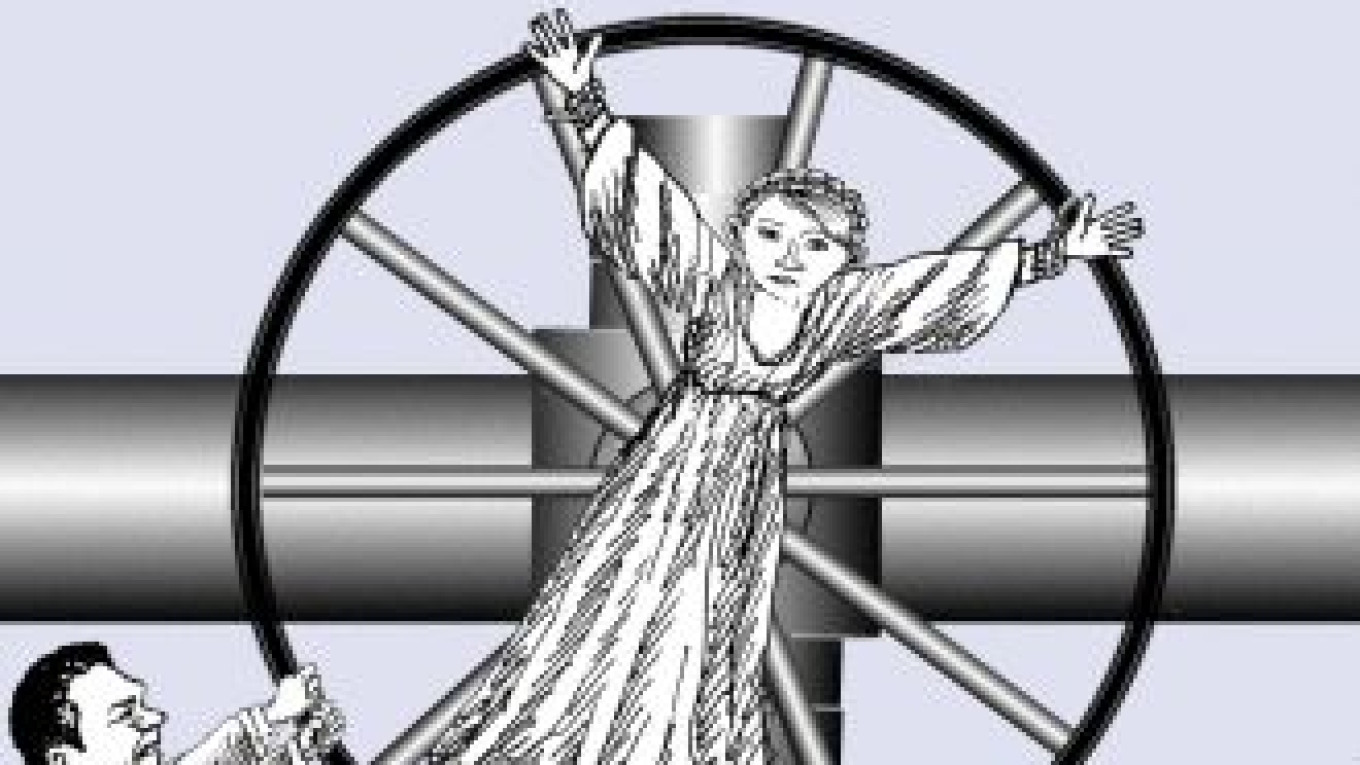
The trial of former Ukrainian Prime Minister Yulia Tymoshenko is approaching its final stages in Kiev. Amazingly, just 18 months ago, Tymoshenko was only a few percentage points away from winning the presidential election, and today the leader of Ukraine’s largest opposition party, Fatherland, is sitting behind bars in pretrial detention.
According to the prosecution, Tymoshenko unlawfully signed a secret gas import contract with Russia in 2009, when she was prime minister, forcing state-owned Naftogaz to sign the gas deal with Gazprom. Prosecutors claim she agreed to the 10-year contract to buy natural gas from Russia at exceedingly high prices without getting approval from the government. Gas prices could reach an incredible price of $500 per thousand cubic meters by the end of this year — a boon for Gazprom but crippling for Ukraine’s teetering economy. In addition, Tymoshenko is charged with illegally using carbon credit funds that were meant to be used for pensions.
Yet many Western commentators have a superficial and naive understanding of the Tymoshenko case. They believe that she is being punished for her political views. I can’t help but smile when I hear these comments. After all, what exactly are her political views? Nobody knows. They are a hodge podge of nationalistic, left-wing, right-wing, liberal and, at times, even Communist rhetoric.
A typical example was during the last presidential election campaign when Tymoshenko dodged a question that was particularly controversial for the highly splintered Ukrainian electorate: Does she consider Stepan Bandera, leader of the armed Ukrainian nationalist movement from the 1930s through the 1950s, a hero? Tymoshenko could not answer yes or no because, for some of her supporters in the western part of the country, Bandera is an icon, a person who fought his whole life for an independent Ukraine and who was ultimately killed by a KGB assassin who had infiltrated his organization. Meanwhile, other Ukrainians, particularly in eastern Ukraine, view Bandera as a terrorist who collaborated with the Nazis and was complicit in war crimes.
Today, Tymoshenko condemns President Viktor Yanukovych and calls the current government criminal. But many remember very clearly that as recently as summer 2009, Tymoshenko negotiated with Yanukovych to form a political alliance. Had those talks succeeded, it is entirely possible that Tymoshenko could have become prime minister under Yanukovych’s current administration. Or Yanukovych could have become prime minister and Tymoshenko president. Both options were considered and discussed in 2009. Thus, many Ukrainians don’t buy Tymoshenko’s claim that she is an ideological opponent of Yanukovych.
But this does not explain why the government seems to be determined to put her behind bars. It might seem that the authorities simply want to silence the leader of the opposition. If convicted of current charges, Tymoshenko could face up to 10 years in prison. Even a suspended sentence would disqualify her from running for parliamentary or presidential elections.
Nonetheless, polls show that if Tymoshenko were to run against Yanukovych in another presidential race, he would likely win because voters view Yanukovych as the lesser of two evils. If a more popular and less-tainted candidate were to run against Yanukovych, however, it would be much more difficult for him to win. Thus, if the goal of the current Tymoshenko trial is to eliminate a competitor, then either somebody is feeding Yanukovych bad advice or else he is unwittingly putting himself into a trap.
At the same time, however, elections are still a long way off, and Ukraine’s economy is already collapsing under the weight of low growth and high gas prices. Something must be done urgently, but Moscow’s only response has been to propose to Kiev that it join a customs union with Russia; let Russia buy up shares in Ukraine’s gas transportation companies, much like Belarus did; and Russia would receive large discounts on gas in return, just as Belarus did. Ironically, President Dmitry Medvedev made this proposal on Aug. 24, the day Ukraine celebrated 20 years of independence from Russia.
It is clear, though, that Ukraine will never enter into a customs union with Russia. That would kill Ukraine’s plans for membership in the World Trade Organization and for signing a free-trade zone agreement with the European Union. It would also eliminate any Ukrainian hopes of ever becoming an EU member state.
Meanwhile, tensions between Russia and Ukraine are getting worse. Ukrainian Prime Minister Nikolai Azarov and presidential administration head Sergei Levochkin announced that Kiev might appeal to an international arbitration court to cancel its current gas agreements with Moscow. ?
This offers another explanation as to why Tymoshenko is on trial. If Kiev can prove in an independent court that Tymoshenko violated the law in signing the gas agreement with Russia, it will reinforce Ukraine’s case to revoke the deal.
Moscow is clearly nervous about the trial. Senior Russian officials have repeatedly made statements defending Tymoshenko and condemning the case against her. This is hypocritical, of course, considering that former Yukos CEO Mikhail Khodorkovsky has been locked up for eight years on politically driven charges.
In the end, Yanukovych may have backed himself into a corner. In part, the Tymoshenko case is being used to defeat Russia’s attempts to use one-sided gas contracts, a customs union and other tricks to keep Kiev within the Kremlin’s sphere of influence. But? this could very well provoke strong protests from European leaders if, in the event of a ruling against Tymoshenko, they conclude that Yanukovych violated Western democratic values and that the ruling was politically driven. This could ultimately undermine his efforts to integrate more closely with the EU.
If so, Yanukovych will receive exactly what he was trying to avoid in the first place. If he is unable to retain the EU as a strategic ally, Ukraine will be forced back into a subservient role with regard to Moscow.
Yevgeny Kiselyov is a political analyst and hosts a political talk show on Inter television in Ukraine.
A Message from The Moscow Times:
Dear readers,
We are facing unprecedented challenges. Russia's Prosecutor General's Office has designated The Moscow Times as an "undesirable" organization, criminalizing our work and putting our staff at risk of prosecution. This follows our earlier unjust labeling as a "foreign agent."
These actions are direct attempts to silence independent journalism in Russia. The authorities claim our work "discredits the decisions of the Russian leadership." We see things differently: we strive to provide accurate, unbiased reporting on Russia.
We, the journalists of The Moscow Times, refuse to be silenced. But to continue our work, we need your help.
Your support, no matter how small, makes a world of difference. If you can, please support us monthly starting from just $2. It's quick to set up, and every contribution makes a significant impact.
By supporting The Moscow Times, you're defending open, independent journalism in the face of repression. Thank you for standing with us.

Remind me later.