

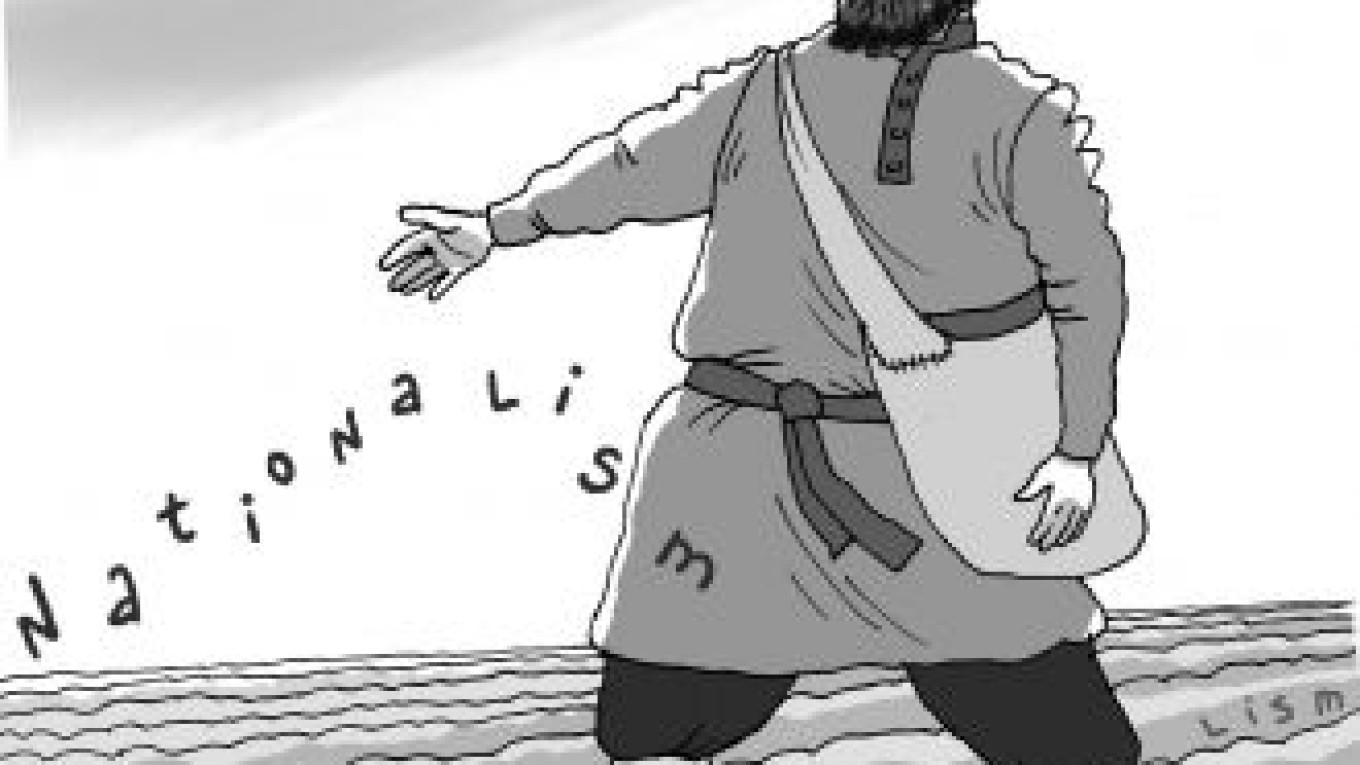
The recent ultranationalist rampage in downtown Moscow was made possible by ineffective law enforcement and ethnic policies that could prove devastating for the multiethnic Russian state.
Organizers tried to justify the Manezh Square rally as a protest against an improper investigation into the killing of Yegor Sviridov, an ethnic Russian and a football fan, shot dead in a street fight with natives from the North Caucasus. But protesters quickly shifted the focus of the protest, giving “Sieg Heil!” salutes and chanting the xenophobic slogans, “Russia for Russians,” “Moscow for Muscovites” and “Kill, kill!”
In his response to the rioting, President Dmitry Medvedev called for the prosecution of those behind what he defined as “pogroms.” Opposition leader Boris Nemtsov warned that such actions might eventually lead to the disintegration of Russia, while conspiracy theorists speculated whether the rampage had been orchestrated to prove that Russia again needs a strong hand — and, consequently, pave the way for the return of Prime Minister Vladimir Putin to the Kremlin as president.
The show of force by ultranationalists across Russia should serve as a wake-up call for the authorities. While they took some steps over the past few years to dismantle violent ultranationalist groups, more needs to be done — and soon. State statistics report that the number of officially registered hate murders has increased nearly fourfold: from 152 in 2005 to 548 in 2009. Moreover, ultranationalists have become increasingly lethal, moving from knives and metal bars as their favorite weapons to guns, explosives and even mercury. Members of these groups have begun to target not only those they take to be “non-Slavs,” but also Russian officials whom they view as part of an “occupational regime” imposed by “enemies of the state.”
Combating the violent ultranationalists is no easy task. Their networks are decentralized and increasingly rely on the Internet for dissemination of propaganda, recruitment and coordination of activities. They are also winning the battle for the hearts and minds of many ethnic Russians. Nationwide polls reveal that a formidable part of the population supports the idea of a “Russia for Russians.” In a nationwide poll by the Levada Center in November 2009, 56 percent of those surveyed both supported this idea and said they believed it should be implemented. This slogan was chanted repeatedly at follow-up rallies held in Moscow and several other cities a week after the Manezh rioting. ?
As a minimum, local and federal authorities need to ensure legitimate and timely investigations into violent crimes if for no other reason than to avoid public outrage and more violent protests. Proper and transparent investigations are all the more important when allegations of racial hatred or police corruption are alleged as is the case of the killing of Sviridov, whose friends claim that some of the suspects bribed their way out of detention.
The government must design and implement a comprehensive and sensible ethnic policy that promotes tolerance among indigenous populations and encourages and helps both migrants and immigrants to integrate and adapt to their new urban environment. ?
Given Russia’s multiethnic and multiconfessional composition, a tolerant nationalities policy is key to insuring that Russia does not disintegrate and collapse like the Soviet Union did.
Simon Saradzhyan is a research fellow and Monica Duffy Toft is an associate professor of public policy at Harvard University’s John F. Kennedy School of Government.
A Message from The Moscow Times:
Dear readers,
We are facing unprecedented challenges. Russia's Prosecutor General's Office has designated The Moscow Times as an "undesirable" organization, criminalizing our work and putting our staff at risk of prosecution. This follows our earlier unjust labeling as a "foreign agent."
These actions are direct attempts to silence independent journalism in Russia. The authorities claim our work "discredits the decisions of the Russian leadership." We see things differently: we strive to provide accurate, unbiased reporting on Russia.
We, the journalists of The Moscow Times, refuse to be silenced. But to continue our work, we need your help.
Your support, no matter how small, makes a world of difference. If you can, please support us monthly starting from just $2. It's quick to set up, and every contribution makes a significant impact.
By supporting The Moscow Times, you're defending open, independent journalism in the face of repression. Thank you for standing with us.

Remind me later.