

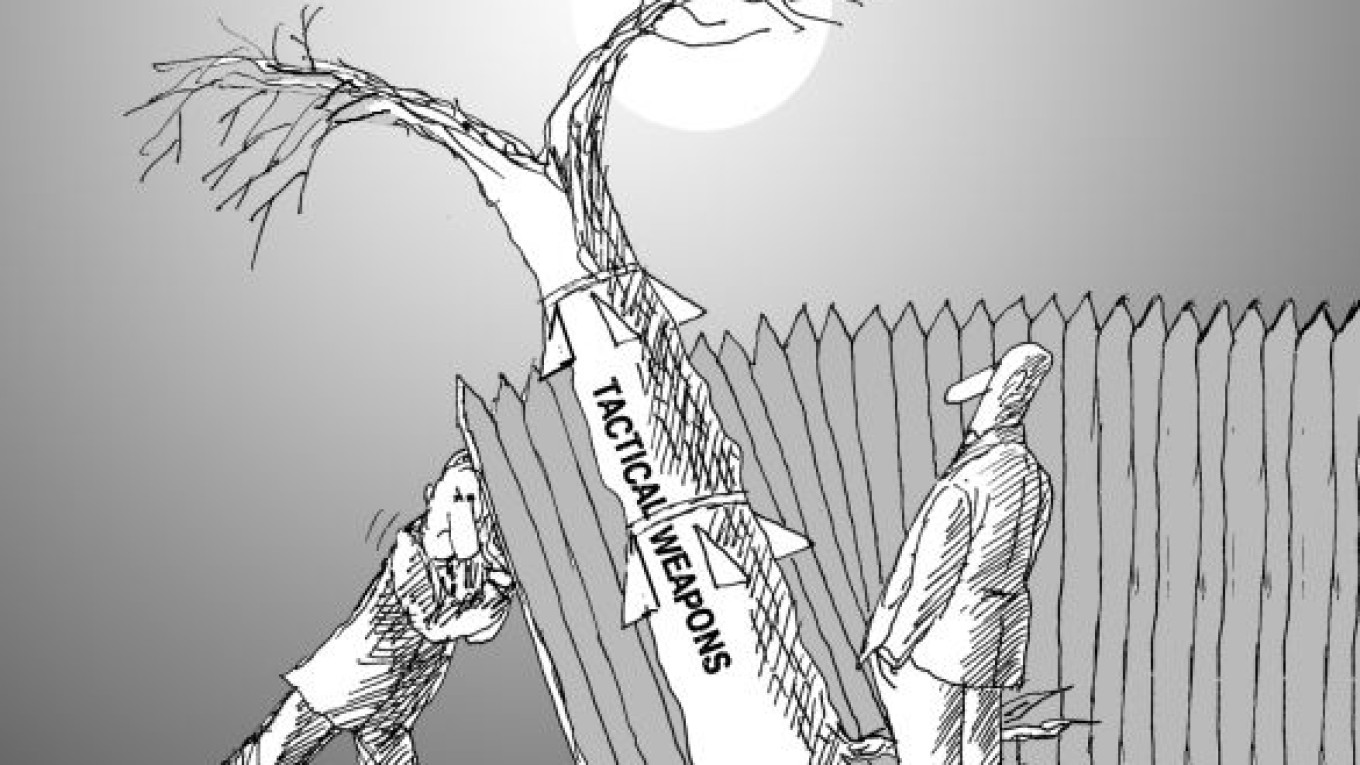
The first suggestion made by Swedish Foreign Minister Carl Bildt and Polish Foreign Minister Radek Sikorski for both Moscow and Washington to reduce and subsequently eliminate tactical nuclear weapons based in Europe was well-grounded.
Their second suggestion was exclusively addressed to Moscow. The authors called on Russia to withdraw its nuclear warheads from areas adjacent to European Union member states — particularly in the Kaliningrad region and on the Kola Peninsula. But there are no nuclear warheads in Kaliningrad; they were all destroyed under the provisions of the Intermediate-Range Nuclear Forces Treaty, or INF, signed between the United States and the Soviet Union in 1987.
The INF and Strategic Arms Reduction Treaty and its follow-up are all very important contributions toward nuclear arms reduction and, hopefully, a nuclear-free world, as the Nuclear Non-Proliferation Treaty envisions. But there is one large gap that remains in the nuclear disarmament structure: There is no treaty that limits tactical weapons.
After the follow-up agreement to the START is signed, Moscow and Washington should make a firm commitment to begin “TART” negotiations on reducing tactical nuclear weapons in Europe.
Any tactical arms reduction treaty needs to address geographical equilibrium in tactical weapons. While Russia has transferred all tactical weapons to its territory from former Soviet republics, the United States is still holding them in five European nations and Turkey, which is in violation of Articles I and II of the Nuclear Non-Proliferation Treaty that prohibits storing nuclear weapons in non-nuclear states. Thus, the United States has to remove all tactical weapons from Europe before any negotiations begin on reducing tactical nuclear arms.
The authors’ second suggestion — to make unilateral “nuclear-free zones” by Russia along the EU borders — is flawed. Russia has the right to deploy on its own territory all kinds of forces needed to protect its population and infrastructure. Russia cannot close its nuclear naval bases built on the Kola Peninsula, just like the United States cannot close its nuclear naval base in San Diego.
Russia insists that there is a direct link between missile defense and strategic offensive weapons, and this link must be included in the START follow-up agreement. This is particularly important considering that Poland will soon deploy U.S. Patriot missiles on its soil. The United States would also like to place sea- and land-based SM-3 interceptors in the Black Sea and surrounding areas.
Russia, which does not have any missile defense installations in foreign countries, has solid grounds to protest U.S. missile defense facilities that are placed near Russia’s borders. Washington claims that these installations are needed to contain Iranian or North Korean missile threats, but even if there were a threat from these countries, that would not justify placing interceptors and radar facilities within 100 kilometers of Russia’s border.
No U.S. missile defense systems should be placed in Europe. If they are, Russia will have to return to President Dmitry Medvedev’s response, which he articulated on Nov. 5, 2008, in his first state-of-the-nation address: to deploy Iskander conventional and nuclear-tipped missiles in Kaliningrad. Other measures will be needed as well because the “revised” U.S. missile defense program in Europe will be even more formidable and dangerous to Russia than the system that was intended for Poland and the Czech Republic that U.S. President Barack Obama cancelled.
Russia has always insisted on a direct link between strategic offensive arms and strategic defensive arms, and this link should be clearly reflected in the follow-up agreement to START.
Vladimir Kozin is head of the analytical section of the Asia-Pacific department at the Foreign Ministry. The views expressed in this comment are his own.
A Message from The Moscow Times:
Dear readers,
We are facing unprecedented challenges. Russia's Prosecutor General's Office has designated The Moscow Times as an "undesirable" organization, criminalizing our work and putting our staff at risk of prosecution. This follows our earlier unjust labeling as a "foreign agent."
These actions are direct attempts to silence independent journalism in Russia. The authorities claim our work "discredits the decisions of the Russian leadership." We see things differently: we strive to provide accurate, unbiased reporting on Russia.
We, the journalists of The Moscow Times, refuse to be silenced. But to continue our work, we need your help.
Your support, no matter how small, makes a world of difference. If you can, please support us monthly starting from just $2. It's quick to set up, and every contribution makes a significant impact.
By supporting The Moscow Times, you're defending open, independent journalism in the face of repression. Thank you for standing with us.

Remind me later.