

 | To Our Readers |
The Moscow Times welcomes letters to the editor. Letters for publication should be signed and bear the signatory's address and telephone number. |
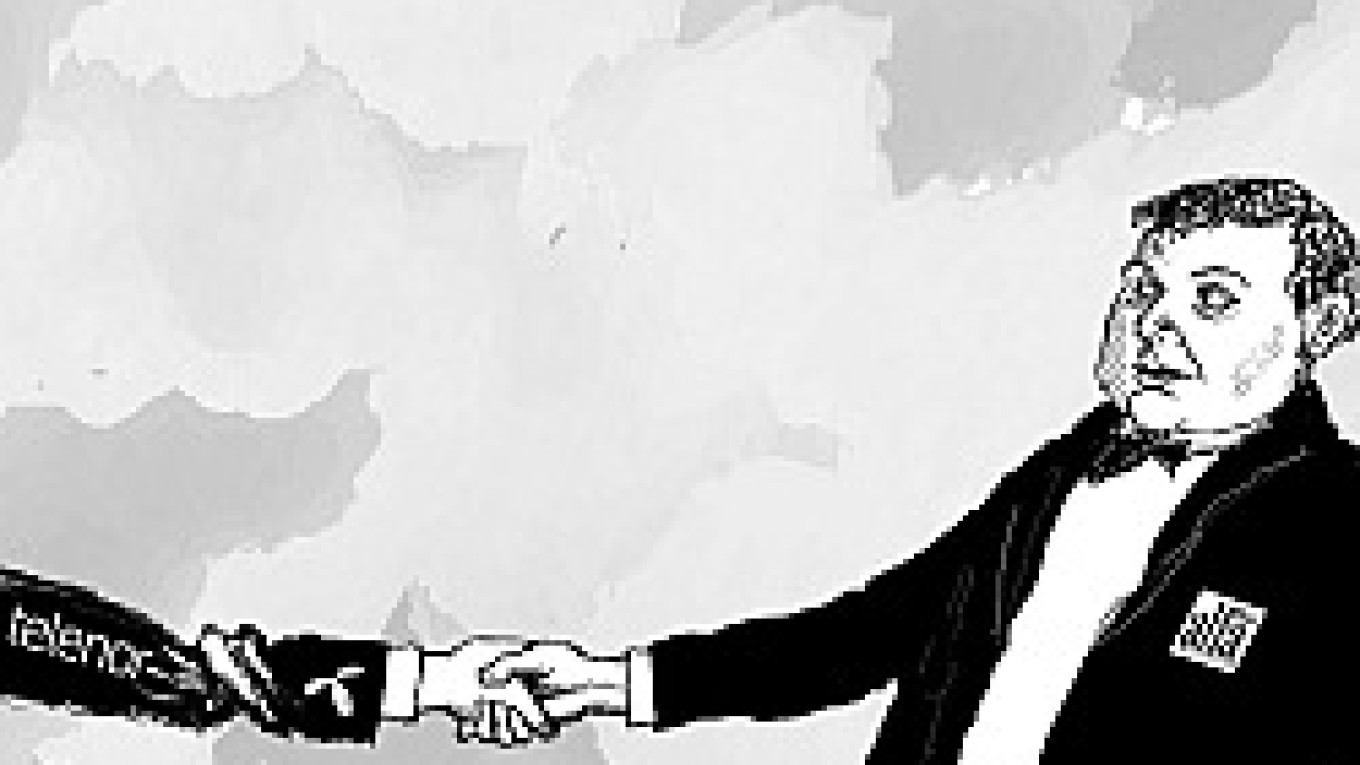
Telenor, the Norwegian telecoms giant, is caught in a dispute with Alfa Group, one of Russia's largest holdings, over the highly lucrative mobile telephone business in Russia and Ukraine. The Norwegian state is a majority shareholder of Telenor, and Alfa is owned by Mikhail Fridman, an oligarch estimated by Forbes in 2008 to be among the 20 richest people in the world. He also has close ties to the Kremlin.
The background to this revealing story of how the power elite do business is as follows: VimpelCom, Russia's second-largest mobile phone operator, is 44 percent owned by Alfa, and 29.9 percent of the voting stock -- 33.6 percent of actual shares -- is owned by Telenor. In Kyivstar, Ukraine's No. 1 mobile phone operator, the situation is somewhat reversed: Telenor owns 56.5 percent, and Alfa has 43.5 percent.
In 2004, VimpelCom, keen to expand into the Ukrainian market, proposed the take over of a small company called Ukrainian Radio Systems, or URS. The deal was opposed by Telenor, which fended off the move for a year, but the purchase was approved by shareholders in 2005. The purchase price totaled $231 million after URS was unsuccessfully offered to another bidder for $100 million.
At the heart of the deal was a shareholders' agreement between Telenor and Alfa that any arbitration would take place in Geneva. However, a microscopic shareholder in VimpelCom, Farimex, took Telenor to court in Siberia for loss of profits in the Ukrainian market. Farimex owns 0.002 percent of VimpelCom's shares and is registered in the British Virgin Islands. The owner apparently was a businessman named Dmitry Fridman, and Alfa insisted that there was no connection to Mikhail Fridman.
Farimex said Telenor stalled VimpelCom's penetration into the Ukrainian market and thus damaged growth prospects, claiming an absurd $1.7 billion for the one-year delay. Still, Farimex won its case in Omsk last year. Telenor refused to put up the money and saw its stock in VimpelCom frozen by the court. An appeal scheduled for June 10 was delayed until Sept. 30 for "technical reasons."
This outcome is Telenor's worst nightmare. It had hoped for a decision, any decision, and to bring the case to the Supreme Court in Moscow. Under Russian law, the court can take ownership of confiscated property after a second trial -- even if there is an appeal pending to the Supreme Court. So, Telenor's shares in VimpelCom can now be sold on the open market before September and before any consideration by the Supreme Court. In that case, it is game over. Court marshals said on June 19 that they had approved an order to auction off Telenor's shares and that the parties were in the process of being notified.
It is true that Russian oligarchs have been very badly hit by the financial crisis and the crash of the Russian stock exchange. Last year, Mikhail Fridman was to repay a $2 billion loan to Deutsche Bank but was unable to do so. Rather than pay with his VimpelCom shares by passing them onto German interests, he was bailed out by state-controlled Vneshekonombank, which took the stock as collateral. If Fridman cannot pay back this fall, Vneshekonombank -- that is, the Russian government -- will become the owner of his VimpelCom stock. If Telenor's shares are sold on the market in the meantime, one will have to wonder who is really pulling the strings.
It is particularly noteworthy that Communications Minister Igor Shchegolev last Tuesday announced the government's plans to restructure national telecommunications holding Svyazinvest. This company holds a dominant position in the fixed-line market and now plans to attain a similar position in the more significant mobile sector. It would be very attractive for the company to build a foundation with one of the three existing operators: VimpelCom, Mobile TeleSystems or MegaFon.
Telenor's legal troubles echo the Yukos case and has become a test of President Dmitry Medevedev's commitment to the rule of law and an independent judiciary. A negative outcome for Telenor might seriously undermine the credibility of the Russian market for foreign investors. It is also noteworthy that Mikhail Fridman was instrumental in the group that drove British oil giant BP to defeat last year in its power struggle at TNK-BP. A lawsuit in that battle also landed in a court in Siberia, a region where courts always seem to make ruling that are favorable to Fridman. The court sided with a small TNK-BP shareholder --? and by extension Fridman -- who complained that fees TNK-BP had paid to use BP specialist "secondees" amounted to an illegal dividend for BP.
For Norway, the VimpelCom affair could have an impact beyond Telenor. The Norwegian government needs to rethink the implications of Statoil, the Norwegian oil conglomerate, as a junior partner in the Shtokman petroleum field in the Barents Sea, where Gazprom is very much in the driving seat.
One more thing. The chairman of the supervisory board of Vneshekonombank is none other than Prime Minister Vladimir Putin, and his board includes First Deputy Prime Minister Viktor Zubkov, Deputy Prime Minister Sergei Ivanov and Finance Minister Alexei Kudrin.
Ivar Amundsen is a Norwegian public figure, human rights activist and director of the Chechnya Peace Forum.
A Message from The Moscow Times:
Dear readers,
We are facing unprecedented challenges. Russia's Prosecutor General's Office has designated The Moscow Times as an "undesirable" organization, criminalizing our work and putting our staff at risk of prosecution. This follows our earlier unjust labeling as a "foreign agent."
These actions are direct attempts to silence independent journalism in Russia. The authorities claim our work "discredits the decisions of the Russian leadership." We see things differently: we strive to provide accurate, unbiased reporting on Russia.
We, the journalists of The Moscow Times, refuse to be silenced. But to continue our work, we need your help.
Your support, no matter how small, makes a world of difference. If you can, please support us monthly starting from just $2. It's quick to set up, and every contribution makes a significant impact.
By supporting The Moscow Times, you're defending open, independent journalism in the face of repression. Thank you for standing with us.

Remind me later.