

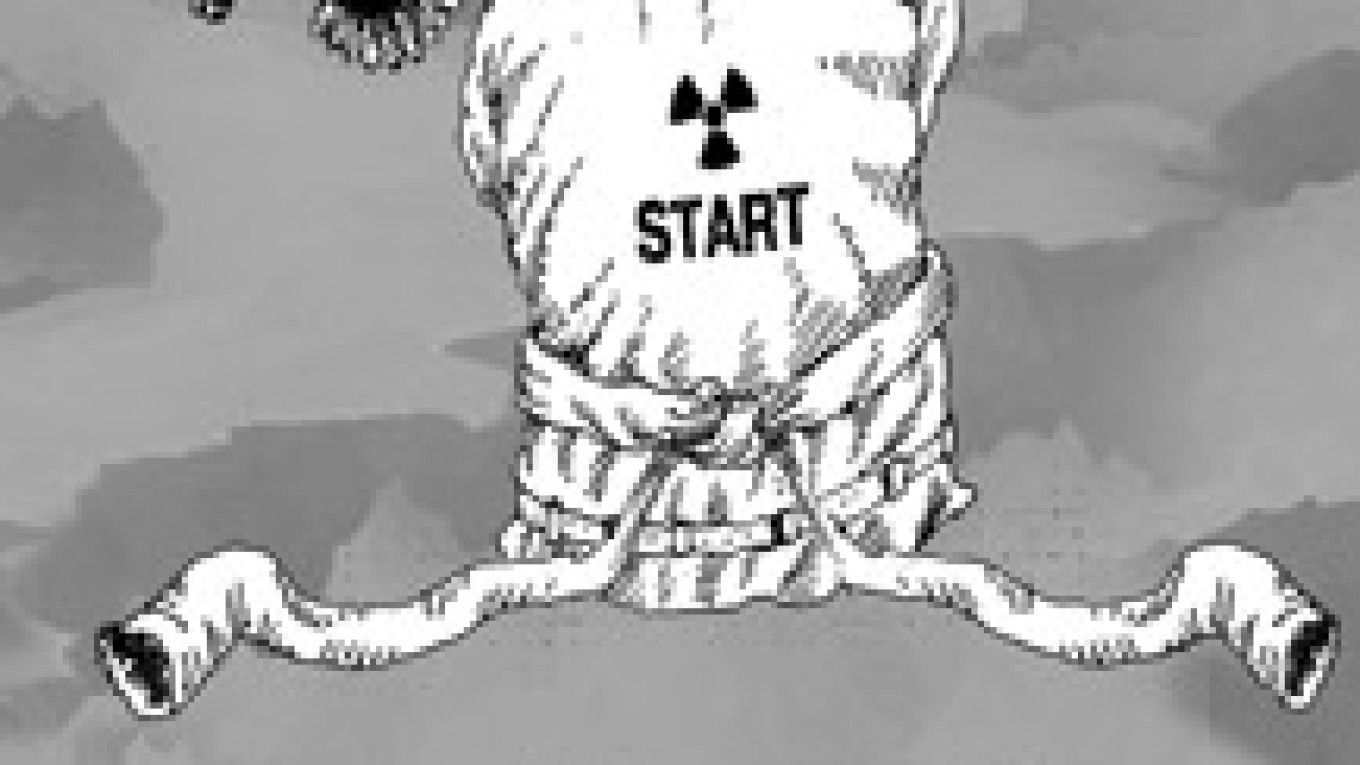
Wishing to indulge its tough negotiating partner, Washington picked a heavily militarized agenda for the Moscow summit — nuclear arms reduction, missile defense and control over nuclear materials. These are areas in which Russia believes it can negotiate with the United States on equal grounds — that is, as equal superpowers.
Since military issues were the cornerstone of the summit talks, the exact relationship between the two sides should have been determined. If Russia and the United States are indeed adversaries, the goal of the negotiations should have been to agree upon measures to avoid a military conflict between the two nuclear powers. If they are partners, then the talks should have focused on combating a common threat.
 | |
|
To Our Readers | |
|
The Moscow Times welcomes letters to the editor. Letters for publication should be signed and bear the signatory's address and telephone number.
| |
| | |
These U.S.-Russian talks attempted to combine two inherently contradictory approaches. Both sides stated beforehand that the most important goal of U.S.-Russian relations is the signing of a new agreement for the reduction of strategic nuclear weapons. But there is no escaping the fact that such treaties are based on the doctrine of mutually assured destruction. But Washington and Moscow both understand that they would never engage in a nuclear war against each other.
Both sides agreed to make reductions to the level of 500 to 1,100 delivery vehicles and from 1,500 to 1,675 warheads within seven years of the treaty coming into force. The 2002 Moscow Treaty — considered an add-on to the 1991 START I — requires a reduction of warheads to 1,700 by 2012. To cut a further 25 warheads within seven years will not require a gargantuan effort.
The situation is even more ludicrous on delivery vehicles. Russia currently has 634 functional delivery vehicles compared to the approximately 1,000 in the United States. Apparently, the two sides were unable to agree on concrete reductions, and that is why they announced an agreement that contains such a broad range between the upper limit (1,100 delivery vehicles) and the lower limit (500 delivery vehicles). This essentially means that the United States will maintain the higher limit — 1,000 delivery vehicles — while Russia will hover around the lower limit — 500 because it simply doesn’t have the resources to go much higher. The fact that Russia agreed to this is amazing. During the Soviet period, Moscow’s negotiators would have been fired on the spot for even proposing these terms.
In the treaty to replace START, Washington would like to count only warheads that are already mounted on missiles; warheads stored in warehouses would not be counted. Since Russia has far fewer stored warheads, this puts the Kremlin at a significant disadvantage if the United States doesn’t have to include its stored warheads in the arms-reduction provisions under the new treaty.
The second problem is the terms for counting delivery vehicles. Because the number of nuclear warheads will decrease, the United States would like to keep its delivery vehicles formerly equipped with nuclear weapons and refit them with non-nuclear weapons.
Finally, nothing was achieved on the largest stumbling block — the link between nuclear arms reductions and U.S. plans to deploy a global missile defense system. Obama and Medvedev agreed only to instruct “our specialists to conduct a joint analysis of ballistic missile challenges of the 21st century and prepare the corresponding recommendations, keeping in mind the priority of using political-diplomatic methods.”
But since the current talks are nothing more than an imitation — if not an outright parody —of serious negotiations, all these points were presented in Monday’s news conference as a major achievement.
Russia’s security relationship with the United States continues to show signs of chronic multiple personality disorder. The latest example was when Medvedev gave Obama a photo album dedicated to the two countries’ cooperation on nuclear security. I suspect that this “gift” was part of a report on how Russia has spent the hundreds of millions of U.S. tax dollars on the Nunn-Lugar program, which is dedicated to help Russia maintain the safety of its nuclear arsenal. This is quite a paradox: Russia’s so-called “adversary” spends huge amounts of money to help it maintain the security of its nuclear arsenal.
The one concrete and significant achievement of the summit was the agreement to allow up to 14 military aircraft a day to fly through Russian airspace en route to Afghanistan. This is another example of Russia’s multiple personalities. Although Moscow presented the deal as a concession on its part, it is clear that U.S.-led coalition forces are helping to secure Russia’s borders by fighting the Taliban in Afghanistan. But how can this level of cooperation be justified if the United States is Russia’s adversary? After all, Russia will perform no more than spot inspections of U.S. aircraft headed for Afghanistan via Russian airspace. What if one of the U.S. airplanes is fitted with nuclear weapons?
Of course, the very idea sounds ridiculous now, but in 1992, when the U.S. Air Force airlifted humanitarian aid into Russia when the country was suffering serious shortages, Russia’s hardened patriots claimed that the Pentagon was exploiting this opportunity to collect intelligence about the condition of Russia’s landing strips.
Eighteen years after the end of the Cold War, it is about time for the Kremlin to end the farce of its fabricated standoff against the United States.
Alexander Golts is deputy editor of the online newspaper Yezhednevny Zhurnal.
A Message from The Moscow Times:
Dear readers,
We are facing unprecedented challenges. Russia's Prosecutor General's Office has designated The Moscow Times as an "undesirable" organization, criminalizing our work and putting our staff at risk of prosecution. This follows our earlier unjust labeling as a "foreign agent."
These actions are direct attempts to silence independent journalism in Russia. The authorities claim our work "discredits the decisions of the Russian leadership." We see things differently: we strive to provide accurate, unbiased reporting on Russia.
We, the journalists of The Moscow Times, refuse to be silenced. But to continue our work, we need your help.
Your support, no matter how small, makes a world of difference. If you can, please support us monthly starting from just $2. It's quick to set up, and every contribution makes a significant impact.
By supporting The Moscow Times, you're defending open, independent journalism in the face of repression. Thank you for standing with us.

Remind me later.