

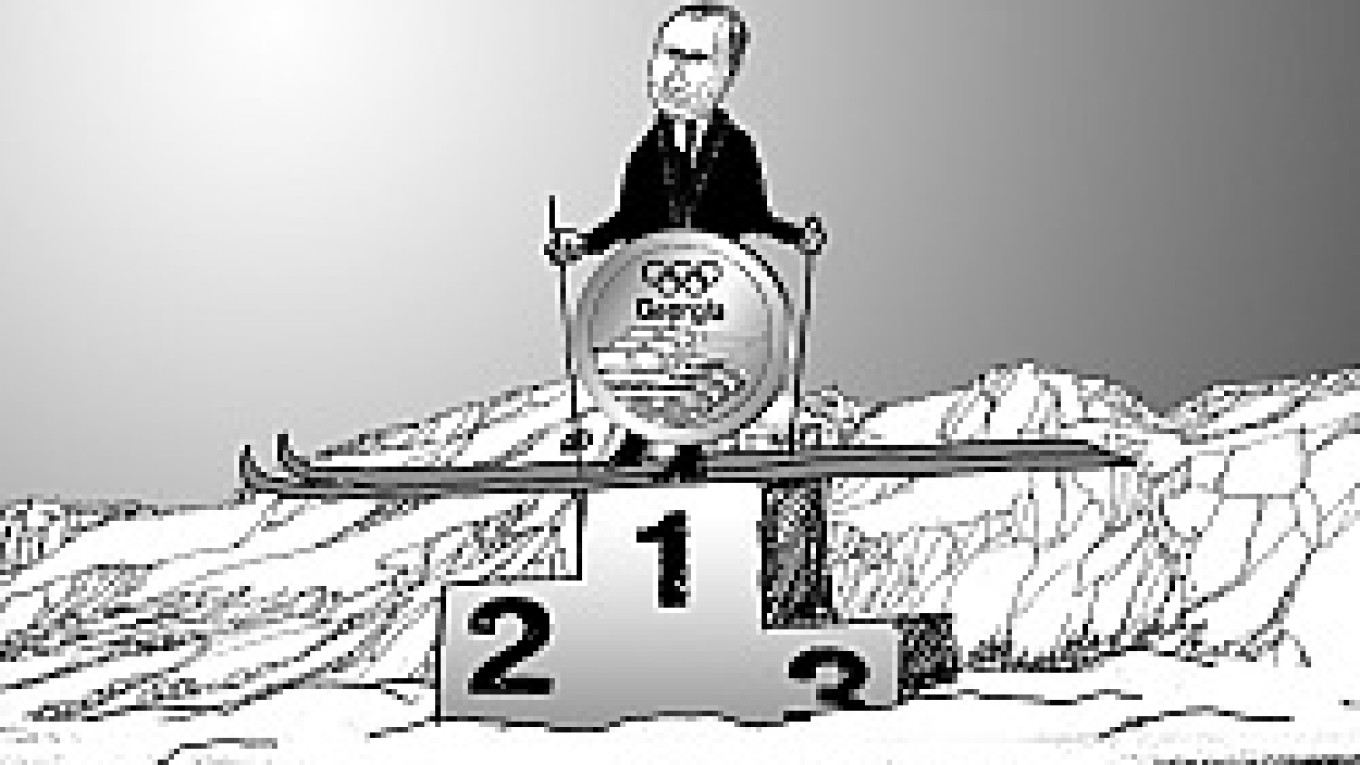
Prime Minister Vladimir Putin remains unambiguously in charge in Moscow. He may play a "good cop-bad cop" routine with President Dmitry Medvedev. But the bad cop, Putin, is the real boss.
Putin cannot stand Georgian President Mikheil Saakashvili, who admittedly is not an easy man to like. Putin thought Saakashvili had become too big for his boots. He waited for Saakashvili to go a step too far, and then came down on him and his poor country like a ton of bricks.
Russia has been stirring up trouble in South Ossetia and Abkhazia for years. Moscow wants to keep Georgia weak. It plays the same game when it supports the pro-Russia separatist region Transdnestr to undermine Moldova. If an outsider had tried similar tactics in Chechnya, the Russians would rightly have howled with rage.
Russia's leaders, like 19th-century tsars, want a sphere of influence around their borders. So far as they are concerned, the countries that were once part of the Russian empire in the Soviet Union should enjoy only limited sovereignty, a message that has been transmitted very clearly to Georgia, Ukraine and the Central Asian republics. Russia has opposed its neighbors joining NATO. What is NATO against, the Russians ask? Where is NATO's front line? Are we Russians really the enemy? If so, how should we react? Russia's actions have had the opposite effect of what was presumably intended. The invasion of Georgia has made a powerful case for further NATO enlargement.
Georgia itself provides an important link to Caspian energy for those Europeans who do not want to be completely dependent on pipelines controlled by Russia. Indeed, Georgia interferes with Russia's policy of using oil and gas as strategic foreign policy weapons, which it has done repeatedly. The Swedish Defense Research Agency has reported that out of 55 deliberate gas supply interruptions, explicit threats, or coercive price actions by Russia since 1991, only 11 had nothing to do with politics.
 | To Our Readers |
The Moscow Times welcomes letters to the editor. Letters for publication should be signed and bear the signatory's address and telephone number. |
The United States' position is further weakened in the absence of a strong and united European response. But you can forget about seeing that.
Russia knows that when it comes to conducting a serious foreign and security policy, Europe is all mouth. The Kremlin has pushed Europe around for years on energy issues, cutting bilateral deals with the bigger countries and opposing efforts to create a common European energy policy.
Europe certainly needs Russian gas. But Russia needs European consumers, and it will seek more European investment in energy exploration and extraction sooner rather than later.
No sensible person in Europe wants to revive the Cold War. But it is not the European Union that is being provocative. It is not Germany, France or Italy that are invading their neighbors.
We Europeans seem to have forgotten our history. There were other times when we have stood by while a militaristic European power insisted that it had the right to intervene wherever it wanted to advance the interests of those who claimed shared ethnicity from the Baltics to the Caucasus.
French President Nicolas Sarkozy claims to have brought peace to Georgia. Yet it looks suspiciously as though the deal that ended the fighting will leave Russian troops in that truncated country for years.
So what, exactly, will Europe do? Perhaps initially, Europeans should be cautious. But I doubt whether anything tougher than strongly worded communiques will ever be employed.
Will we stop talking about our alleged shared values with Russia? Will we press the pause button on further discussion of how to integrate Russia into the international community? Will we cut off some of our contacts with Russia, reconsider its membership of the Group of Eight, or delay its entry to the World Trade Organization and Organization for Economic Cooperation and Development? Will we put to the side for the time being negotiations on a partnership and cooperation agreement between the EU and Russia?
I suspect that the answer to each of these questions is a resounding "no." It will be business pretty much as usual as Europeans prepare cheerfully in the years ahead for the Winter Olympics in Sochi in 2014, just up the road from the Russian missiles and tanks on Georgian soil. Meanwhile, Europeans will continue to talk about their crucial role in world affairs.
It is enough to make even the cynics shake their heads in disbelief. You could not make it up. Europe's approach is weak and will cause bigger problems in the future. So Putin wins the gold medal in his favorite event -- bullying his smaller neighbors.
Chris Patten is a former EU commissioner for external relations, chairman of the British Conservative Party and was the last British governor of Hong Kong. He is currently chancellor of Oxford University and a member of the British House of Lords. ?© Project Syndicate
A Message from The Moscow Times:
Dear readers,
We are facing unprecedented challenges. Russia's Prosecutor General's Office has designated The Moscow Times as an "undesirable" organization, criminalizing our work and putting our staff at risk of prosecution. This follows our earlier unjust labeling as a "foreign agent."
These actions are direct attempts to silence independent journalism in Russia. The authorities claim our work "discredits the decisions of the Russian leadership." We see things differently: we strive to provide accurate, unbiased reporting on Russia.
We, the journalists of The Moscow Times, refuse to be silenced. But to continue our work, we need your help.
Your support, no matter how small, makes a world of difference. If you can, please support us monthly starting from just $2. It's quick to set up, and every contribution makes a significant impact.
By supporting The Moscow Times, you're defending open, independent journalism in the face of repression. Thank you for standing with us.

Remind me later.