

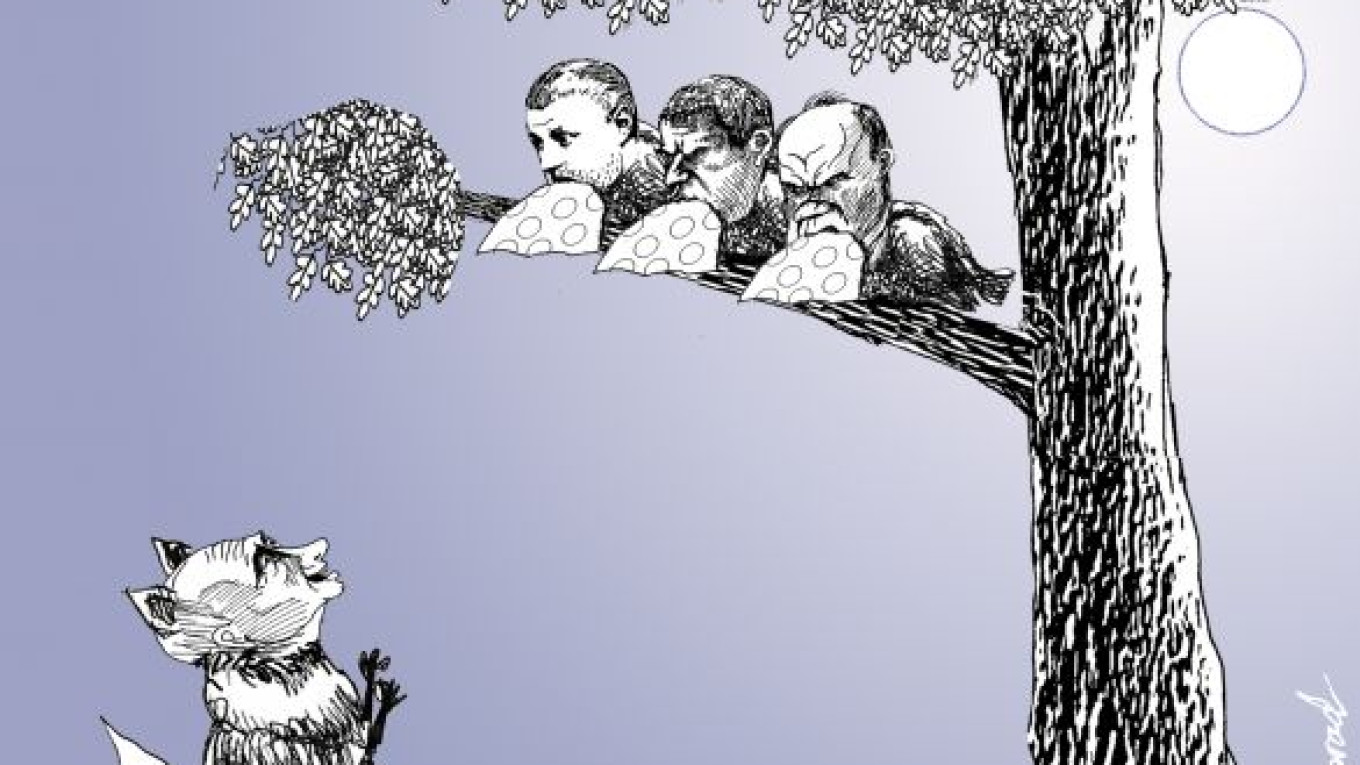
As it is clear to almost everyone, the State Duma elections results were fabricated. The question now is: Will the Kremlin-approved “opposition” parties finally oppose the ruling regime?
Authoritative and independent elections observers, including Alexander Kynev and Dmitry Oreshkin, estimate that United Russia falsely inflated its results by an average of 15 percentage points to 17 percentage points — and in Moscow, by 20 percentage points. That means the party of power actually received about 33 percent to 35 percent of the vote on average and as little as 20 percent to 25 percent in the largest cities.
The 49 percent that United Russia supposedly received will give the “party of crooks and thieves” a majority number of seats in the Duma, and this will enable the party to control all Duma committees and pass all federal laws, including the federal budget and legal codes, without consulting with the other three parties.
The leaders of the other three parties that made it into the Duma? — Gennady Zyuganov of the Communist Party, Sergei Mironov of A Just Russia and Vladimir Zhirinovsky of the Liberal Democratic Party — declared that the elections had been marred by unprecedented fraud and violations, calling them the dirtiest elections in Russian history. But the only thing they demanded was that President Dmitry Medvedev and Central Elections Commission head Vladimir Churov investigate the violations and bring the perpetrators to justice. Those parties are now filing hundreds of complaints and appeals with the courts and elections committees. But this a useless exercise given the country’s weak and pliable court system and the Kremlin’s terrible record on conducting internal investigations.
Yabloko leader Grigory Yavlinsky called on the three minority parties to reject their own mandates to protest the rigged elections. Yavlinsky also called for new parliamentary elections with new rules and regulations to crack down on ballot-stuffing and other methods used to rig the vote. What’s more, Yavlinsky said additional parties, including those denied registration on trumped-up charges, should be allowed to run. Former Soviet leader Mikhail Gorbachev chimed in, arguing that the results of these elections be thrown out and new, free elections be held.
Meanwhile, the Kremlin is actively working on damage control. For example, more than 60,000 police and Interior Ministry troops were deployed to deal with large-scale protest rallies, and more peaceful demonstrators have been detained than at any other time in post-Soviet history. The special services have been intimidating ordinary citizens, and the police have been conducting “anti-
terrorist exercises” in the regions. Denial-of-service attacks against independent Internet sites and social networks continue.
According to media reports, the Kremlin asked its three pocket parties to refrain from participating in demonstrations against election fraud. (The few party members who did appear at some of the protests attended in a private capacity only.) This “opposition on a leash” is more than willing to cooperate with the authorities and, in exchange, has been bargaining hard for additional authority in the Duma. The Communist Party, for example, has its sights on the powerful agriculture committee. Some party leaders are hoping to take away from the deal ministry posts in Medvedev’s so-called “big government” if he, indeed, becomes prime minister.
If the three minority parties were truly oppositional, they would be protesting the widespread election fraud by refusing to take part in the new Duma, starting with the first session on Dec. 21. They would refuse to elect the new Duma speaker and deputy speaker and committee heads, and they would demand that the results be thrown out at thousands of polling places and that a recount be conducted.
In short, if the three parties took these measures, United Russia’s simple majority would, by default, become a simple minority in just two or three weeks.
After that, they could elect their own Duma speaker and committee heads without interference. But more important, they would be free to turn their campaign promises into real action. This includes reinstituting the direct election of governors and mayors, lowering the barrier required for parties to qualify for elections, creating a system of parliamentary control over elected officials, and introducing radical anti-corruption measures.
If their was a vote recount, the three parties would secure a majority in the Duma and receive a true mandate from those who voted for them. This popular mandate would enable the Communist Party, the Liberal Democratic Party and A Just Russia to finally shake off their image as Kremlin puppets.
To declare that the elections were falsified, the three minority parties must be courageous and step up to the plate. They should boycott the Duma entirely until these demands are met. If they fail to do this, they will only legitimize Prime Minister Vladimir Putin and United Russia and the theft of millions of their votes.
If they don’t do this, these parties will once again prove that they are the Kremlin’s junior partners and United Russia’s satellites. They will also betray the hopes of millions of people who placed their trust in them.
Vladimir Ryzhkov, a State Duma deputy from 1993 to 2007, hosts a political talk show on Ekho Moskvy radio and is a co-founder of the opposition Party of People’s Freedom.
A Message from The Moscow Times:
Dear readers,
We are facing unprecedented challenges. Russia's Prosecutor General's Office has designated The Moscow Times as an "undesirable" organization, criminalizing our work and putting our staff at risk of prosecution. This follows our earlier unjust labeling as a "foreign agent."
These actions are direct attempts to silence independent journalism in Russia. The authorities claim our work "discredits the decisions of the Russian leadership." We see things differently: we strive to provide accurate, unbiased reporting on Russia.
We, the journalists of The Moscow Times, refuse to be silenced. But to continue our work, we need your help.
Your support, no matter how small, makes a world of difference. If you can, please support us monthly starting from just $2. It's quick to set up, and every contribution makes a significant impact.
By supporting The Moscow Times, you're defending open, independent journalism in the face of repression. Thank you for standing with us.

Remind me later.