

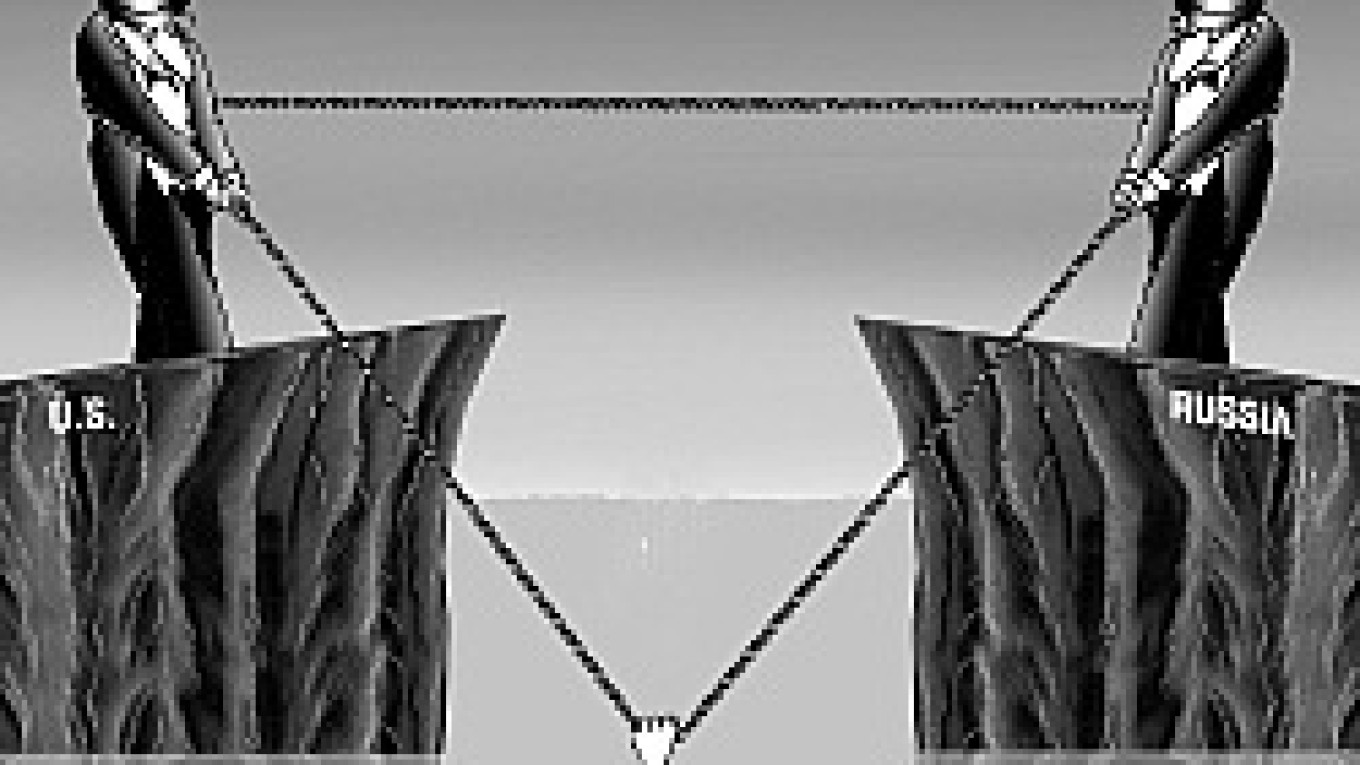
During the eight years of Vladimir Putin's presidency, Russia adopted this type of diplomacy by creating several mini-triangles. Within each triangle, two of the three sides belonged to Russia and the United States. The third country differed each time, although the main criterion always remained the same: That country had to lack diplomatic contacts with the United States and reside on the enemy list of U.S. President George W. Bush.
 | To Our Readers |
The Moscow Times welcomes letters to the editor. Letters for publication should be signed and bear the signatory's address and telephone number. |
The U.S. buildup of similar diplomatic triangles against Russia has been less prominent. The Bush administration forged alliances with Georgia and Ukraine, aiming to diminish Russia's influence on its former republics. This approach, however, has been largely ineffective since both countries, and especially Ukraine, have a substantial economic dependency on their larger neighbor. The U.S. push for their membership in NATO has fallen on the deaf ears of West European colleagues, who fear alienating Russia over two states that do not add much strategic value.
Meanwhile, Putin's alliances carry far greater weight. They are vital to several major conflicts on the U.S. diplomatic front, in which Russia maintains relative neutrality.
The prospect of expelling Russia from the Group of Eight, raised by U.S. politicians on both sides of the aisle, could tilt Russian neutrality toward its partnerships with "rogue states." Russia would not tolerate humiliation. While no longer a superpower, it seeks to be a major political and economic player in the world arena. As Dmitry Trenin, Carnegie Moscow Center analyst, said: "What Russia craves is respect. It does not want to be a junior partner -- it wants to be an equal." The Putin administration was successful in restoring Russia's image that was severely weakened in the 1990s. The triangular diplomacy comes as an inevitable result on the political front, while the rising price of oil strengthens Russia on the economic front.
The G8 expulsion could once again divide the world order into pro-U.S. and pro-Russian domains. The world's rogue states would eagerly join a pro-Moscow bloc, and this would make it difficult for the United States to fulfill its key foreign policy objectives. At a time when Washington intends to curb Iran's nuclear ambitions, secure loose nuclear materials, stabilize Iraq and achieve resolution to the Israeli-Palestinian conflict, it cannot afford to instigate a Cold Peace in U.S.-Russian relations.
Instead, the United States should turn a disadvantage into an advantage. Specifically, Washington could leverage Moscow's alliances to conduct diplomacy with the rogue states, when necessary. The recent presence of William Burns, former U.S. ambassador to Russia and current U.S. undersecretary of state for political affairs, during nuclear discussions with Iran indicates that a dialogue is at times inevitable. Since direct and immediate talks with a country such as Iran or Syria may be politically damaging for the U.S. side, Russia could become a safe conduit for breaking the ice. Its role could be that of an honest broker, ranging from a dialogue's facilitator to that of a third-party host to bilateral negotiations. As the ice breaks, so will some of Moscow's triangles. Triangular diplomacy is incapable of sustaining itself when two former foes commence a dialogue. Meanwhile, Russia would get the respect that it seeks.
The proponents of Russia's expulsion from the G8 would argue that Putin's nondemocratic policies should not be encouraged, but punished. But what political purpose would the proposed punishment serve for the United States? Few question Russia's rise of authoritarianism in the post-Yeltsin years. Yet the country is still far more liberal than it was in 1972, when Nixon made his historic visit to the Soviet Union and launched detente. Nixon was no lover of communism, but he chose to close his eyes on some aspects of Soviet domestic politics when it served U.S. foreign policy interests. The next president of the United States should choose to do the same.
Alexander Veytsman is a senior manager for international markets at American Express in New York.
A Message from The Moscow Times:
Dear readers,
We are facing unprecedented challenges. Russia's Prosecutor General's Office has designated The Moscow Times as an "undesirable" organization, criminalizing our work and putting our staff at risk of prosecution. This follows our earlier unjust labeling as a "foreign agent."
These actions are direct attempts to silence independent journalism in Russia. The authorities claim our work "discredits the decisions of the Russian leadership." We see things differently: we strive to provide accurate, unbiased reporting on Russia.
We, the journalists of The Moscow Times, refuse to be silenced. But to continue our work, we need your help.
Your support, no matter how small, makes a world of difference. If you can, please support us monthly starting from just $2. It's quick to set up, and every contribution makes a significant impact.
By supporting The Moscow Times, you're defending open, independent journalism in the face of repression. Thank you for standing with us.

Remind me later.