

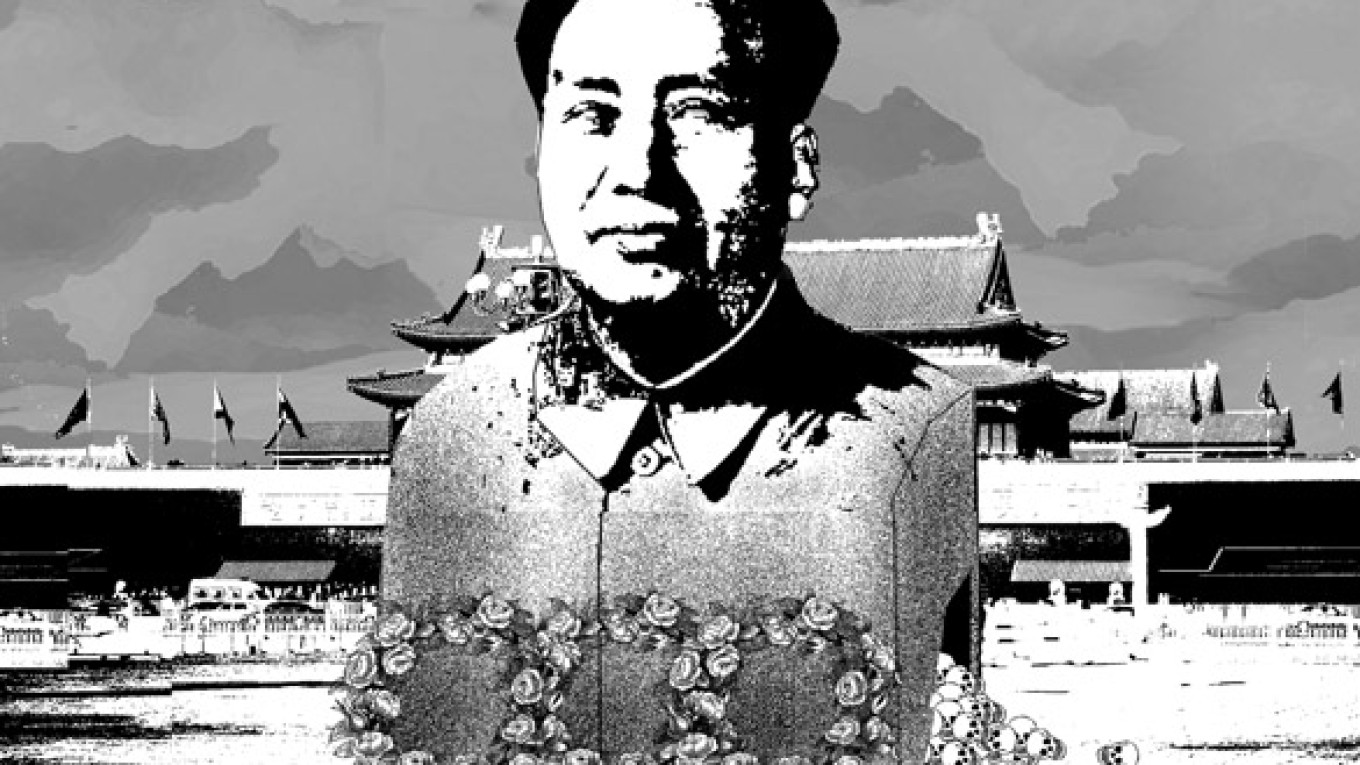
Every country is shaped by its history, but countries fabricate and rewrite their histories, too. The story of how we became who we are needs to accommodate our sense of tribal solidarity and accomplishment. Our triumphs and virtues are exaggerated. Our villains externalized, and our failings covered up. All this makes the study of history potentially insurrectionary, but hugely valuable. Good historians encourage us to be honest about ourselves. They destroy our self-delusions.
This is especially true of our flawed heroes, as we see today with the Chinese Communist Party’s treatment of Mao Zedong. Sixty years ago on Oct. 1, Mao stood on the rostrum of Tiananmen, the Gate of Heavenly Peace in Beijing, and declared the founding of the People’s Republic. That moment marked the end of years of war and terrible hardship. The revolution had been won through blood, sacrifice, heroism, the mistakes of enemies and the manipulative assistance of Stalin, who purported to be a friend. The decades of rapacious war lords, greedy imperialists and Japanese invaders were over. China could stand up, though much misery still lay ahead as Mao’s tyranny put down its roots.
Verdicts on Mao differ wildly. For hard-line Communists, he was a hero three times over — historical, patriotic and world-class. For the brave and charismatic dissident Wei Jingsheng, Mao “cast virtually the whole of China into a state of violence, duplicity, and poverty.”
The Communist Party’s official verdict, undoubtedly the product of fierce ideological disputes, is that he was a great Marxist and revolutionary, whose “gross mistakes” during the Cultural Revolution were outweighed by his contribution to China. “His merits,” it argues, “are primary and his errors secondary.”
China’s Communist Party will not tolerate any questioning of this assessment. Mao’s establishment of authority over China, his injection of patriotic pride into a land that had been appallingly sundered and humiliated by external and internal forces for a century and a half and his romantic legend as a global revolutionary leader — all contribute to the moral and political legitimacy for which China’s leaders search. What they cannot gain through democratic elections they acquire through the history of the revolution and today’s economic triumphs.
But the dark side of Mao cannot be totally expunged. Too many people remember what happened. It is an intimate part of their family stories.
There was the Great Leap Forward, which led to mass starvation and perhaps as many as 38 million deaths. Then the madness of the Cultural Revolution, when millions suffered terribly, many died and many more behaved disgracefully as Mao sought to destroy those who had rescued China from his earlier follies. Jung Chang’s famous biography of Mao, published in 2005, recounts those awful events in the sort of bleak detail that makes Communist propagandists nervous — and some academic Sinologists critical that Mao’s achievements go too little recognized.
I remember being told a story about China that gives credence to the Communist leadership’s generous verdict on Mao. The mother of a Chinese journalist (now living outside the country) had been one of those who returned after 1949 to her homeland with her husband and family from a comfortable life at a U.S. university. They regarded returning as their patriotic duty.
The family sacrificed everything. They were hit by round after round of Mao’s tyrannical campaigns against “Rightists,” beginning with the silencing of critics after the Hundred Flowers Movement in 1956. The family lived in penury. The father died from ill treatment during the Cultural Revolution.
But the mother never complained. She believed that her family’s sacrifices were justified by the liberation and rise of China. Toward the end of her life, this mood changed. She saw in the 1990s the beginning of China’s economic ascent — the early years of spectacular growth. She witnessed the return of the greed and corruption that she believed had destroyed the Kuomintang in the 1930s and 1940s. Why, she asked, had her family suffered so much if it was only to prepare the way for this?
Yet it is China’s economic renaissance — some of whose effects so disturbed this patriotic old woman — which has been the most remarkable event in recent world history. The economic turnaround began under the leadership of Deng Xiaoping, who had survived Mao’s purges to follow in his footsteps and become the architect of China’s rise as a world power. The hundreds of millions of Chinese who have been lifted out of poverty as a result of Deng’s reforms will in time regard him as a greater hero than Mao.
But, whatever Mao’s terrible failings, during his years of absolute power there was a sense of common purpose and solidarity that went with shared hardship. Maoism was a curious and unique mixture of class warfare and socialist leveling, all enunciated by a man who believed that individuals — or at least Mao himself — could shape history rather than be formed by its tides and currents.
This creed has clearly not survived its creator. Pragmatism with a Leninist face is the order of the day. The glories of getting rich have overwhelmed the deprivations of patriotic self-sacrifice. Mao made China proud. Deng made it prosperous.
What happens next? For all our sakes, I hope that the future does not derail China’s economic progress, though it will be a surprise if it does not challenge its arthritic and adamantine political system.
Chris Patten, the last British governor of Hong Kong and a former European Commissioner for External Affairs, is chancellor of the University of Oxford. © Project Syndicate
A Message from The Moscow Times:
Dear readers,
We are facing unprecedented challenges. Russia's Prosecutor General's Office has designated The Moscow Times as an "undesirable" organization, criminalizing our work and putting our staff at risk of prosecution. This follows our earlier unjust labeling as a "foreign agent."
These actions are direct attempts to silence independent journalism in Russia. The authorities claim our work "discredits the decisions of the Russian leadership." We see things differently: we strive to provide accurate, unbiased reporting on Russia.
We, the journalists of The Moscow Times, refuse to be silenced. But to continue our work, we need your help.
Your support, no matter how small, makes a world of difference. If you can, please support us monthly starting from just $2. It's quick to set up, and every contribution makes a significant impact.
By supporting The Moscow Times, you're defending open, independent journalism in the face of repression. Thank you for standing with us.

Remind me later.