

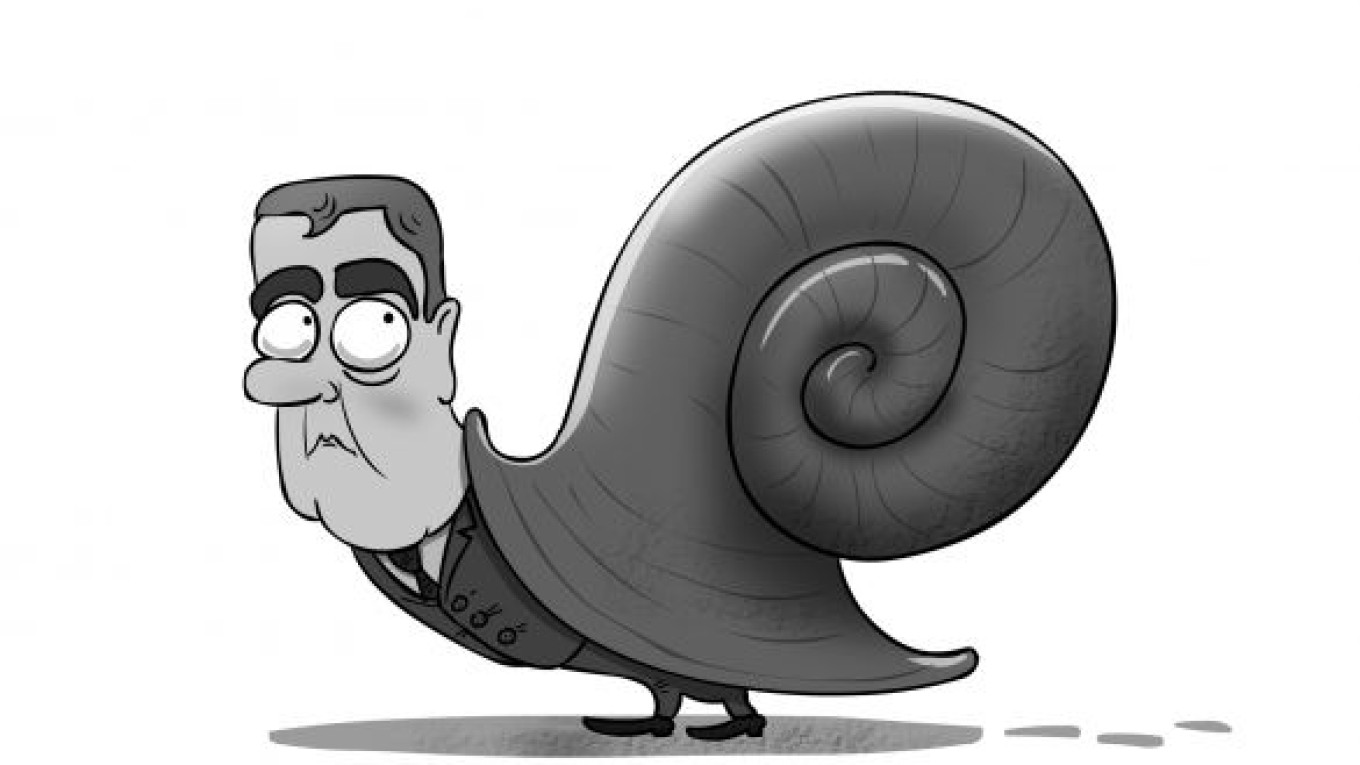
Based on Dmitry Medvedev’s previous speeches, few people expected any cogent policy statements from the president during his address on Thursday to the third annual Global Policy Forum in Yaroslavl. Medvedev did not disappoint these expectations — or rather, the lack of them. His speech, like his previous ones, largely consisted of generalities.
As a commentator for the Rosbalt news agency noted: “The inarticulate and vague speech the president gave is practically becoming his personal trademark.”
Political analyst Lilia Shevtsova wrote on her blog: “Every time Medvedev speaks in public, he only reinforces the impression of inadequacy. How many times can you say the same thing over and over again?”
But perhaps the critics aren’t being entirely fair or maybe they missed several key moments in Medvedev’s speech. Medvedev should be given credit for clearly articulating a political ideology that is vastly different from the one guiding Prime Minister Vladimir Putin.
Medvedev strongly spoke out against attempts to resolve the problems of poverty, interethnic hostility and diversification of the economy by the traditional Russian method of introducing more draconian laws. “Today more than ever there is a great temptation to ‘tighten the screws’ once again,” Medvedev said. “There are many pretexts for it. That’s the easiest response. But that’s not the right idea. We must not limit people’s rights and especially must not stifle criticism.”
Medvedev also proposed limiting the role of the state through delegating part of its authority to nongovernmental organizations and transferring some federal powers to the regions.
In Medvedev’s speech, it was hard to miss criticism of the actions of Putin’s team, which has created the Soviet-style All-Russia People’s Front to boost United Russia’s popularity before the State Duma elections in December. The goal of the organization is some kind of “consolidation of society,” which in translation from newspeak usually means “clamping down on dissent.”
“There are people who believe that it would be advisable to line everyone up and, as they say, march in formation into the bright future,” Medvedev said. “I’m certain that this isn’t just unnecessary — it would be very harmful for our country.”
For all that, the speech did make a strange impression, probably because it sounded more like a professor’s conference presentation than a policy statement by a president with broad constitutional authority.
Medvedev has been in office long enough to judge his public statements against his record. He can be credited with drafting legislation to lower the electoral threshold for parties in the Duma from 7 percent to 5 percent. However, the new law won’t go into effect before the upcoming elections, and liberals are concerned that it could be easily reversed by the Duma in the five years before the next parliamentary elections.
“The sanctity of private property, regardless of size … must be guaranteed,” Medvedev said.
And in fact, Medvedev has taken measures to liberalize the Criminal Code on economic crimes. But practice has shown that these changes are easily ignored by judges and other law enforcement agencies. Last month, prosecutors once again opened a case against Sergei Magnitsky, who died in a pretrial detention center, in violation of the law that requires consent by the relatives of the deceased.
Medvedev also indirectly gave support to the belief that the campaign to expose bureaucrats responsible for Magnitsky’s death is a “foreign plot,” when he instructed the Foreign Ministry to draw up a blacklist of U.S. officials banned from entering Russia. This is a largely symbolic act, but the symbolism is from the Cold War era.
Finally, Medvedev could free former Yukos owners Mikhail Khodorkovsky or Platon Lebedev from prison with a pen stroke, but both are still behind bars.
The biggest disappointment in Medvedev’s speech was his failure to even hint about his plans to run for president. This means that the most likely candidate for the presidency will be Putin. Not surprisingly, according to Yury Pronko, a radio show host on Finam FM, the rumor circulating during the coffee breaks at the forum was that Putin would announce his candidacy in November at the Valdai forum — the annual gathering of foreign experts on Russia that is traditionally held in September but? is apparently delayed this year to avoid uncomfortable questions about who will run for president.
If Putin plans to mount a presidential bid, what will be left for Medvedev to do? Most likely he will join the growing speakers’ pool of failed Russian reformers led by former Soviet President Mikhail Gorbachev. Medvedev’s Yaroslavl speech sounds like a pretty impressive rehearsal for this new role.
Victor Davidoff is a Moscow-based writer and journalist whose blog is .
A Message from The Moscow Times:
Dear readers,
We are facing unprecedented challenges. Russia's Prosecutor General's Office has designated The Moscow Times as an "undesirable" organization, criminalizing our work and putting our staff at risk of prosecution. This follows our earlier unjust labeling as a "foreign agent."
These actions are direct attempts to silence independent journalism in Russia. The authorities claim our work "discredits the decisions of the Russian leadership." We see things differently: we strive to provide accurate, unbiased reporting on Russia.
We, the journalists of The Moscow Times, refuse to be silenced. But to continue our work, we need your help.
Your support, no matter how small, makes a world of difference. If you can, please support us monthly starting from just $2. It's quick to set up, and every contribution makes a significant impact.
By supporting The Moscow Times, you're defending open, independent journalism in the face of repression. Thank you for standing with us.

Remind me later.