

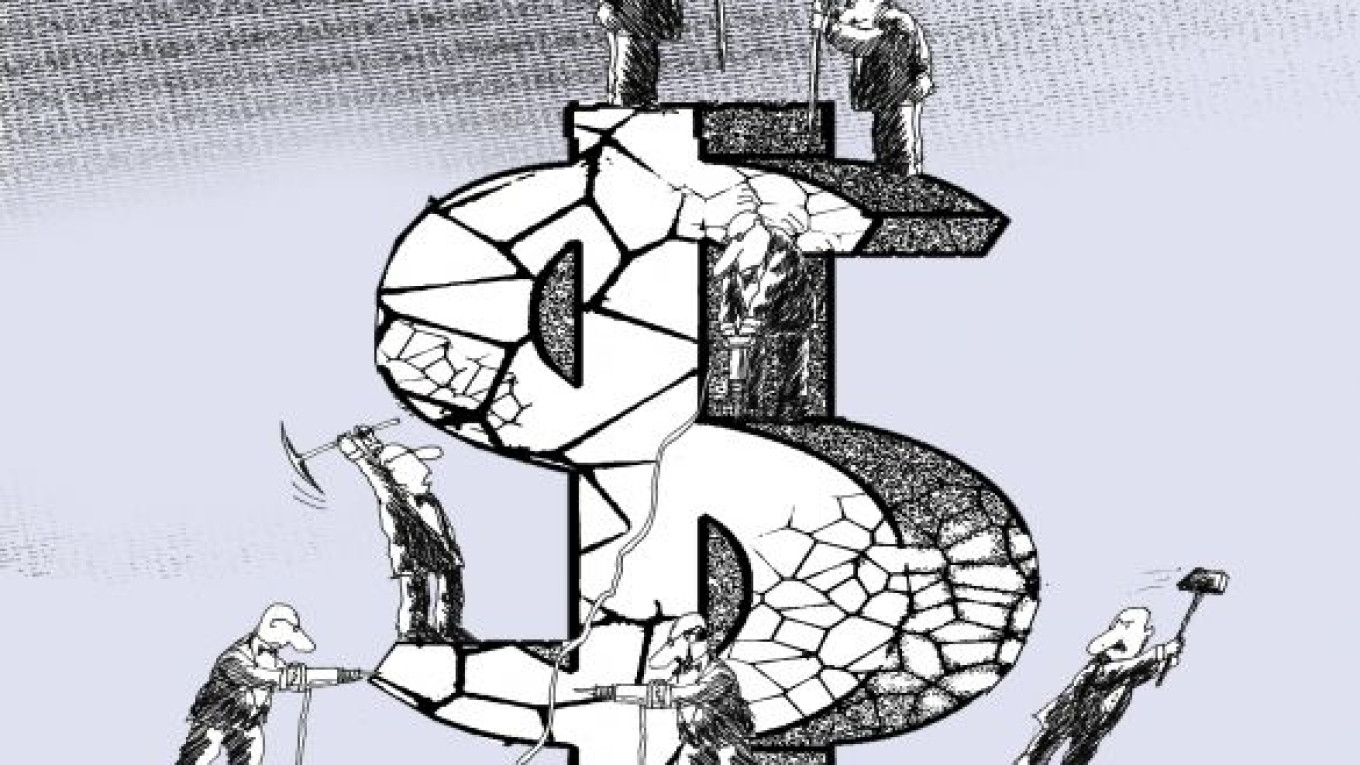
While the global recovery is stalling, renewed concerns over sovereign debt and bank liabilities are adding to the gloom of sluggish growth and high unemployment. This is exacerbated by a looming currency and trade war between surplus countries such as China and deficit countries like the United States.
When financial leaders gather at the International Monetary Fund and World Bank meeting in Washington on Friday, there are three global players in particular — Russia, Brazil and the European Union — that need to act in concert to avert an escalation and help create a new global currency arrangement that promotes sustained growth.
With growth slowing, governments are quickly running out of options. Neither monetary expansion nor the fiscal stimulus has secured stable, strong growth. Much of the additional liquidity injected into the financial system has been abused by investment banks for speculative purposes and a new bonus bonanza instead of being channeled into cash-strapped businesses and households.
With global imbalances between deficit and surplus countries once again rising, Beijing has continued to hold down the value of its currency to boost exports. In retaliation, Washington has imposed trade barriers to shield its domestic market from cheap imports. As such, both are manipulating their currencies and distorting free trade.
The United States has depreciated the value of the dollar, the world currency reserve, by printing more money. Countries with large dollar holdings like China, Taiwan and South Korea have responded by intervening to limit currency appreciation. Currency intervention is Beijing’s preferred policy of propping up the value of its vast dollar reserves and promoting cheap exports on which strong domestic growth depends. Last week, the U.S. House of Representatives passed legislation enabling U.S. companies to apply for duties to be levied on imports from countries manipulating their currencies — that is, China.
Countries like Russia and Brazil that rely on trade with the United States and China are caught between both sides. They are seeing the value of their dollar reserves decline and that of their currencies rise. That is why last Friday, Guido Mantega, the Brazilian finance minister, said the world was in an “international currency war” that threatens global growth and endangers emerging markets like Brazil and Russia.
Evidence of growing currency manipulation abounds. Since January 2009, Beijing has accumulated almost $600 billion, which represents 40 percent of new global currency reserves. Total Chinese holdings of dollars now stand at $2.45 trillion, more than half of the country’s overall national output. This accumulation fuels global imbalances between surplus and deficit countries by providing China with a permanent export subsidy. No wonder that U.S. lawmakers have resorted to new trade barriers.
Washington wants to limit cheap imports from China and the rest of Asia while at the same time expanding U.S. exports. Unless something gives, the risk of escalation is real and growing. A full-fledged currency and trade war would almost certainly plunge the world economy back into recession.
With U.S. deficit and debt levels at unprecedented levels, Washington can’t afford to antagonize Beijing. After all, China can only buy U.S. Treasury bonds because of strong growth based on a cheap labor force and a cheap currency.
By contrast, Russia, Brazil and the EU have greater room to maneuver. They could launch a common initiative aimed at creating a new global currency arrangement. First, they could support French President Nicolas Sarkozy — whose country will soon take over the Group of 20 chairmanship for one year — in his efforts to reform the Bretton Woods institutions. This includes ideas for a new global currency mechanism — possibly some form of managed system? — and over time the creation of a world reserve currency based in part on IMF special drawing rights.
Second, Russia, Brazil and the EU can lead the way in trading much more in their respective currencies instead of relying primarily on the dollar. That would diversify their own currency holdings and make them less vulnerable to U.S. attempts to depreciate the value of the dollar.
Third, they could pioneer limits on speculative practices in terms of both financial instruments and commodity trading to reconnect finance to productive activities and the trade of goods. That would go a long way toward diversifying the global economy and supporting industry and manufacturing on which sustained economic growth depends.
Adrian Pabst is a lecturer in politics at the University of Kent and a visiting professor at the Institut d’Etudes Politiques de Lille (Sciences Po).
A Message from The Moscow Times:
Dear readers,
We are facing unprecedented challenges. Russia's Prosecutor General's Office has designated The Moscow Times as an "undesirable" organization, criminalizing our work and putting our staff at risk of prosecution. This follows our earlier unjust labeling as a "foreign agent."
These actions are direct attempts to silence independent journalism in Russia. The authorities claim our work "discredits the decisions of the Russian leadership." We see things differently: we strive to provide accurate, unbiased reporting on Russia.
We, the journalists of The Moscow Times, refuse to be silenced. But to continue our work, we need your help.
Your support, no matter how small, makes a world of difference. If you can, please support us monthly starting from just $2. It's quick to set up, and every contribution makes a significant impact.
By supporting The Moscow Times, you're defending open, independent journalism in the face of repression. Thank you for standing with us.

Remind me later.