

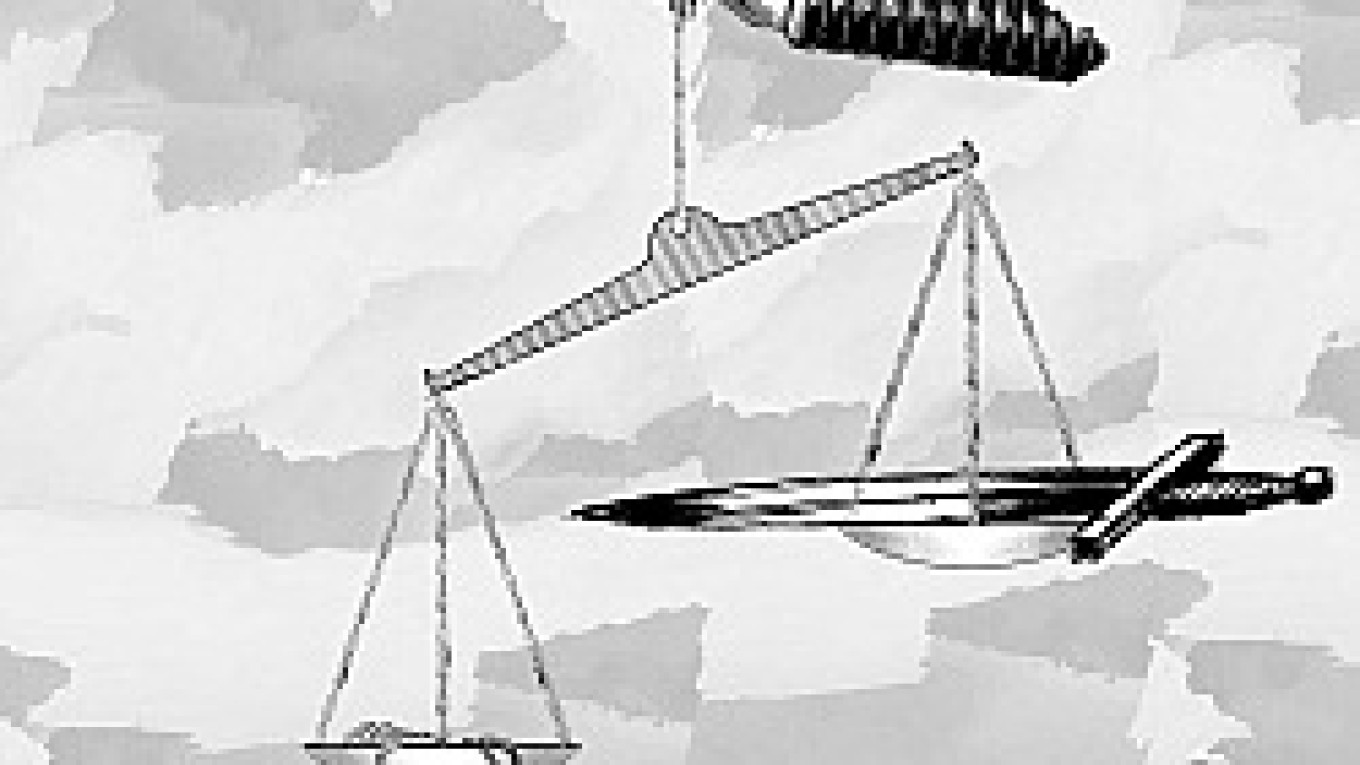
Some U.S. analysts, such as Edward Luttwak, have concluded that Russia's invasion of Georgia proves the "irrelevance of soft power," and the dominance of hard military power. In reality, the story will turn out to be more complicated for both countries.
Soft power is the ability to get what you want through attraction rather than coercion or payment. It is not the solution to all problems. North
 | To Our Readers |
|
The Moscow Times welcomes letters to the editor. Letters for publication should be signed and bear the signatory's address and telephone number.
|
But other goals, such as the promotion of democracy and human rights, are better achieved by soft power, which can also create an enabling or disabling environment, as the United States discovered in the aftermath of the invasion of Iraq.
Skeptics who belittle soft power because it does not solve all problems are like a boxer who fights without using his left hand because his right hand is stronger. Soft power alone is rarely sufficient, but it is often crucial to combine soft and hard power to have an effective strategy of "smart power." As U.S. Defense Secretary Robert Gates said last year, "I am here to make the case for strengthening our capacity to use soft power and for better integrating it with hard power."
Military force is obviously a source of hard power, but the same resource can sometimes contribute to soft-power behavior. The impressive job by the U.S. military in providing humanitarian relief after the Indian Ocean tsunami in 2004 and the South Asian earthquake in 2005 helped restore the United States' image.
On the other hand, misuse of military resources can undercut soft power. The Soviet Union had a great deal of soft power in the years after World War II, but destroyed it by the way the Kremlin used its hard power against Hungary and Czechoslovakia.
Russia is now going through a period of nationalistic reaction to what it regards as the humiliation it suffered after the Soviet empire collapsed. With the rise in energy prices boosting its economy, Russia has seen an opportunity to reassert its power over its neighbors. In addition, it felt aggrieved by plans for further expansion of NATO, a planned installation of elements of a ballistic missile-defense system in Eastern Europe, and Western recognition of Kosovo's secession from Russia's ally, Serbia.
Russia has sought to weaken Georgia's government for some time. In early August, it set a trap in South Ossetia, and Georgia foolishly walked into it.
If the Kremlin had used its so-called peacekeeping force solely to protect South Ossetians' "self-determination," citing the precedent of Western actions in Kosovo, it would have done little damage to its soft power, and the benefits could have exceeded the costs. But by bombing, blockading and occupying many parts of Georgia, delaying its withdrawal, parading blindfolded Georgian soldiers and failing to protect Georgian citizens, Russia lost its claims to legitimacy and sowed fear and mistrust in much of the world.
Neighbors such as Ukraine have become more wary. An immediate cost was Poland's reversal of its resistance to a U.S. missile-defense system. When Russia appealed for support of its Georgia policy to its fellow members of the Shanghai Cooperation Organization, China and others refused. Longer-term costs may include the failure of Russia's proposal for a new European security system, a revived European interest in the Nabucco and White Stream gas pipelines that bypass Russia and a decline in foreign investment.
In contrast, China ended August with its soft power enhanced by its successful Olympic Games. In October 2007, Chinese President Hu Jintao declared the country's intent to increase its soft power, and the Olympics were an important part of that strategy. With its establishment of Confucius Institutes to promote Chinese culture, increased international broadcasting, attraction of foreign students to its universities and softer diplomacy toward its neighbors in Southeast Asia, China has made major investments in soft power. Opinion polls show an improvement in its international reputation.
But China's government did not achieve all its Olympic objectives. By not keeping its promises to allow peaceful demonstrations and free Internet access, China undercut its soft-power gains.
It will take more than a successful Olympics to overcome these self-imposed limits. For example, a recent Pew poll showed that despite China's efforts to increase its soft power, the United States remains dominant in all soft-power categories. So, while China won the most gold medals, the Beijing Olympics did not turn the tables on Washington outside the sports arenas. Let's hope that China's leaders will learn the importance of free expression for establishing soft power.
Of course, only time will tell the ultimate outcomes of the guns and gold of August for Russia and China. Unlike an Olympic competition, their recent performances will not be given a final score until well after their power games have been played.
Joseph S. Nye Jr., professor of international relations at Harvard University's John F. Kennedy School of Government, is the author most recently of "The Powers to Lead." © Project Syndicate
A Message from The Moscow Times:
Dear readers,
We are facing unprecedented challenges. Russia's Prosecutor General's Office has designated The Moscow Times as an "undesirable" organization, criminalizing our work and putting our staff at risk of prosecution. This follows our earlier unjust labeling as a "foreign agent."
These actions are direct attempts to silence independent journalism in Russia. The authorities claim our work "discredits the decisions of the Russian leadership." We see things differently: we strive to provide accurate, unbiased reporting on Russia.
We, the journalists of The Moscow Times, refuse to be silenced. But to continue our work, we need your help.
Your support, no matter how small, makes a world of difference. If you can, please support us monthly starting from just $2. It's quick to set up, and every contribution makes a significant impact.
By supporting The Moscow Times, you're defending open, independent journalism in the face of repression. Thank you for standing with us.

Remind me later.