

The Education and Science Ministry headed by Andrei Fursenko has a good shot at winning the dubious title of Least-Loved Federal Agency, an honor once incontestably held by the Health and Social Development Ministry when it was headed by Mikhail Zurabov. He was disgraced after trying to monetize pensioners' benefits, which sparked widespread protests in 2005.
Criticism has not subsided over standardized university-entrance exams that were intended to end corruption by leveling the educational playing field for rich and poor, urbanites and people from the provinces. But the exams have only given the advantage to the most corrupt regions and turned the educational process into a mindless rote process of memorizing facts instead of testing students' intellectual ability.
Criticism is also growing over reforms to science education, as another scandal unfolds over proposed changes to the curriculum for upper classes. It is difficult to recall a faster growing or larger-scale public backlash to a proposal by the authorities. And no wonder: The proposed changes would affect every Russian citizen and the very future of the country.
A closer look at the proposed reforms — already approved by the standards council of the Education and Science Ministry and debated in the State Duma and Public Chamber ?€” is enough to send any rational person into shock.
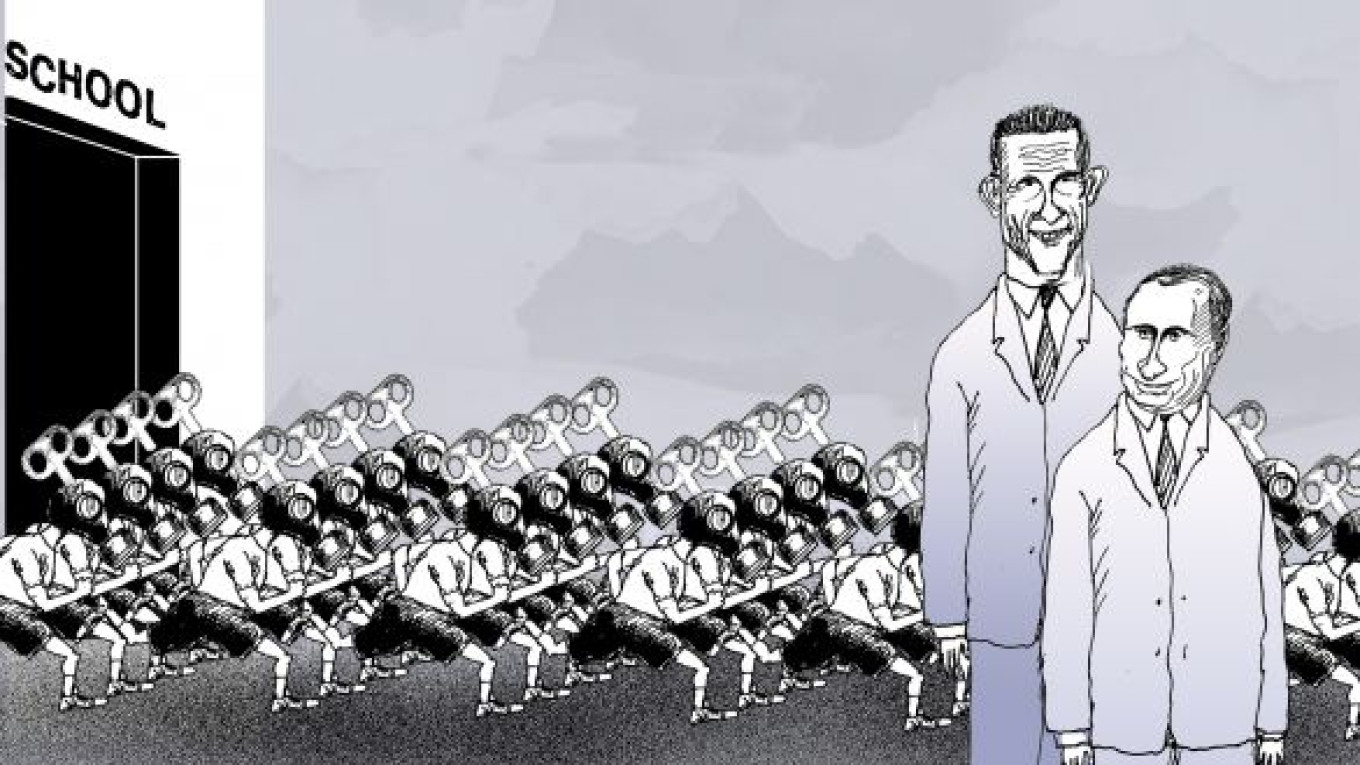
According to the plan, starting in 2012, schoolchildren will study only four required subjects, and of those, only two are clearly defined: physical education and general safety. The remaining two are the cryptic "individual project" and the highly suspicious Russia in the World.
Thus, for the sake of physical education, general safety and "Russia in the World" ?€” a subject dreamed up by "patriots" who are determined to raise the level of "patriotic education" among schoolchildren ?€” the authorities are set to destroy the very foundation of the education system. This threatens developments dating from its earliest beginnings through the famous reforms by Tsar Alexander II and into the modern period when education served as the cornerstone that helped define Russia's leading role in the world.
The approach endorsed by the Education and Science Ministry and United Russia will inevitably lead to the further deterioration of Russia's high school educational system and its continued low standing in the Program for International Student Assessment, or PISA. On the positive side, the new standards will make Russian schools ideally suited for churning out young men ready to serve in the armed forces by training them to identify Russia's numerous internal and external enemies and to defend the motherland. Russia in the World, a subject that rumor has it was developed at the personal request of Prime Minister Vladimir Putin, will most likely force-feed political indoctrination in the spirit of ideologist Alexander Dugin and other arch-conservative dinosaurs to see Russia as a "besieged fortress" and to glorify Russia as a "powerful state" around which all must rally to defend it from enemies.
After the scandal broke, Fursenko slowed confirmation of the new standards, and Putin even criticized the Education and Science Ministry's proposals as having gone too far. But this delay means little. After all, the disagreement is not over a few technical details but over the strategic path of the country's future.
An alternative approach to the ministry's proposal would preserve and develop Russia's comprehensive curriculum, as well as help foster interethnic unity and societal integration by drawing on the great heritage of Russian culture. At the very least, it would preserve the emphasis on engineering and the natural sciences.
The final decision on the education reform proposal will reveal a great deal about how the top leadership sees Russia's future ?€” as a closed and militaristic, economically and technologically underdeveloped authoritarian power, or as an open democratic society focusing on innovation and standing on par with the leading countries of the world.
Putin and United Russia's attempt to indoctrinate high school students is only one example of how the Kremlin is degrading the country's future human capital. Moscow is actively increasing expenditures on state machinery, law enforcement and defense while cutting spending on developing the country's human capital ?€” health care, science and education. Only recently, the Higher School of Economics published findings indicating that in many regions last year teachers' salaries actually fell after inflation. Worse, their salaries were already five to 10 times lower on average than their colleagues in economically developed countries and even significantly lower than those in China. What's more, many schools are being closed in many cities and rural areas. Implementing the new standards could result in parents having to pay a fee for their children to receive instruction in subjects that were previously part of the standard curriculum, thereby shifting even more of the economic burden for education away from the state and onto the shoulders of citizens.
What's more, President Dmitry Medvedev's budget message for 2011-13 calls for cutting the share of federal spending on education from 1.1 percent of gross domestic product in 2009 to 0.5 percent in 2013. It also includes spending cuts in other such key areas as culture, health care and payments to the regions, of which a large part goes to grammar school education. The little money that remains should be just enough to teach young people the most important skills of how to identify the country's enemies and love Putin's autocracy.
Vladimir Ryzhkov, a State Duma deputy from 1993 to 2007, hosts a political talk show on Ekho Moskvy radio.
A Message from The Moscow Times:
Dear readers,
We are facing unprecedented challenges. Russia's Prosecutor General's Office has designated The Moscow Times as an "undesirable" organization, criminalizing our work and putting our staff at risk of prosecution. This follows our earlier unjust labeling as a "foreign agent."
These actions are direct attempts to silence independent journalism in Russia. The authorities claim our work "discredits the decisions of the Russian leadership." We see things differently: we strive to provide accurate, unbiased reporting on Russia.
We, the journalists of The Moscow Times, refuse to be silenced. But to continue our work, we need your help.
Your support, no matter how small, makes a world of difference. If you can, please support us monthly starting from just $2. It's quick to set up, and every contribution makes a significant impact.
By supporting The Moscow Times, you're defending open, independent journalism in the face of repression. Thank you for standing with us.

Remind me later.