

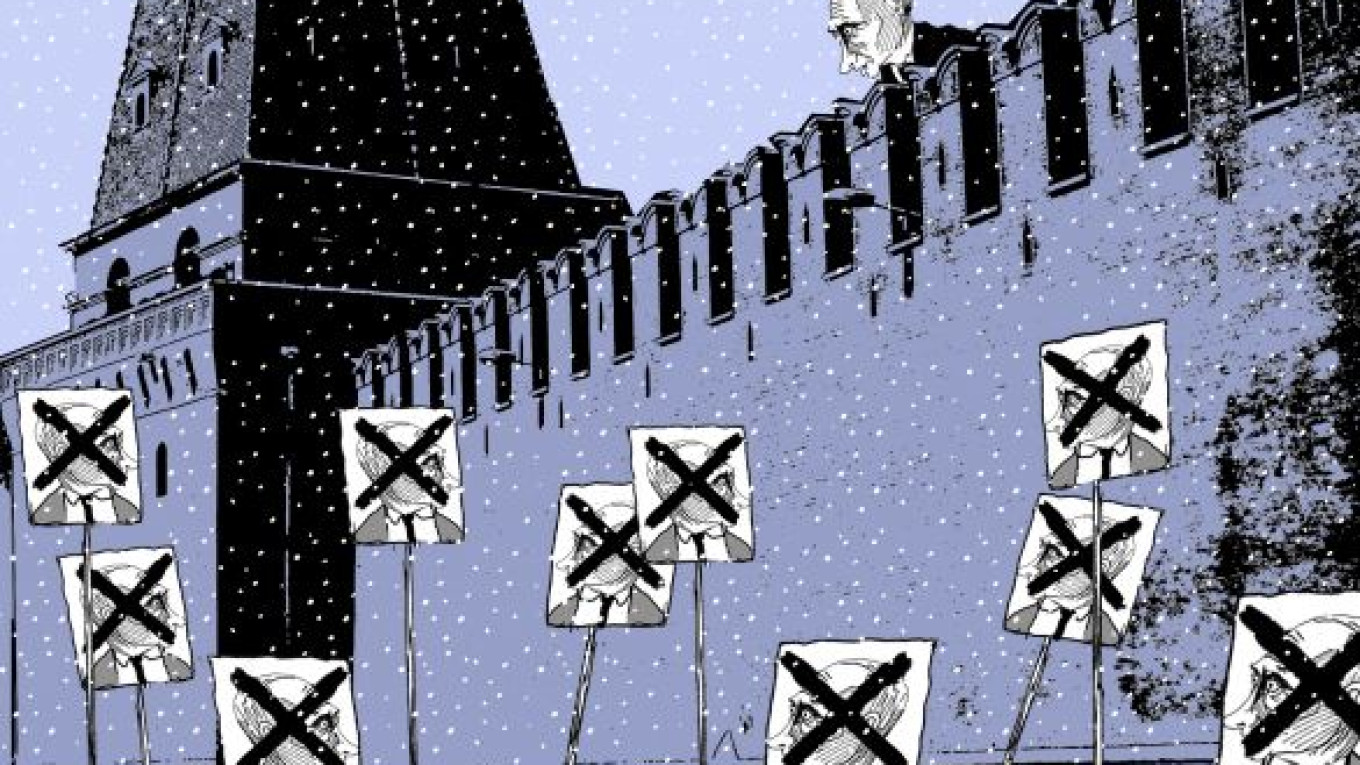
Russia is not Egypt. And Moscow is not on the eve of revolution as Cairo was less than a year ago. Indeed, Russia's powerful have at their disposal assets that former Egyptian President Hosni Mubarak's regime lacked.
As an energy superpower, Russia can open its coffers to appease — at least in part — the humiliation that it has inflicted on its citizens by falsifying the country's recent State Duma election results. And not all Russians are in the streets. We should beware of the "zoom effect," which made many people believe that the young protesters of Cairo's Tahrir Square were fully representative of Egyptian society. They were not. Rural Egypt, like rural Russia, is much more conservative than the young elites who seize the world's imagination with their protests and embrace of modern social media.
Furthermore, Mubarak was old and sick and no longer enjoyed the trust of his people. Prime Minister Vladimir Putin, by contrast, exudes energy and health and may still reassure many segments of Russian society whose main concern is their country's glory rather than its citizens' happiness.
Yet Putin may be overplaying the macho card so excessively that it could backfire and contribute to his isolation from Russia's urban and more educated voters. But even though the tens of thousands of demonstrators are unlikely to threaten the survival of Putin's regime, the Kremlin would be wise to take them seriously. The protesters' trademark so far has been moderation and restraint. Nothing would be more dangerous for the Kremlin than violent repression.
Beyond the issue of violence, the Russian authorities would take a huge historical risk by failing to register the public's growing alienation. Sheltered physically and metaphorically by the Kremlin's high walls and having progressively lost contact with the living conditions of ordinary people — if they ever had any contact before — Russia's leaders seem to consider their lifestyle to be both normal and eternal.
From the standpoint of condemning elite behavior, Russian protesters evoke, at least in part, the actors of the Arab revolutions. In their denunciation of "Soviet electoral practices," they reject the combination of despotism and corruption that characterized Soviet power yesterday and Russian power today — rhetoric familiar from Arab revolutionaries. As young Arabs told the rulers of Libya, Egypt, Tunisia, Syria, Yemen and other Arab countries, this new generation of Russians is telling Putin: "Get Out!"
But most participants hold few illusions about the efficacy of their protest. They want to express to Russia's rulers the extent of their frustration and determination. They may not expect regime change, but they expect at least some minimal reforms.
Above all, they want to set limits on Putin's power. But their protest's ironic consequence may be that the more moderate of the ruling tandem, President Dmitry Medvedev, will not be appointed prime minister, as had been planned. A game of political musical chairs would simply be too much in the eyes of too many Russians.
The protests have caught the Kremlin's masters, as well as the majority of Russia's citizens, by surprise. They failed to recognize that globalization — particularly the global information revolution — has made the world more transparent and interdependent than ever. The protesters of Madrid were inspired by those of Cairo and were themselves a source of inspiration from New York to Tel Aviv — and, subsequently, to Moscow.
A following lesson emerges: With the deepening of the economic crisis, on the one hand, and instant global connectivity, on the other, what was accepted yesterday is regarded as intolerable today.
That applies to Russia, too. For a long time, Russia has perceived itself as a "White Africa." The average life expectancy of Russian men, slightly below 60, is more African than European (or even Asian, for the most part). The corrupt enrichment of so many Russian elites mimics the disastrous habits of many of their African counterparts.
But this comparison has limits. Despite its many problems, Africa today has become a continent of hope. Its population is exploding, as are its economic growth rates. Senegalese firms seek to help their Spanish business partners, while Portugal extends an almost royal welcome to the leaders of their former colony, newly oil-rich Angola.
Africa is on the rise, while Russia is on the decline. The democratic idealism that accompanied the fall of communism 20 years ago is gone, but the "imperial pride" recovered in part during the Putin years may not be enough to compensate for the contempt with which the Russian state treats its citizens. Russia's demonstrators' message is simple: "Too much corruption, disdain and inequality is too much." Russia, like the Arab world, wants modernity.
Dominique Moisi is the author of "The Geopolitics of Emotion." © Project Syndicate
A Message from The Moscow Times:
Dear readers,
We are facing unprecedented challenges. Russia's Prosecutor General's Office has designated The Moscow Times as an "undesirable" organization, criminalizing our work and putting our staff at risk of prosecution. This follows our earlier unjust labeling as a "foreign agent."
These actions are direct attempts to silence independent journalism in Russia. The authorities claim our work "discredits the decisions of the Russian leadership." We see things differently: we strive to provide accurate, unbiased reporting on Russia.
We, the journalists of The Moscow Times, refuse to be silenced. But to continue our work, we need your help.
Your support, no matter how small, makes a world of difference. If you can, please support us monthly starting from just $2. It's quick to set up, and every contribution makes a significant impact.
By supporting The Moscow Times, you're defending open, independent journalism in the face of repression. Thank you for standing with us.

Remind me later.