

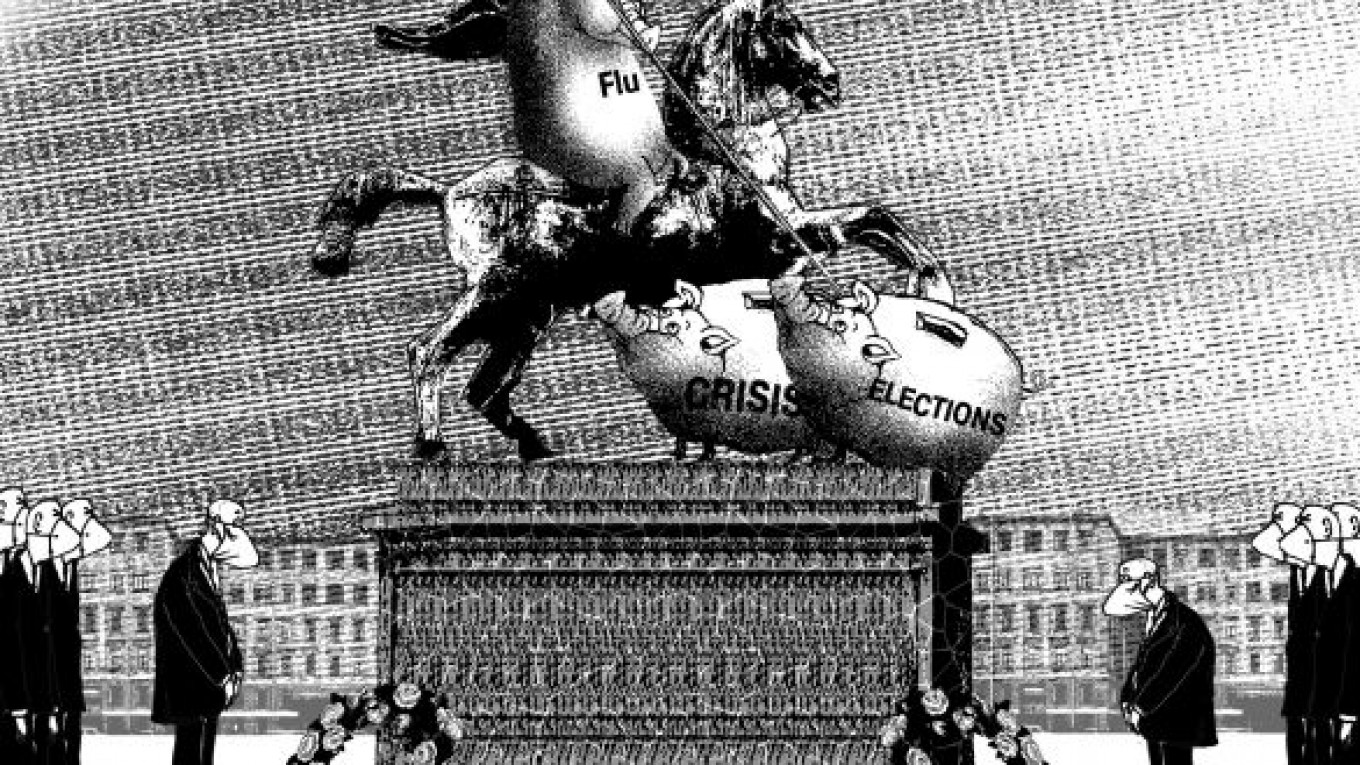
Who would have thought that the flu would be grabbing bigger headlines this fall than the economic crisis? The whole world has learned how Mexico decided to erect a monument to its dozens of swine flu victims. What we don’t hear about is how many people die every year in Mexico from other illnesses or from simple hunger, or how many fall victim to violent crime or drug addiction. Why? Because that isn’t interesting.
A few radial voices claim that the swine flu epidemic was caused by the inhumane treatment of animals on pig farms — places that have grown into major corporations resembling concentration camps. The same cruel methods once used against people were applied to the pigs, but their bodies could not withstand such treatment. With an enormous number of pigs confined to a small space and living under unsanitary conditions, an epidemic broke out. According to this theory, the pigs first caught the flu virus from humans. Later, the virus mutated and was passed back to humans.
The revenge of the pigs was born.
It has since come to light that swine flu does not differ greatly from ordinary seasonal flu, with roughly the same number of victims developing complications with both illnesses. Even so, Russia’s chief public health official, Gennady Onishchenko, unexpectedly became a prominent political figure when he issued a few simple orders that greatly complicated the lives of tens of thousands of people. For example, collective trips by schoolchildren to Spain and Britain were banned. Worse, the prohibition was announced at the last minute, when the trips had been paid for, visa applications had been prepared and travel plans set. The decision inflicted the maximum possible losses to tour agencies, disrupted the work of schools and upset the summer plans of countless families.
Passengers flying in from abroad are obliged to fill out detailed questionnaires that are reviewed by Onishchenko’s agency, although the forms are undergoing continual upgrades. It remains a mystery as to what exactly is done with these forms and how the information is used. Other agencies will probably have to be brought on board to process all the data. Airports also measure passengers’ temperatures with the help of a high-tech device of questionable effectiveness — but unquestionably very expensive price tag. All airports are required to install the equipment.
Onishchenko also proposed leveling a fine against anyone with the flu who appears in public without wearing a sanitary mask. The initiative is very valuable. While other manufacturing sectors are in a slump, the production of sanitary masks is booming. And, considering the money pouring into state coffers from flu sufferers caught bare-faced in public, it will soon become necessary to transfer the chief public health official to the Economic Development and Trade Ministry or the Finance Ministry, where his creative ideas will reap even greater dividends.
Meanwhile, Ukrainian presidential aide Igor Popov announced that a state of emergency might be declared because of his country’s flu epidemic, and that the presidential election might be pushed back from January to May. It turns out that this flu virus is even capable of extending a presidential term! I can just imagine how, after hearing the news from Ukraine, officials at the Health and Social Development Ministry in Moscow turned green with envy. For all of its size and scope, Moscow’s anti-flu campaign doesn’t pack anywhere near the same punch as the measures in Kiev.
It is interesting that Popov claimed it might be necessary to postpone elections in order to protect the interests of the opposition. It turns out that, with a flu epidemic raging, it is impossible to provide “equal opportunities to presidential candidates and to uphold voters’ rights.” In fact, “the ban on mass gatherings during the quarantine has hit the opposition presidential candidates hardest because the candidate in power can visit regions under quarantine as well as meet with supporters and the press, while other candidates feel that they are subject to discrimination.”
With or without the flu, Ukrainian President Viktor Yushchenko can expect nothing good from the upcoming election, and the tactic of declaring a state of emergency could be used in cases other than fighting a flu epidemic. It might also come in handy next spring, by which time something else bad is bound to happen — rivers overflowing their banks, a financial default or even an outbreak of the common cold.
Boris Kagarlitsky is director of the Institute of Globalization Studies.
A Message from The Moscow Times:
Dear readers,
We are facing unprecedented challenges. Russia's Prosecutor General's Office has designated The Moscow Times as an "undesirable" organization, criminalizing our work and putting our staff at risk of prosecution. This follows our earlier unjust labeling as a "foreign agent."
These actions are direct attempts to silence independent journalism in Russia. The authorities claim our work "discredits the decisions of the Russian leadership." We see things differently: we strive to provide accurate, unbiased reporting on Russia.
We, the journalists of The Moscow Times, refuse to be silenced. But to continue our work, we need your help.
Your support, no matter how small, makes a world of difference. If you can, please support us monthly starting from just $2. It's quick to set up, and every contribution makes a significant impact.
By supporting The Moscow Times, you're defending open, independent journalism in the face of repression. Thank you for standing with us.

Remind me later.