

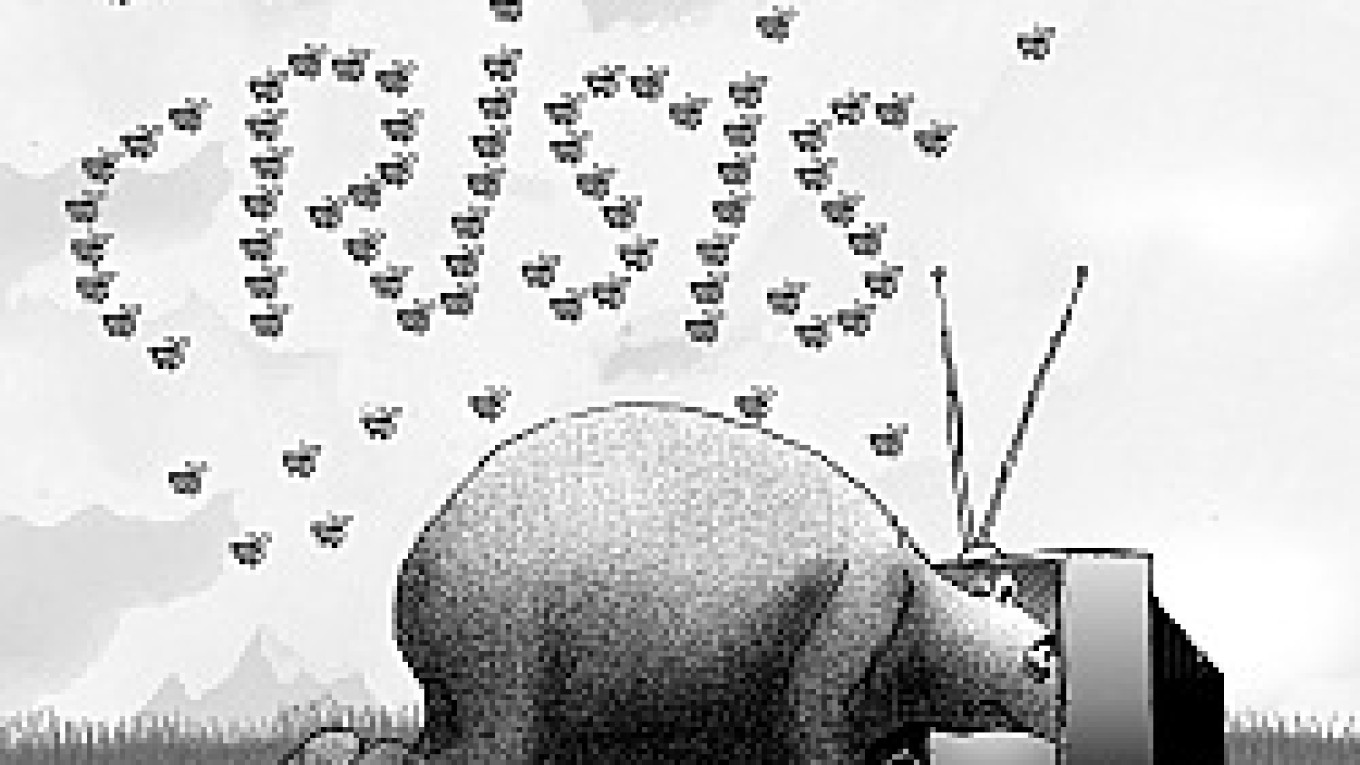
Instead, television news usually focuses on the financial woes in the United States and the U.S. responsibility for the global crisis. Stressing Russia's emergence as the world's new economic superpower is high on the agenda for the state-run media. For the average viewer just tuning in, the outlook might seem rosy in Russia, especially compared to other countries.
One can also frequently find reports of new credit being extended to troubled banks and Kremlin-friendly corporations, as well as segments on economic directives being issued down the political chain of command. Coverage of Russia's collapsing stock exchanges, which have fallen much more than their counterparts in other countries, has been scant.
 | To Our Readers |
The Moscow Times welcomes letters to the editor. Letters for publication should be signed and bear the signatory's address and telephone number. |
It is interesting to compare this picture to the one in Ukraine. They could hardly be more different. On daily talk shows and live broadcasts from Ukraine's parliament, one can watch bickering politicians debate the conditions of the International Monetary Fund loan to Ukraine. And around Kiev, the rumor mill is grinding out stories of imminent hyrvnia devaluation.
News reports do not shy away from discussing which firms are having trouble paying off their debts, and speculation is rife about which political forces benefit most from avoiding a solution to the crisis.
Russia is arguably better positioned than Ukraine to deal with the effects of a prolonged crisis. First, Moscow's foreign currency reserves are much larger than Ukraine's. Second, Russia's inflation rate is much lower. Third, Ukraine is heavily dependent on Russia's supply of gas, and if Moscow raises its prices, this will be an additional blow to Ukraine's economy.
But the key element that differentiates Ukraine from Russia is the simple acknowledgement by the state and the media that the financial situation is a mess. Obfuscation, finger-pointing, blame-shifting and denial have been the Russian government's standard responses to the first signs of the country's crisis. Ukraine, however, seems to have learned a key lesson of an open society -- that sweeping your problems under the carpet does not get them solved. There is a benefit in engaging in political and economic discussion and debate. Keeping such debates out in the open does not guarantee that the best solutions will be found and implemented, but the chances for such solutions are much higher.
It is difficult to predict what direction economic and financial recovery will take in the coming months and years. Yet one thing is certain: Ukraine is not Russia. Access to information, press scrutiny and open debate on available policy options and the ramifications of bailout plans will speed Ukraine's rebound. But in Russia, the absence of conflicting opinions and debate and selective media coverage will undermine that country's path out of the crisis.
It has been said that if a frog is thrown into boiling water, it will jump out to save itself, while a frog in cold water will boil to death if the heat were slowly turned up. The theory isn't particularly scientific, but it nonetheless provides a useful framework for observing Russia and Ukraine during these times.
Like the frog in cold water, people have a tendency to avoid gradual changes. If the problems are ignored, they can escalate in severity. By extension, it may be easier for outside observers to notice important developments that seem insignificant to those on the inside who have grown accustomed to them.
Ukraine is trying to jump out of the pot while the temperature hasn't yet reached the boiling point, and it is doing this in the public view. But in Russia, the state continues to pretend that the heat is not even turned on. In a matter of months, however, Russia will not be able to escape the heat, and at that point, the crisis will become so severe that it could have catastrophic consequences for the country.
Marc Schleifer is program officer for Eurasia and Aleksandr Shkolnikov is senior program officer for global programs at the Center for International Private Enterprise in Washington.
A Message from The Moscow Times:
Dear readers,
We are facing unprecedented challenges. Russia's Prosecutor General's Office has designated The Moscow Times as an "undesirable" organization, criminalizing our work and putting our staff at risk of prosecution. This follows our earlier unjust labeling as a "foreign agent."
These actions are direct attempts to silence independent journalism in Russia. The authorities claim our work "discredits the decisions of the Russian leadership." We see things differently: we strive to provide accurate, unbiased reporting on Russia.
We, the journalists of The Moscow Times, refuse to be silenced. But to continue our work, we need your help.
Your support, no matter how small, makes a world of difference. If you can, please support us monthly starting from just $2. It's quick to set up, and every contribution makes a significant impact.
By supporting The Moscow Times, you're defending open, independent journalism in the face of repression. Thank you for standing with us.

Remind me later.