

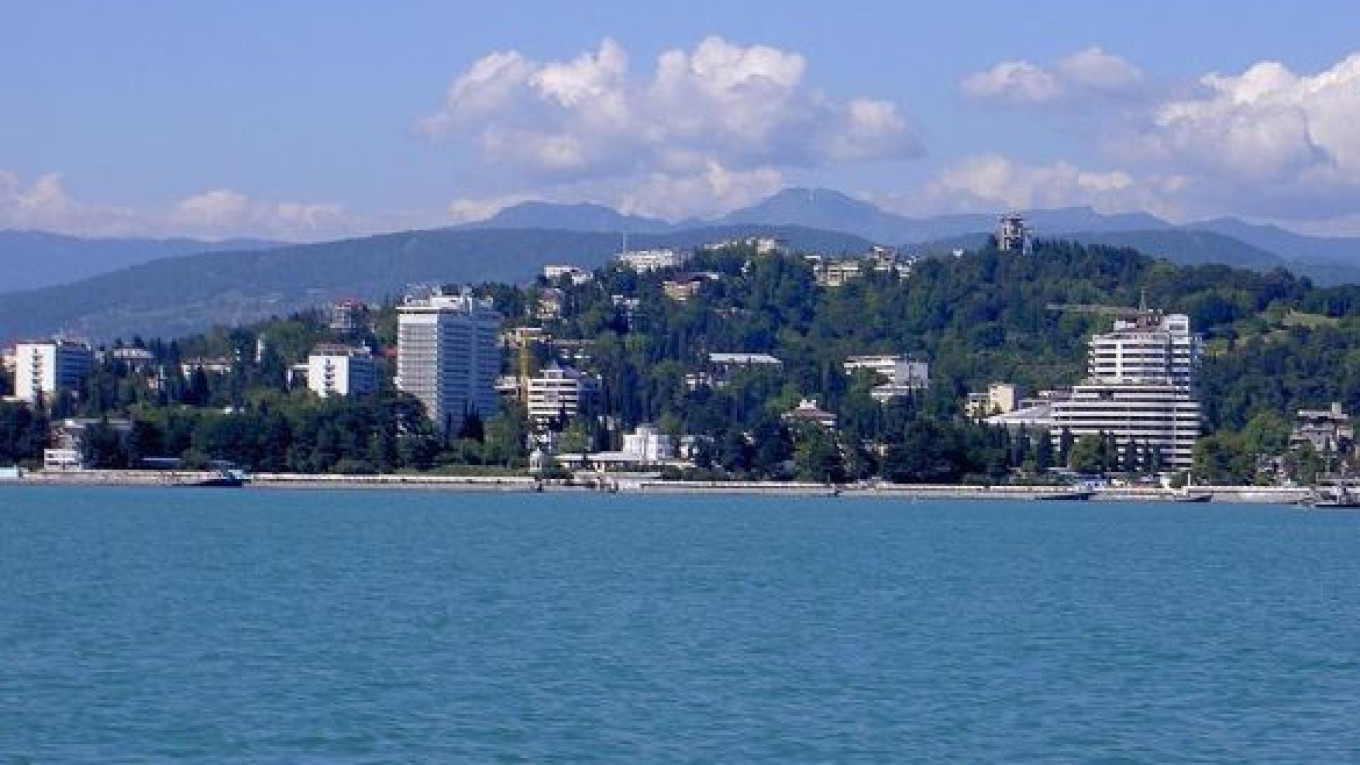
One year before the Winter Olympics are to kick off, it looks like Sochi 2014 is getting mired in controversy.
While the country's leaders have made it clear that the Olympics are a matter of national pride and prestige, national and international media attention is increasingly focused on the unprecedented $50 billion price tag, allegations of massive corruption, involvement of warring mafia clans, ecological destruction and the unfair forced resettlement of local residents.
On Wednesday, U.S. watchdog Human Rights Watch weighed in by saying that migrant workers employed in construction sites are subject to systematic exploitation.
Earlier this week, a report in Britain's Guardian linked the city with an ongoing turf war between mafia clans because reputed crime boss Aslan Usoyan, who was killed in Moscow last month, had vital business interests here.
And in a rare appearance on national television, veteran opposition leader Boris Nemtsov said on RBC TV that "between 50 and 80 percent" of the money "or some $30 billion" that is poured into Sochi is pocketed by corrupt officials and businessmen.
Nemtsov, who was born in Sochi and unsuccessfully ran for mayor in the city in 2009, argued that it was a huge mistake to award the Winter Games to a city with a subtropical climate, where practically all related infrastructure had to be built from scratch.
President Vladimir Putin seemed to respond to that criticism on Wednesday, when he admitted that corruption was driving up costs. "The most important thing is that nobody pilfers, so that there won't be unsubstantiated price hikes," he warned during an inspection in the Roza Khutor skiing resort.
Putin is widely seen as the games' patron after he was credited with personally convincing members of the International Olympic Committee to award them to Russia in Guatemala City in 2007.
Analysts even said that his desire to preside over the games as head of state was one explanation for his decision to return to the presidency last year. "One reason certainly was that opening the games with world leaders gives you such international prestige," said Alexei Makarkin of the Center of Political Technologies, a think tank.
Deputy Prime Minister Kozak, the government's point man for the Olympics, picked up this theme when he rebutted criticism of cost overruns by arguing that most of the money went into infrastructure projects. Speaking to reporters in Sochi on Tuesday, he said that only 200 billion rubles ($6.6 billion), split evenly between private investors and the state, is going into the Olympic construction, while the rest would be for the benefit of the local population.
"Attracting so much investment should be a matter of national pride," he was quoted as saying by Interfax.
Feelings of pride have been competing with a barrage of criticism for some time.
Critics argue that most of the private money comes from large state corporations, which rarely act in corporate interests. The games' general sponsor is state oil giant Rosneft, while Gazprom and Russian Railways are also on board.
Prominent among the critics are ecologists, who say that the massive construction projects are destroying local wildlife. In 2010, the United Nations Environment Program said in a report that the government had ignored the cumulative effects of the various projects on the regional ecosystems.
Another campaign against the games has been waged by Circassians, the remnants of the region's aboriginal inhabitants, many of whom fled after the Russian conquest of the Caucasus in the mid-19th century. Circassian activists, based mostly in the United States and the Middle East, complain that their ancestors' mass exodus amounts to brutal colonization and genocide committed by the Russian Empire and have launched a website against the games. http://nosochi2014.com/
But the most serious concerns have been around security, which is fragile in the entire North Caucasus region, that begins just behind the mountains that tower over Sochi.
In a bizarre incident, the Federal Security Service, or FSB, fueled such fears when it said last year that agents foiled a terrorist plot on Sochi, that was masterminded by Chechen separatists and authorities in Georgia. Making matters worse, the FSB said it discovered a huge arms cache in Abkhazia, a breakaway Georgian republic that lies just kilometers from Sochi.
However, PR experts interviewed for this article said that while it is facing an uphill struggle, the government might still reap a positive outcome.
They say that while media typically devote attention on controversy and criticism in the run-up to the games, their successful conduct can make this quickly forgotten.
"In the Olympic cycle you typically get a dip in confidence around a year before the start," said Dan Timms, who was the British government's head of communications for the 2012 London Summer Games, and who now works for Portland, a London-based communications agency.
Timms said that organizers should work hard over the coming 12 months because Olympic Games invariably provide an opportunity like no other.
"There are few international sporting events that might have a larger impact on how the rest of the world views a host country," he said.
As an example, Timms pointed out that Canada made a huge image leap because of the 2010 Winter Games in Vancouver.
He added that in the run-up, Vancouver was also hit by criticism, ranging from climate concerns to opposition from native Americans. "But they launched a clever promotional campaign, and their nation brand index jumped from 2005 in 2010," he said by telephone.
Russia usually fares poorly in international image ratings. In a 2011 survey it was rated the worst member of the BRIC group, which includes China, Brazil and India, tying with Egypt and Venezuela.
Timms suggested that while the games won't heal a negative image overnight, they could do a lot of good by surprising people.
"They can send a strong signal to the world of a new, modern Russia," he said.
His words were echoed by Peter Necarsulmer, a veteran PR strategist who has worked in Russia since 1990.
Necarsulmer argued that while the task was definitely difficult, the country was doomed to succeed because "there is nothing more important than pulling off a globally successful 2014."
He added that the government would have "demonstrate that the fabulously large investment has benefit not only for the image also for the people."
Igor Reichlin, owner of the Reichlin & Partners PR firm, predicted a mixed result. "They will do anything possible to prevent disaster. Russia is always good for mass-mobilization," he said. "But I don't know if they will manage to cover the gaping holes behind the scenes."
Related articles:
A Message from The Moscow Times:
Dear readers,
We are facing unprecedented challenges. Russia's Prosecutor General's Office has designated The Moscow Times as an "undesirable" organization, criminalizing our work and putting our staff at risk of prosecution. This follows our earlier unjust labeling as a "foreign agent."
These actions are direct attempts to silence independent journalism in Russia. The authorities claim our work "discredits the decisions of the Russian leadership." We see things differently: we strive to provide accurate, unbiased reporting on Russia.
We, the journalists of The Moscow Times, refuse to be silenced. But to continue our work, we need your help.
Your support, no matter how small, makes a world of difference. If you can, please support us monthly starting from just $2. It's quick to set up, and every contribution makes a significant impact.
By supporting The Moscow Times, you're defending open, independent journalism in the face of repression. Thank you for standing with us.

Remind me later.