

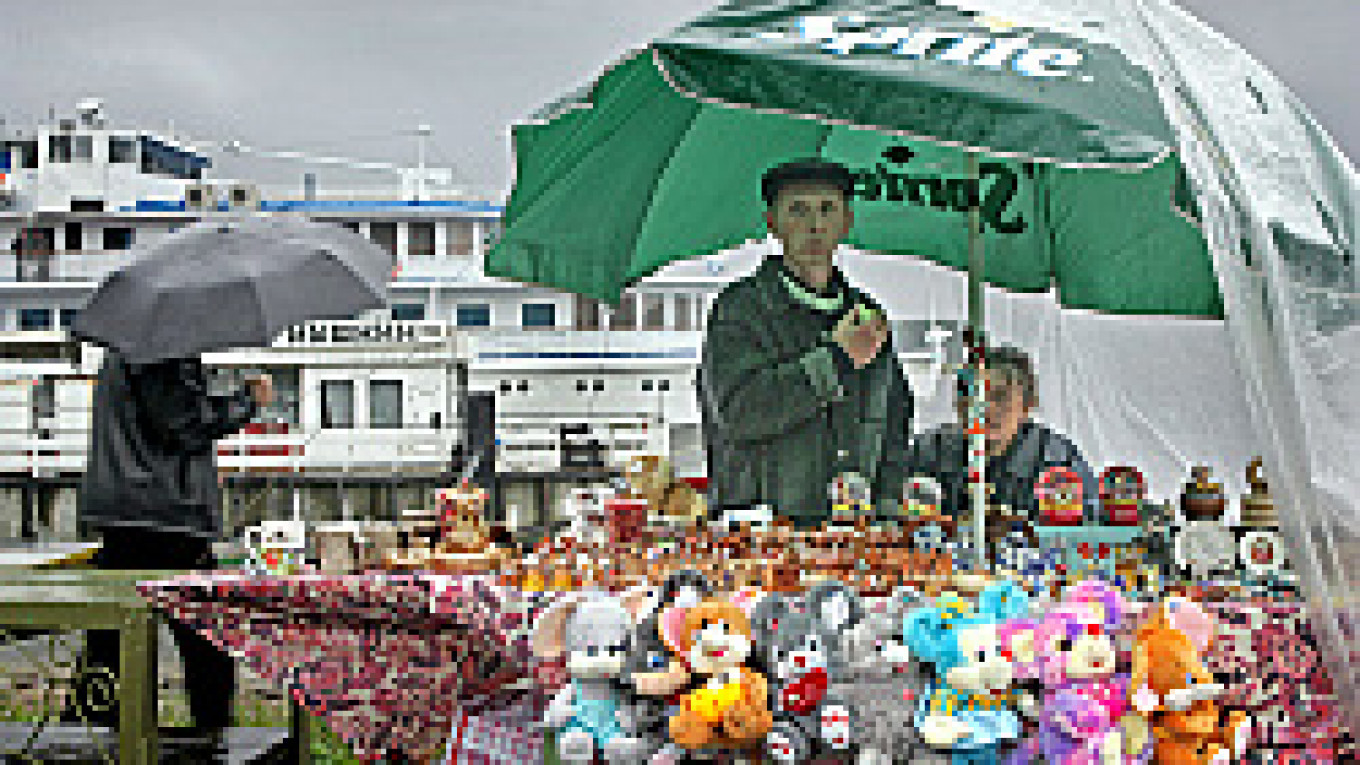
Whatever sort of historical vista you sought but couldn't find in the quickly modernizing capital is likely to be tenderly preserved in this small town in the Yaroslavl region, 280 kilometers north of Moscow.
Myshkin, or "Mouse Town," was established as a town in 1777, during the reign of Catherine the Great. Its lore boasts that the empress once passed the town on a trip down the Volga. A portion of Catherine's ship's log, which includes Myshkin on its route, is preserved in the town's National Historical Museum Complex. The settlement of this area, however, predates the town by centuries. The settlement's existence can be found in the historical record as early as the 15th century, but archaeologists believe that the area may have been populated since 5,000 B.C.
The town owes its colorful name to a local legend. A feudal lord had fallen asleep on the hill and was awakened by a mouse running across his face. His initial fury quickly turned to gratitude when he saw that a serpent was ready to strike him. The mouse had saved his life, and in return the lord ordered a cathedral to be built on that spot that is now the center of town. He further ordained that the town surrounding the cathedral be named after the mouse that saved him.
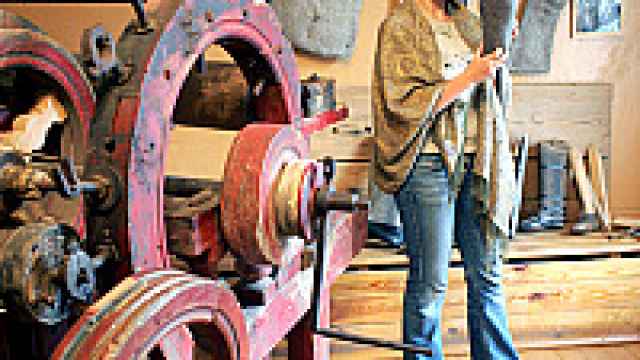 Vladimir Filonov/MT Myshkin's museums include one about retro-mechanics and another for felt boots. |  |
| |
"We are history fanatics," said Nikolai Lushin, director of Myshkin's National Historical Museum complex. "We travel all over the region to collect everything we find interesting."
Lushin said that the Myshkin museum opened in the 1960s, when three teachers from Myshkin founded a group of amateur history enthusiasts and invited the town's residents to donate artifacts to a small historical exhibit. The townspeople donated everything they could find, from the arrowheads and mammoth tusks that had washed up on the shores of the Volga, to family heirlooms. The museum even acquired a 19th-century bar of soap. The group of historians, led by Myshkin scholar Vladimir Grichukhin, began traveling around the country to carry out archaeological digs. One of the most ancient artifacts in the museum is a Finnish wishing stone that dates back to the fourth century.
The museum complex includes five museums: the Museum of Oarsmen, the Museum of Carpentry, the Museum of Retro-Mechanics, the Smirnov Museum, and, of course, the Mouse Museum.
"It was easy to gather these treasures because when we started collecting, no one was interested in preserving Russian history," said Lushin. "Communist ideology was all about building something new, so the government didn't value these historic possessions and they were simply there for the taking."
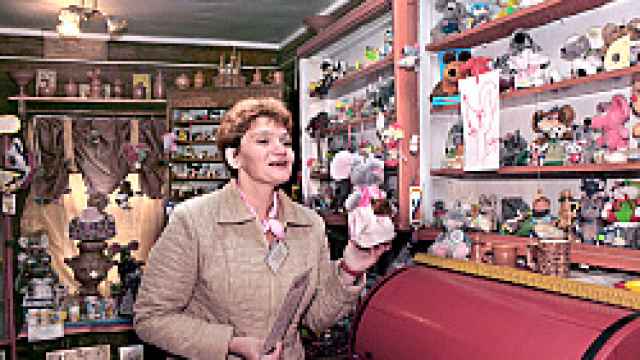 Vladimir Filonov/MT The toy mice in the Mouse Museum may soon outnumber Myshkin's residents. | |
| |
"You would walk into an abandoned house and everything was still in its place. Not only did people not bother to take their things, they sometimes even left the lights on."
Lushin and members of the museum continue to travel around the country to collect artifacts, large and small. The outdoor exhibit includes several peasant huts, a smithy, a windmill and a wooden fire station. A self-proclaimed techno-fanatic, Lushin has also built a collection of retro-technology, which mostly dates back to the World War II era. The museum is actively working to acquire and restore more pieces, which they rent to period films. Lushin hopes that the museum will soon be able to let visitors take a ride in some of their GAZ cars and ZiL trucks.
Visitors must be wary of historical vertigo as they wander around Myshkin's museum complex. The collections are as extensive as they are undiscriminating.
"We even have an American school bus!" Lushin said, pointing to a giant yellow bus that stands awkwardly next to the traditional peasant village that has been recreated in the museum's outdoor exhibit.
For the nostalgic traveler, much of Myshkin's allure derives from the fact that Myshkin has not entirely shed its Soviet demeanor. A silver Lenin still stands below drooping power lines and Soviet cafeterias have not been replaced by fast food chains; they haven't even been renamed. Stolovaya No. 2 serves pirogi to tourists and residents alike for 10 rubles.
In honor of the Chinese calendar designating next year the year of the mouse, Myshkin plans to host a festival of the mouse. It is rumored that President Vladimir Putin plans to attend. The town is quickly developing and expanding its already large list of tourist attractions; Myshkin plans to build a new hotel and a small-scale, mouse-themed amusement park. While these developments bode well for Myshkin's tourist industry, they threaten some of its more interesting and unguarded relics such as Stolovaya No. 2.
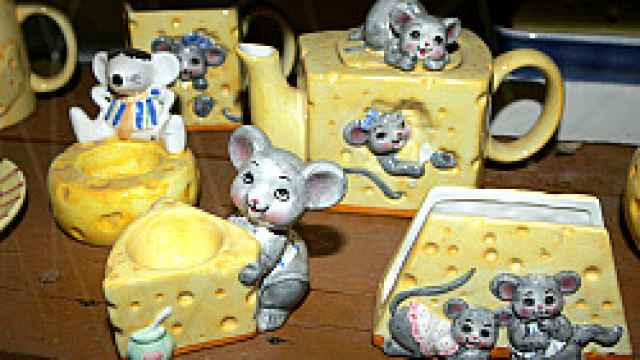 Vladimir Filonov/MT As a blossoming tourist trap, Myshkin is not without an element of cheesiness. | |
| |
Lushin insists that we stay for tea, tempting us with kolbasa, cheese, chocolates and ***kosarylovka,*** homemade liquor. The drink takes its name from the expression one makes when drinking it (***kosa*** means cross and ***rylo*** refers to the face of a beast), but the drink is actually syrupy and delicious. While there are several small hotels in Myshkin, Myshkinites often open their homes to tourists. Lushin will arrange home-stays for people who come to visit his museum. Visitors should be aware, however, that it is difficult to find lodging during the busy summer months; plan to book in advance.
While no one can deny this town its hard-earned success, the nostalgic tourist should seize the opportunity to visit Myshkin before its treasures are buried beneath gimmicks and Russian kitsch.
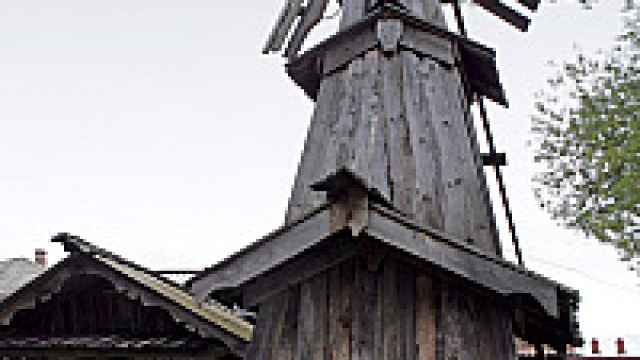 Vladimir Filonov/MT An old wooden windmill on display in the outdoor exhibit of Myshkin museum. | |
| |
By train: Take train No. 602 Moscow-Rybinsk to Volga station. From there, it's a 20-kilometer bus ride to Myshkin. In the summer months, the train leaves daily at 9:04 p.m. from Belorussky station and arrives at 5:43 a.m. Traveling by train takes eight and a half hours, about twice as long as traveling by car. In the winter months, the train only runs on Monday, Wednesday and Friday.
By car: Take Uglichskaya Ulitsa to Sergiyev Posad then follow the signs toward Kalyazin. About four kilometers before reaching Kalyazin, take a right toward Uglich and follow the signs toward Myshkin.
What to See
Myshkin National Historical Museum Complex -- encompasses five museums. You can pick and choose which you would like to explore, but it doesn't take too long to visit all five.
Summer hours: 6 a.m. to 10 p.m. In the fall/winter/spring, call ahead to find out the hours. 19 Uglichskaya Ulitsa, (48544) 2-13-39, www. myshkin.ru.
Museum of Valenki -- A museum of traditional Russian felt boots. You can learn all about them and even buy a pair at the door. Hours: 9 a.m. to 5 p.m. on weekdays and by request on weekends, 18 A Nikolskaya Ulitsa, (48544) 2-27-77.
Where to Stay
Hotel Myshkino Podvorye -- There is a bar/restaurant in the hotel. Rooms run about 1,500 to 3,000 rubles per room on weekends and 1,300 to 2,800 rubles on weekdays. In the busy summer months, you may want to book rooms a month or two in advance.
Myshkin, Yuhot village, (48544) 2-8275, www.myshkin-inn.ru.
Home-stays can be arranged at the Myshkin National Historical Museum Complex for 250 to 300 rubles per night.
Where to Eat
Restaurant Myshelovka -- The restaurant is designed to resemble a wooden peasant hut, but with its private dining room, live music, and dance floor Myshelovka is well equipped to entertain large parties of tourists. The restaurant's signature dish is a soup with white mushrooms and cheese called Pohlyobka po Derevensky (65 rubles).
27 Rybinskaya Ulitsa, (48544) 2-2480, noon-midnight.
A Message from The Moscow Times:
Dear readers,
We are facing unprecedented challenges. Russia's Prosecutor General's Office has designated The Moscow Times as an "undesirable" organization, criminalizing our work and putting our staff at risk of prosecution. This follows our earlier unjust labeling as a "foreign agent."
These actions are direct attempts to silence independent journalism in Russia. The authorities claim our work "discredits the decisions of the Russian leadership." We see things differently: we strive to provide accurate, unbiased reporting on Russia.
We, the journalists of The Moscow Times, refuse to be silenced. But to continue our work, we need your help.
Your support, no matter how small, makes a world of difference. If you can, please support us monthly starting from just $2. It's quick to set up, and every contribution makes a significant impact.
By supporting The Moscow Times, you're defending open, independent journalism in the face of repression. Thank you for standing with us.

Remind me later.