

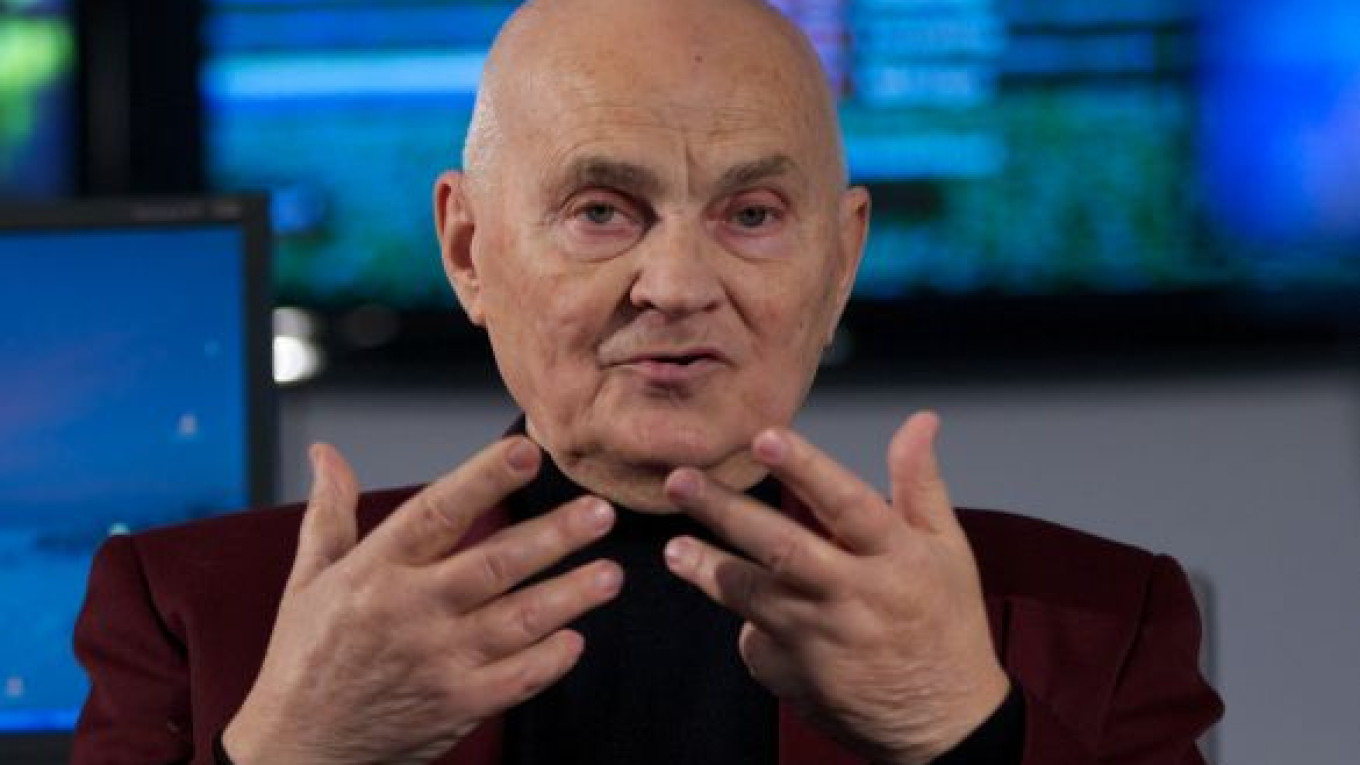
A former senior Russian archive official says he saw a file that could shed light on Holocaust hero Raoul Wallenberg's fate — challenging the FSB's insistence that it has no documents about the man who saved thousands of Hungarian Jews before disappearing into the hands of Soviet secret police.
Anatoly Prokopenko, 78, said in 1991 he saw a thick dossier containing numerous references to Wallenberg that suggested he was being spied on by a Russian aristocrat working for Soviet intelligence. Russian officials later said the file didn't exist, in line with blanket denials of having information on Wallenberg.
"That file is extremely interesting because it could allow us to determine the reasons behind his arrest," Prokopenko said, while acknowledging that he had only a few minutes to flick through hundreds of pages of documents.
As Sweden's envoy to Nazi-occupied Hungary, Wallenberg saved 20,000 Jews by giving them Swedish travel documents or moving them to safe houses, and managed to dissuade Nazi officers from massacring the 70,000 inhabitants of the city's ghetto. The 32-year-old diplomat was arrested by the Soviets in January 1945 when the Red Army stormed Budapest and imprisoned him in Moscow.
The Soviets had stubbornly denied that Wallenberg was in their custody before issuing a 1957 announcement that he had died on July 17, 1947, in his prison cell of a sudden heart attack. They stonewalled international demands for information about his fate, and rejected allegations that Wallenberg could have lived as a prisoner under a different identity as late as the 1980s.
Prokopenko said that in the fall of 1991, on an inspection tour of the main KGB archive in a tightly guarded facility outside Moscow, he came across a hefty dossier on Count Mikhail Tolstoy-Kutuzov, a Russian aristocrat who left Russia after the 1917 Bolshevik Revolution and worked alongside Wallenberg in Budapest.
Prokopenko said he only had a few minutes to peek at the dossier, but he saw Wallenberg's name mentioned repeatedly in what appeared to be Tolstoy-Kutuzov's reports to his handlers in Soviet intelligence.
"I realized that he was following every step Wallenberg made," Prokopenko said.
Prokopenko was fired just over a year later and deprived of his access to the archives — a move Prokopenko attributes to his efforts to reveal secret Soviet archives to the public.
He said he advised Guy von Dardel, Wallenberg's half-brother who spent years searching for clues to his fate, to ask the KGB successor agency for permission to see the files on Tolstoy-Kutuzov. They turned him down, saying no such files existed.
When von Dardel said he knew from Prokopenko that this wasn't true, officials asked him to come back in a few days and handed him a dossier that contained only a few pages lacking any reference to Wallenberg.
Prokopenko said Stalin's secret police possibly suspected Wallenberg of being involved in secret contacts between the Western Allies and the Nazis and were eager to learn about his connections.
Wallenberg had been recruited for his rescue mission in Budapest by a U.S. intelligence agent, with Swedish government approval, on behalf of the War Refugee Board created by President Franklin D. Roosevelt. But he is not known to have been engaged in intelligence gathering.
Susanne Berger, a German researcher who advised a Swedish-Russian working group that conducted a 10-year investigation that ended in 2001, backs Prokopenko's view that the Soviets likely saw Wallenberg as a valuable source of intelligence.
"The Soviet leadership was particularly paranoid about what it perceived as a possible Anglo-American conspiracy against Soviet interests," she said in e-mailed comments.
Berger added that Stalin might have hoped to use Wallenberg for future bargaining with the West.
"The most likely reason for Stalin to arrest Raoul Wallenberg would have been to use him as some kind of 'asset,' to bargain or negotiate for," Berger said. "Stalin may have felt that with Raoul Wallenberg, the scion of a powerful Western business family, he held a rather interesting bargaining chip."
The former archivist said KGB officers privately told him that Wallenberg was killed because his refusal to cooperate made him a liability. "They couldn't have set him free, they would have needed to liquidate him," Prokopenko said.
The chief of the archives of the Federal Security Service, the main KGB successor agency, admitted in a rare interview in September that the Soviet version that Wallenberg died of a heart attack could have been fabricated and that his captors may have "helped him die." Lt. Gen. Vasily Khristoforov said all documents related to Wallenberg likely had been destroyed back in the 1950s and denied that his agency was withholding any information related to his case.
Prokopenko, who headed the Special Archive containing documents from 20 European countries in the waning years of the Soviet Union, allowed researchers working for an international commission investigating Wallenberg's case to search for clues to his fate amid Soviet President Mikhail Gorbachev's openness campaign.
They quickly found a document on Wallenberg's transfer from one Soviet prison to another, but the KGB immediately learned of the effort and ordered them out.
Prokopenko lost his job soon afterward, but continued his work to open the archives under the government of Boris Yeltsin.
A Message from The Moscow Times:
Dear readers,
We are facing unprecedented challenges. Russia's Prosecutor General's Office has designated The Moscow Times as an "undesirable" organization, criminalizing our work and putting our staff at risk of prosecution. This follows our earlier unjust labeling as a "foreign agent."
These actions are direct attempts to silence independent journalism in Russia. The authorities claim our work "discredits the decisions of the Russian leadership." We see things differently: we strive to provide accurate, unbiased reporting on Russia.
We, the journalists of The Moscow Times, refuse to be silenced. But to continue our work, we need your help.
Your support, no matter how small, makes a world of difference. If you can, please support us monthly starting from just $2. It's quick to set up, and every contribution makes a significant impact.
By supporting The Moscow Times, you're defending open, independent journalism in the face of repression. Thank you for standing with us.

Remind me later.