

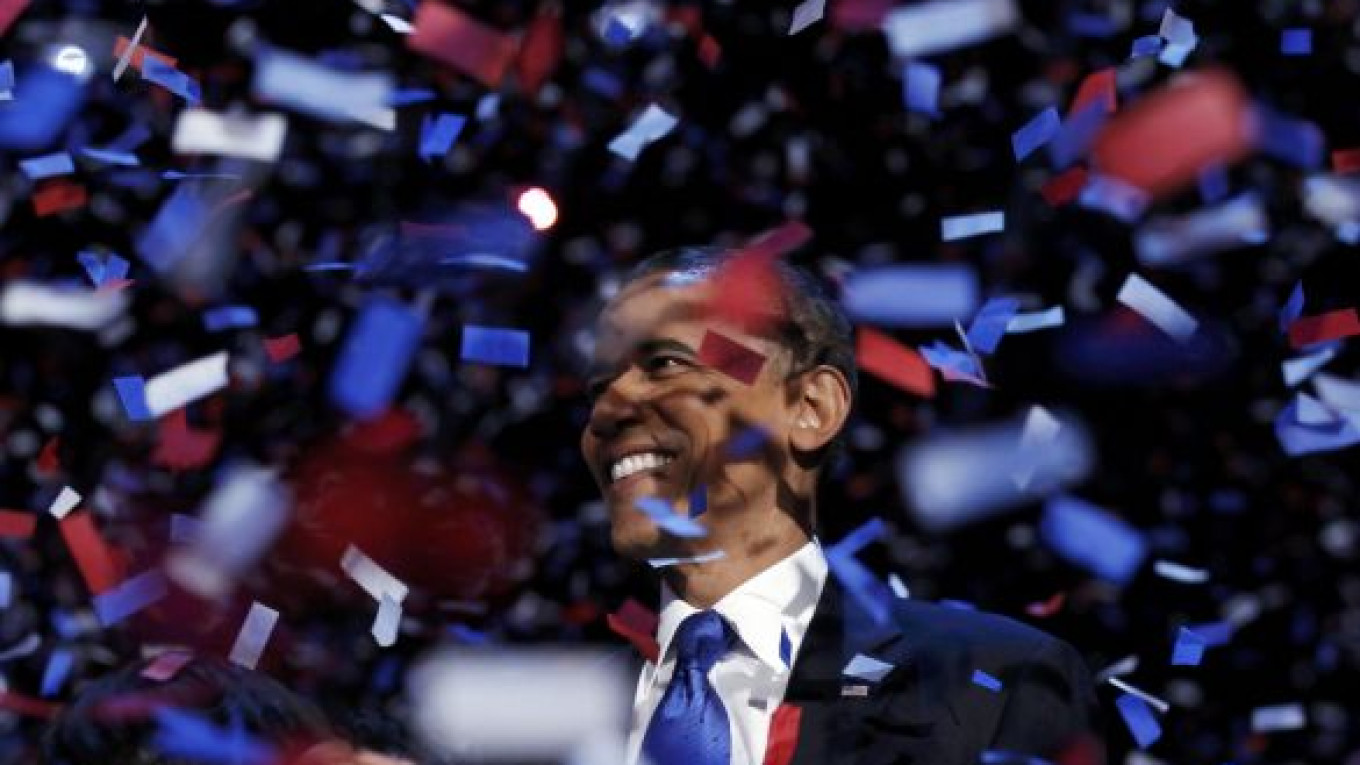
U.S. President Barack Obama’s re-election was widely praised in Moscow on Wednesday, although opposition leaders and analysts cautioned that the much-touted “reset” in relations would hardly continue in its present form.
Russian-American relations took a roller-coaster ride during Obama’s first term. The White House’s reset policy peaked with the 2010 New START nuclear arms agreement, but ties noticeably cooled this year, as Putin’s return to the Kremlin was marked by anti-American rhetoric and an ongoing crackdown on the opposition.
Alexei Pushkov, the hard-line chairman of the State Duma’s International Affairs Committee, said Wednesday that Obama’s victory meant a “less aggressive” U.S. foreign policy than if the Republican contender, Mitt Romney, would have won. But Pushkov declared Obama’s reset policy a failure and called on the administration to turn a new leaf.
“If you look at the reset as an attempt to raise relations to a new quality and to move geopolitical interests closer, then it has failed,” he was quoted as saying by Interfax. Pushkov said that both sides need to make a fresh start and overcome accumulated mistrust.
“If the American side understands that it needs to work with [President] Vladimir Putin and must not think about its dislike of today’s Russia, then maybe we can achieve results,” he said.
Mikhail Margelov, chairman of the Federation Council’s International Affairs Committee, cautioned that it would be hard for Obama to pursue new highs in U.S.-Russian relations because of differences over NATO, Afghanistan and a global political arena that has become “fuzzy” after the Arab Spring toppled authoritarian regimes in the Middle East and North Africa, Interfax reported.
He predicted that the reset would continue but in a stilted manner. “I agree with the experts who say that U.S. foreign policy under the re-elected President Barack Obama will be carried out on an ‘incentive-response’ principle that is virtually unpredictable in terms of what the incentives will be, what the responses will be and even what the relationship with Russia will be,” Margelov said.
Staunch nationalist Vladimir Zhirinovsky, leader of the Liberal Democratic Party, said America was “doomed for stagnation” for the coming four years. “What will Obama do now? Nothing. He has no third term, he wants to reign another four years, he will travel abroad and won’t solve domestic problems,” Zhirinovsky wrote on his blog.
Zhirinovsky, who also is a deputy speaker in the State Duma, also said the U.S. should introduce a single, six-year presidential term, to ensure “more dynamic” candidates for the job. Russia introduced a six-year presidential term starting with Putin’s election for a third term earlier this year.
Pro-Western opposition leaders said they had limited expectations of how Obama’s second term would affect mutual relations.
Boris Nemtsov, a co-leader of the Republican Party — People’s Freedom Party, said the biggest problem was in Moscow, not in Washington. “Putin is dependent on aggressive anti-Americanism. He needs an enemy,” Nemtsov told The Moscow Times.
Putin has accused the U.S. State Department of financing the massive street protests against him that started after last December’s Duma elections.
Nemtsov added that he thought the reset had failed and that Washington knows that. “Obama has understood that Putin is paranoid [about America],” he said.
Asked about his expectations for the upcoming second Obama presidency, Nemtsov said he only hoped for a passing of the so-called Magnitsky bill that would slap sanctions on Russian officials implicated in human rights violations.
The bill, named after former Hermitage lawyer Sergei Magnitsky who died in a Moscow detention center, has been firmly opposed by the Obama administration out of fear that it would jeopardize the reset.
Analysts agreed that it would be hard to breathe new life into U.S.-Russian relations during Obama’s second term.
Pavel Bayev, a professor with the Peace Research Institute Oslo, argued that under President Putin’s third term it made little sense to continue policies that worked between Obama and former President Dmitry Medvedev.
“The Russia that tries to modernize and to re-establish cooperation with the West is gone,” Bayev said by telephone from Oslo. He added that the present Putin administration differed not just from the one under Medvedev but also from Putin’s first two administrations.
“He no longer aims to build personal networks among global peers. He has given up on that,” Bayev said, adding that Western leaders understood this. “Few believe in Putin the reformer,” he said.
Andrei Piontkovsky, a veteran analyst who is also active in the opposition movement, said he would have preferred Romney to win because a Republican president would make fewer compromises.
He confessed that he was one of among 27 guests who voted for Romney in a mock vote at an election night party at Spaso House, the U.S. ambassador’s residence, on Tuesday. One hundred and thirty-seven ballots were cast for Obama, Interfax reported.
Piontkovsky said that even under Obama the reset would soon be a thing of the past. “The U.S. has bigger problems than Russia and will forget this reset,” he said.
Romney had also been endorsed by opposition leader and former chess world champion Garry Kasparov, who called Obama’s reset policy “a disaster giving Putin everything he wants.”
Writing on Facebook, Kasparov said Romney was correct when calling Russia the United States’ “No. 1 geopolitical foe” during a campaign event. However, “he should have specified it is Putin, and not the Russian people,” Kasparov said.
But Dmitry Trenin, director of the Moscow Carnegie Center, disagreed.
Trenin argued that it was wrong to assume foreign policy toward Moscow could change the country’s domestic agenda. The capacity of an outsider to play a meaningful role in a big country’s domestic politics is pretty low,” Trenin told The Moscow Times.
He suggested that Washington should focus on “doable” policies to keep good relations with Moscow alive. As examples, he noted NATO’s planned missile defense shield for Europe and cooperation over peaceful exploration of the Arctic.
“The U.S. is not out to topple the government or to help who ever wants to topple it, but to deal with a country that is a very important partner in key areas of the world,” Trenin said.
President Vladimir Putin told Obama in a congratulatory telegram that he hoped for “constructive” cooperation and continued “substantive and open dialogue” with Washington, according to a Kremlin transcript.
Putin also said that U.S. Russian cooperation would make the world safer and more stable. But while “sizable results” were achieved during the last years, both sides need to solve “a host of issues” to open up the whole potential for mutual cooperation. He invited Obama to visit Russia next year.
Related articles:
A Message from The Moscow Times:
Dear readers,
We are facing unprecedented challenges. Russia's Prosecutor General's Office has designated The Moscow Times as an "undesirable" organization, criminalizing our work and putting our staff at risk of prosecution. This follows our earlier unjust labeling as a "foreign agent."
These actions are direct attempts to silence independent journalism in Russia. The authorities claim our work "discredits the decisions of the Russian leadership." We see things differently: we strive to provide accurate, unbiased reporting on Russia.
We, the journalists of The Moscow Times, refuse to be silenced. But to continue our work, we need your help.
Your support, no matter how small, makes a world of difference. If you can, please support us monthly starting from just $2. It's quick to set up, and every contribution makes a significant impact.
By supporting The Moscow Times, you're defending open, independent journalism in the face of repression. Thank you for standing with us.

Remind me later.