

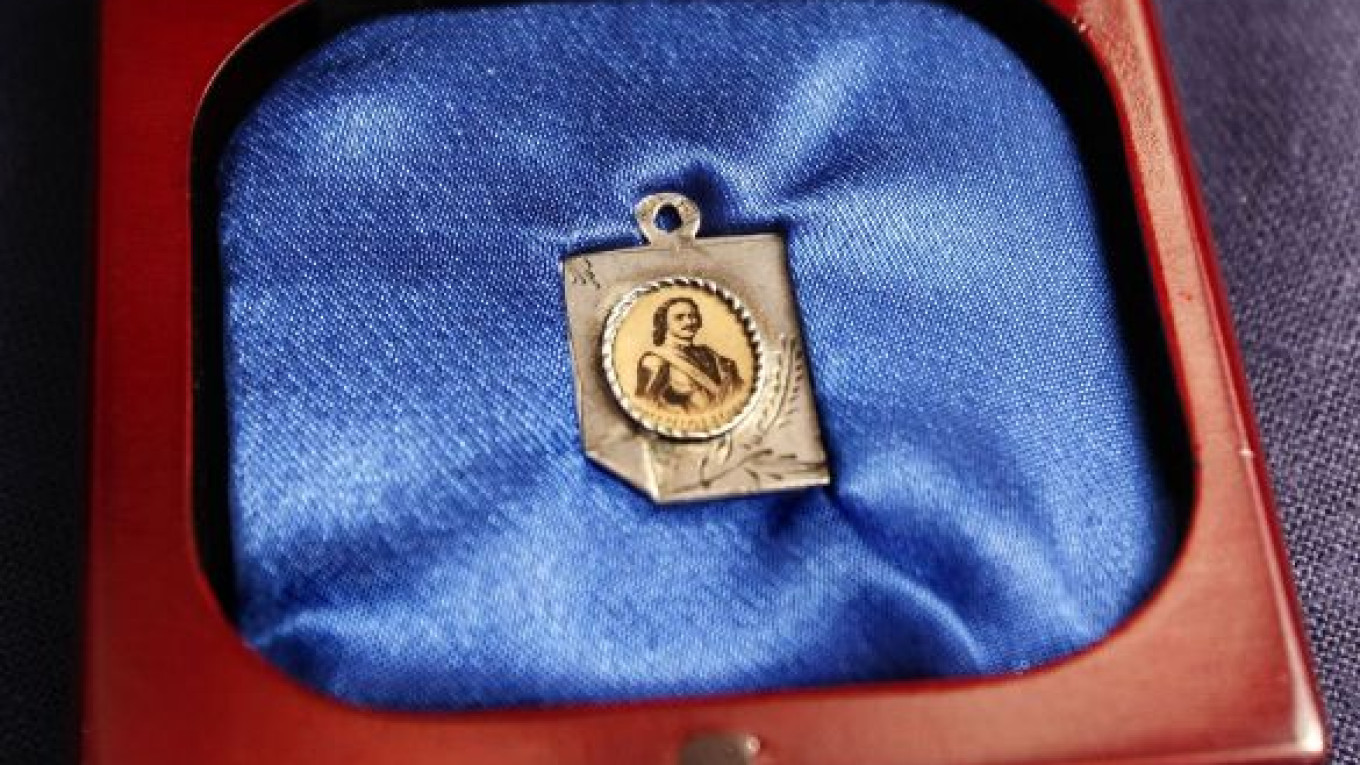
The United States on Thursday returned home a stolen silver pendant that once belonged to Russia's last tsar and surfaced on a online auction site last year with a starting price of $500.
In a conciliatory gesture, U.S. Ambassador John Beyrle handed the pendant to Investigative Committee spokesman Vladimir Markin in a small ceremony that brought U.S. lawmen and Russian cultural agents to the ambassador's Spaso House residence just off Arbat.
"This is not just a story about a small medallion, it is also a big example of successful cooperation that is building a better relationship," Beyrle said.
The pendant was among more than 200 items that authorities say were stolen four years ago by a married Russian couple working at St. Petersburg's Hermitage Museum, the Winter Palace of the tsars. It emerged on a U.S. auction site late last year.
Russian investigators had asked the United States to recover the pendant, which is 2.6 centimeters long and 1.7 centimeters wide and depicts a tiny portrait of 18th-century Tsar Peter the Great.
"We were able to locate the individual who had it, seize it and bring it back home," said Special-Agent-in-Charge Leigh Winchell, adding that it was found in the northwestern U.S. state of Washington.
He refused to identify who had the piece but said legal action against the person would take place.
The Federal Service for the Protection of Cultural Heritage said the pendant once belonged to Tsar Nicholas II, who was killed by the Bolsheviks after they swept to power in 1918.
It was among 220 items stolen from the Hermitage by the couple, said Alexander Kibovsky, the agency's head.
He added that the cash value of the pendant, which shows the long-haired, moustachioed Peter the Great clad in armor, was about $5,000, but that it was the cultural significance for Russians that made it "invaluable."
A Message from The Moscow Times:
Dear readers,
We are facing unprecedented challenges. Russia's Prosecutor General's Office has designated The Moscow Times as an "undesirable" organization, criminalizing our work and putting our staff at risk of prosecution. This follows our earlier unjust labeling as a "foreign agent."
These actions are direct attempts to silence independent journalism in Russia. The authorities claim our work "discredits the decisions of the Russian leadership." We see things differently: we strive to provide accurate, unbiased reporting on Russia.
We, the journalists of The Moscow Times, refuse to be silenced. But to continue our work, we need your help.
Your support, no matter how small, makes a world of difference. If you can, please support us monthly starting from just $2. It's quick to set up, and every contribution makes a significant impact.
By supporting The Moscow Times, you're defending open, independent journalism in the face of repression. Thank you for standing with us.

Remind me later.