

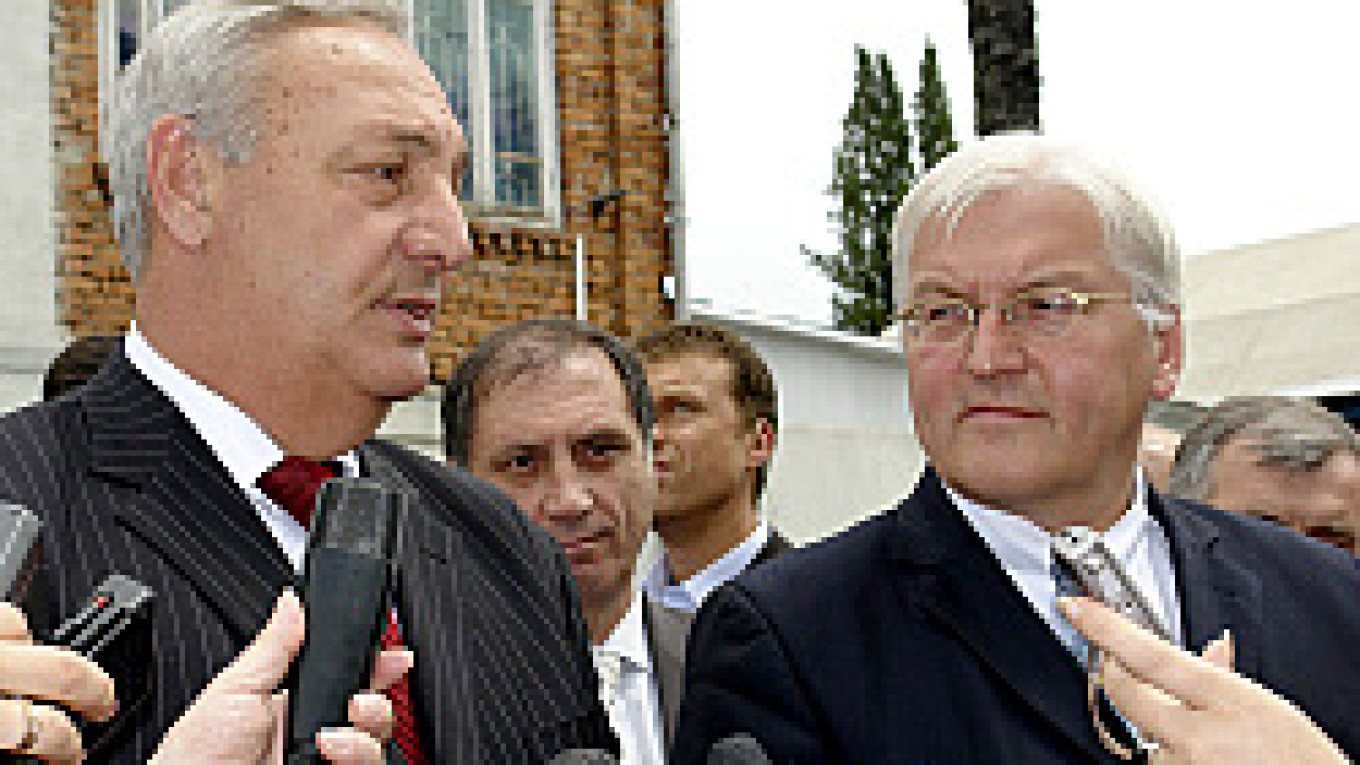
Speaking in an interview Sunday, Georgia's Reintegration Minister Temur Iakobashvili said German Foreign Minister Frank-Walter Steinmeier's tour of the region late last week represented "a very successful start."
Berlin is well suited to be an "honest broker" in the conflict, Iakobashvili said by telephone from Tbilisi. "Germany is in a unique position to have very friendly relations both with Georgia and the Russian Federation. And that is an opportunity."
Steinmeier presented a three-stage plan during a lightning visit Thursday and Friday to meet the leaders of Georgia, Abkhazia and Russia. While Tbilisi and Moscow cautiously accepted the initiative, Abkhaz President Sergei Bagapsh rejected it out of hand.
Proposed talks with Tbilisi over the return of refugees who fled during a vicious civil war that ended in 1993 and on the political status of the internationally unrecognized republic were unacceptable, Bagapsh told journalists Friday, after talks with Steinmeier. The two met in Gali, the Abkhaz town closest to the de facto border with Georgia.
Bagapsh warned that a return of the 250,000 Georgians expelled from Abkhazia would "definitely lead to a new war." As a precondition for negotiations, he identified the withdrawal of Tbilisi's forces from the upper Kodor valley.
Georgia regained control of the mountain region in Abkhazia after sending armed forces there in 2006.
Bagapsh's negative comments were echoed by both Foreign Minister Sergei Lavrov and President Dmitry Medvedev, who each held separate talks with Steinmeier the same evening outside Moscow.
"The highest priority is to sign an agreement on not using military means on both sides and on the withdrawal of Georgian forces from upper Kodor," Lavrov said in a statement published on the Foreign Ministry web site.
Medvedev also said in a statement that these two points were a precondition for any solution.
Lavrov had earlier said the plan called for the return of refugees at too early a stage.
But Iakobashvili said the criticism by Bagapsh, Lavrov and Medvedev should be considered the beginning of a brokering process.
"Everybody is trying to position himself in the limelight for a maximum bargaining position," he said.
In fact, Lavrov wrapped his criticism in an unusually warm appraisal for Steinmeier's mission.
"We highly value Germany's role as a coordinator," he said, adding that the plan has "the right conceptual approach and addresses all aspects."
"I am very grateful that Frank-Walter Steinmeier has made it possible for us to coordinate and discuss the next steps," he said.
Tbilisi has accused Moscow of supporting the separatists in Abkhazia and of further destabilizing the situation with covert activities like the recent shooting-down of a Georgian spy plane and violations of its airspace by fighter jets.
Last week, Tbilisi temporarily withdrew its ambassador from Moscow and threatened to shoot down Russian jets in the event of further incursions.
The German-sponsored plan was agreed to in principle last month in Berlin by representatives of the five powers acting under the United Nations secretary-general ?€” Britain, France, Germany, Russia and the United States.
The plan envisions three stages, the first of which involves increasing confidence-building measures between the government in Tbilisi and the Abkhaz leadership in Sukhumi.
The second stage is to focus on the province's economic reconstruction with a donors' conference in Berlin, while the third would see talks on Abkhazia's political status, which most experts consider by far the most difficult issue.
Bagapsh said Friday that he would only consider the first stage.
Iakobashvili said expectations should not be raised too high and that no one expected that Steinmeier had any kind of magic wand that could solve the problems all at once.
Steinmeier himself said he had no illusions but that he wanted to press on.
"Each side's position is still far from that of the other," he said in a report posted on the German Foreign Ministry's web site. "But the recent events force us to find a way out of the rising violence."
Iakobashvili said he thought the current phase of instability would continue.
"I believe that there will be more provocations, unfortunately," he said. "I believe that there will be ?€¦ more allegations ?€¦ until there is a new administration in the United States."
He also warned Moscow against opening an official mission in Abkhazia.
"It would be a very clear indication that Russia is moving toward annexation if they opened something like that," Iakobashvili said.
As the current crisis unfolded earlier this year, Moscow announced that it would set up "institutional links" with Abkhazia and Georgia's other breakaway region, South Ossetia. No further steps have been reported so far, but Bagapsh held talks in Moscow about opening a Russian mission in Abkhazia earlier this month.
Iakobashvili said Moscow would probably open "something semiofficial," reflecting previous patterns. He said, however, that he still believed "that there are people with reasonably good brains in Russia that will not allow hotheads to move in that direction."
Abkhazia angered Tbilisi last week when it opened an official representation with a self-styled ambassador in Transdnestr, the breakaway region east of Moldova.
As for Steinmeier's mission, Sergei Malashenko, an analyst with the Moscow Carnegie center, said it was a positive sign and could provide the impetus toward further negotiations.
"Russia well understands that Europe is taking an active role in the region," Malashenko said, adding that the current standoff could not go on forever and that Moscow needed an independent broker. "Sooner or later, a proposal will be accepted, and this was a successful first step."
But the German initiative also highlights the significance of Berlin's special relationship with Moscow on the European Union's ties with Russia.
Diplomats suggested that France, which in July took over the EU's rotating presidency, had yet to live up to expectations.
"The French side has, unfortunately, not taken a very active role yet," a senior European diplomat said Sunday, speaking on condition of anonymity because of the sensitivity of the matter. "But the EU hopes that this will provide an impetus and is ready to assist."
EU Foreign Policy chief Javier Solana on a recent visit to Georgia invited all sides to hold talks in Brussels.
Yet Boris Chochiyev, a deputy prime minister of South Ossetia, said his government had rejected the invitation because no representative from the neighboring Russian province of North Ossetia had been invited, The Associated Press reported.
A Message from The Moscow Times:
Dear readers,
We are facing unprecedented challenges. Russia's Prosecutor General's Office has designated The Moscow Times as an "undesirable" organization, criminalizing our work and putting our staff at risk of prosecution. This follows our earlier unjust labeling as a "foreign agent."
These actions are direct attempts to silence independent journalism in Russia. The authorities claim our work "discredits the decisions of the Russian leadership." We see things differently: we strive to provide accurate, unbiased reporting on Russia.
We, the journalists of The Moscow Times, refuse to be silenced. But to continue our work, we need your help.
Your support, no matter how small, makes a world of difference. If you can, please support us monthly starting from just $2. It's quick to set up, and every contribution makes a significant impact.
By supporting The Moscow Times, you're defending open, independent journalism in the face of repression. Thank you for standing with us.

Remind me later.