

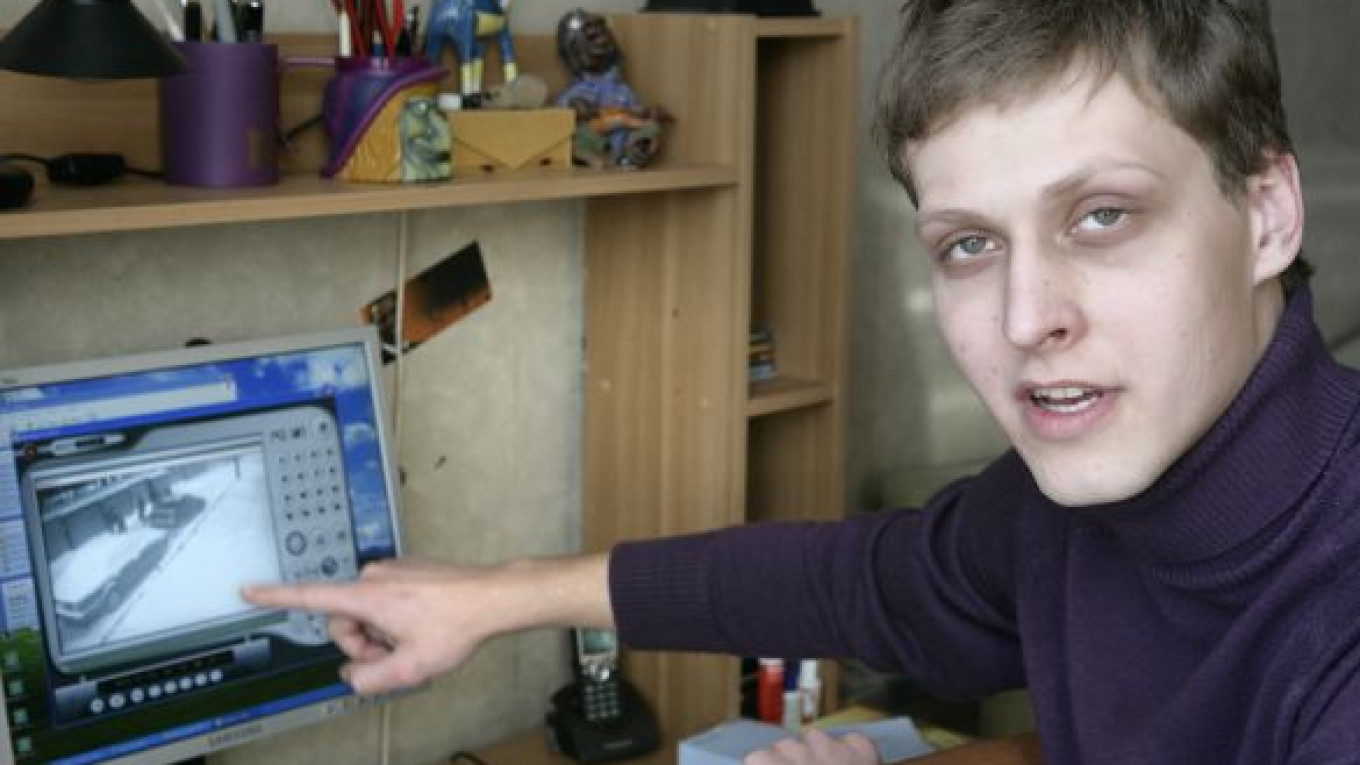
Vasily Astrashabov, a 19-year-old Moscow student, met with friends to go to a movie theater on New Year's Day but caught the eye of police officers seeking the attackers of a married Kyrgyz couple.
Astrashabov was detained, and the Kyrgyz wife identified him as one of the attackers. The husband, who was badly injured in the attack, said he was not sure.
But Astrashabov's father, a former Moscow police officer, said he saw a police investigator telling the wife that she "must identify" his son and calling him a "killer."
Astrashabov's lawyer, Raisa Tyurina, accused investigators of failing to include in their official case file any evidence of her client's innocence, including testimony of friends about his whereabouts that night and video footage from street surveillance cameras.
Astrashabov spent a month in detention on charges of attempted murder and was only released after his lawyer filed several complaints with various state agencies. He is still facing trial.
Supporters say Astrashabov fell victim to a bureaucracy that has infiltrated law enforcement agencies and forces them to report continually growing crime-solving rates.
The Interior Ministry, which has long linked crime-solving rates to bonuses and reprimanded police officers for not boosting their rates every year, tweaked the system in late January in a bid to reduce the temptation to make arrests for the sake of crime-solving rates.
The changes, however, are not inspiring confidence among a public weary of notorious police corruption.
It certainly hasn't made a difference for Astrashabov, who says he was 200 to 300 meters away from the underground pass outside the Rizhskaya metro station where the Kyrgyz couple was attacked hours earlier by a group of young people. The husband was hospitalized with grave stab wounds.
"Law enforcement officers did all this to report that they had solved a crime while in hot pursuit of the suspects, and this has led to accusations against a person who didn't commit the crime," Astrashabov's father, Alexander, said in an interview in the family's apartment.
Police referred questions about Astrashabov's case to the Investigative Committee's Moscow branch, which refused to comment, citing the ongoing investigation.
How many innocent people fall victim to police officers' drive for statistics is unknown. The Moscow Helsinki Group received about 610 complaints from suspects and convicts about violations by law enforcement officials between January and October last year, the group's executive director Nina Tagankina said.
The complaints included illegal detention, torture, psychological pressure and the refusal of law enforcement officers to consider requests from defense lawyers, Tagankina said.
The 610 complaints constituted 18 percent of all complaints that the group received over the 10 months.
A total of 418 people complained to the group In Defense of the Rights of Prisoners last year about their sentences, said a member of the group, Nadezhda Radnayeva. Sixteen of the 418 people told of law enforcement officers using violence against suspects who were under investigation. All 16 wrote from detention centers.
"Rather often, convicts complain that the confessions were beaten out of them or that they were convicted of grave crimes they didn't commit in addition to the crimes that they did commit," Radnayeva said.
Under orders from President Dmitry Medvedev to reform the country's police force, the Interior Ministry in late January enforced new rules for evaluating the work of police officers. Under the new rules, "the number of numerical indicators has been reduced" and "public opinion has become the main criteria" to assess police work, Interior Ministry spokesman Oleg Yelnikov said by telephone.
The new rules, a copy of which was obtained by The Moscow Times, declare themselves aimed at securing "the quality and legality of police work" and "the population's trust in the police."
Activists and one former police officer said that while the new rules have changed the method for assessing police work, the essence of the work remains the same.
"It's the same system that leads to power abuse, only the wording is different," said Dmitry Povarov, head of the Moscow branch of a police union, the Interregional Professional Union of Police Officers of the Russian Federation.
He said officers would still be required to show high crime-solving rates. Under such circumstances, police officers will continue to opt "to pin the crime on someone," he said.
Povarov was echoed by Mikhail Pashkin, head of the Professional Union of Police Officers of Moscow. "A police officer has to report a higher number of crimes and administrative offenses every year, and what if their numbers don't grow?" Pashkin said. "Police have been prosecuting the innocent and will continue to prosecute them."
A former Moscow police officer said the crime-solving rates reported by police precincts to the Interior Ministry "don't reflect reality" anyway because apart from "creating crimes," police "buy" figures for their crime-solving rates from colleagues and other law enforcement agencies and take figures from subordinate police units.
The former officer asked for anonymity in order to talk candidly without fear of reprisal.
She said police used to commonly "create crimes" by planting weapons on the homeless and drugs on drug abusers, and now they detain people and force them to steal from shops under threat of violence.
"Police are busy drawing up reports about crime-solving rates while nobody cares about solving crimes in reality," she said.
The Interior Ministry registered 2.8 million crimes from January to November last year, and 42.4 percent of them have not been solved, primarily because of a lack of suspects, it said on its web site. The 1.1 million unsolved crimes include 1,700 murders and murder attempts and 6,400 violent attacks.
Povarov and Pashkin said public opinion was important in assessing police work but the new rules did not ensure that it would be taken into account.
The new rules mention independent public opinion surveys as a way to assess police work. They also stipulate that the surveys be carried out by the Interior Ministry.
In any case, public opinion does not carry a lot of weight under the new system for scoring police work, Pashkin noted. If the new rules gave high marks for good public opinion, "then police would really work for the people," he said.
Astrashabov, the suspect in the New Year's attack, said he was proud of his father's work as a police officer but his opinion of the police had faltered after his arrest. He showed a reporter surveillance footage on his home computer that he said investigators had ignored and proved that he was not near the scene of the attack.
Astrashabov said he used to walk around the city "without fear, thinking that law enforcement officers protected me."
"Now I am more afraid of people in epaulets than hooligans," he said.
A Message from The Moscow Times:
Dear readers,
We are facing unprecedented challenges. Russia's Prosecutor General's Office has designated The Moscow Times as an "undesirable" organization, criminalizing our work and putting our staff at risk of prosecution. This follows our earlier unjust labeling as a "foreign agent."
These actions are direct attempts to silence independent journalism in Russia. The authorities claim our work "discredits the decisions of the Russian leadership." We see things differently: we strive to provide accurate, unbiased reporting on Russia.
We, the journalists of The Moscow Times, refuse to be silenced. But to continue our work, we need your help.
Your support, no matter how small, makes a world of difference. If you can, please support us monthly starting from just $2. It's quick to set up, and every contribution makes a significant impact.
By supporting The Moscow Times, you're defending open, independent journalism in the face of repression. Thank you for standing with us.

Remind me later.