

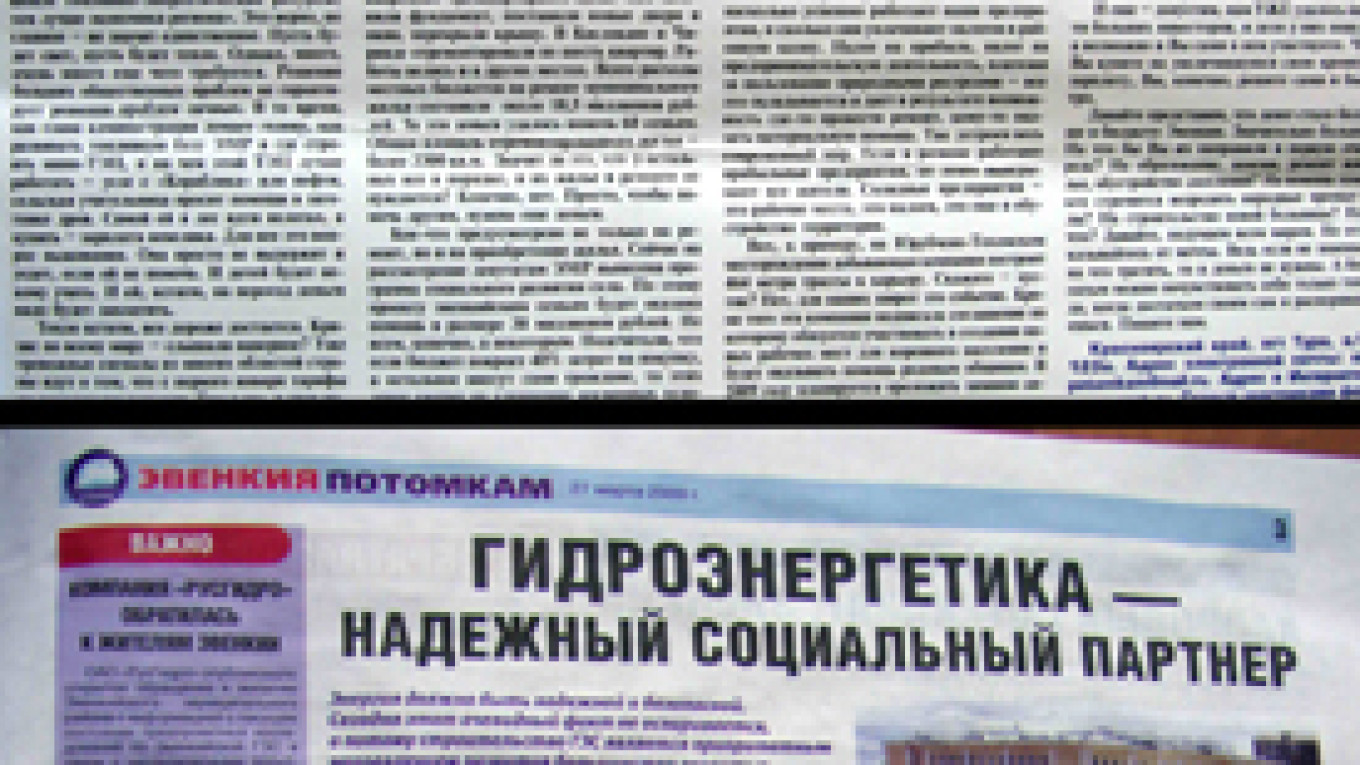
RusHydro's multibillion-dollar plans to develop the Evenkia dam on the Lower Tunguska River in the West Siberian region of Evenkia have been met with staunch opposition from both the local indigenous population and environmental organizations.
The think tank, the National Institute for Development of Modern Ideology, trumpets the social organization, which is called Evenkia for Our Descendants, as a "successful PR project" in its recently released annual bulletin.
Institute deputy director Yury Barklyansky confirmed by telephone that the institute had been involved in the social organization, which he said it "worked on with RusHydro."
Barklyansky said the institute's involvement lasted for two months last fall. He said RusHydro's point person for the organization was Natalya Stovskaya, deputy head of RusHydro's special-purpose communications department. The organization is still active but without the institute's participation, he said. When asked for further details, he said, "It would be more appropriate to ask RusHydro at this point."
Stovskaya denied that the social organization was created by RusHydro and said RusHydro has not worked with the institute. "I never knew such an institute existed," she said.
The National Institute for Development of Modern Ideology says on its web site that it was created to assist United Russia's work in the State Duma and "acts as an instrument of informational and analytical support in decision-making on key problems and the development of creative political solutions."
Two pages of the institute's annual bulletin are devoted to the Evenkia social organization, and the section is titled, "Forming Positive Public Opinion About Large Investment Projects Among the Inhabitants of Evenkia."
Many Evenks fear that the dam construction will destroy their habitat and way of life, and a recent poll by the local government found that 85 percent of them oppose RusHydro's plans. The dam project is currently at the stage of environmental impact assessment, and this will be followed by public hearings with local residents.
To counter the dismay over the dam, the National Institute for Development of Modern Ideology said it put together a plan for the social organization to spread "rational and emotional" messages of support for "developing large projects" in Evenkia. The emotional component "appeals to ancestral feelings" by referring to Evenk mythological writings and to the image of the white elk to "exert influence on the deepest human archetype, that of kin," according to the institute's bulletin.
The plan also calls for the publication of question-and-answer brochures, flyers and articles in the media and the creation of a special web site. The social organization employs five people, two of whom were "planted in Tura," Evenkia's capital, the bulletin says.
The organization's web site at Sever-Rost.ru features a leaping white elk on its home page, together with quotes from a myth about the animal's origin. "Nobody knows this land better than us, people living in Evenkia, and our voice should be heard by the Russian authorities," the site's mission statement reads.
The web site is registered to DV-News, a Moscow PR agency that won a tender last June to provide PR services and media support to RusHydro, according to publicly available records.
When asked about RusHydro's work with DV-News, Stovskaya said RusHydro chose the agency because of its "connections in the region." She did not elaborate on what kind of PR services are provided by the agency.
Evenk residents confirmed that Evenkia for Our Descendants is active in the region, distributing flyers, but they said it lacks public support. "They have talked to everyone in Tura, and only a couple people have joined them," Vladimir Lvov, an opponent of the dam, said by telephone from Tura.
He said he knows of three people working for the organization: Viktoria Merkulyeva, a local schoolteacher who heads the organization, and two people who have been living in a Tura hotel for months. "They take pictures and interview locals and then change our quotes and mix up information," he said.
While the organization may not have the support of the locals, it has been recognized by RusHydro and was the first indigenous organization to meet with company management in January. A subsequent company press release quoted Merkulyeva as saying that the organization was seeking to "draw locals into an active discussion about the Evenkia dam." Last Friday, the organization sent an open letter to President Dmitry Medvedev and Prime Minister Vladimir Putin, "pleading" on behalf of the Evenk population to take notice of "the intimidation tactics" used by environmental groups that "misinform and scare" the locals into opposing the dam.
Environmental groups in Russia and abroad have cautioned that flooding from the dam may lead to environmental catastrophes.
In regional television broadcasts on the dam issue, Merkulyeva has been shown in "man-on-the-street" interviews. "Life has stopped in Evenkia, there are not even toilets!" she complained on the Krasnoyarsk channel Yenisei-Region last month. She called for measures to develop the region. The program identified her as a local teacher, making no mention of her position with the social organization.
Attempts to contact Merkulyeva and other representatives of the group were unsuccessful this week. The group's web site provides no telephone numbers, and an e-mail sent Monday to an address listed on the site went unanswered.
The organization is not active with any other groups representing indigenous peoples in Russia, said Pavel Sulyandziga, who works with Russia's indigenous groups through the Association of the Small Indigenous Peoples of the North, Siberia and the Far East. "They are not an indigenous organization. We don't know who they are," he said.
He said any involvement by RusHydro in the group's creation would not only violate ethical norms but also infringe on international standards laid out in a United Nations declaration on indigenous rights. Russia, however, is one of 10 countries that abstained from approving the declaration in 2007.
Evenk residents have decried the tactics of the social organization, which they suspect is bankrolled by RusHydro. "If RusHydro wanted a normal business dialogue, it would act differently, without using dirty PR tricks," said Alina Sutyagina, an indigenous rights activist who works for the Evenkia administration. "This construction is a question of life and death for us."
A Message from The Moscow Times:
Dear readers,
We are facing unprecedented challenges. Russia's Prosecutor General's Office has designated The Moscow Times as an "undesirable" organization, criminalizing our work and putting our staff at risk of prosecution. This follows our earlier unjust labeling as a "foreign agent."
These actions are direct attempts to silence independent journalism in Russia. The authorities claim our work "discredits the decisions of the Russian leadership." We see things differently: we strive to provide accurate, unbiased reporting on Russia.
We, the journalists of The Moscow Times, refuse to be silenced. But to continue our work, we need your help.
Your support, no matter how small, makes a world of difference. If you can, please support us monthly starting from just $2. It's quick to set up, and every contribution makes a significant impact.
By supporting The Moscow Times, you're defending open, independent journalism in the face of repression. Thank you for standing with us.

Remind me later.