

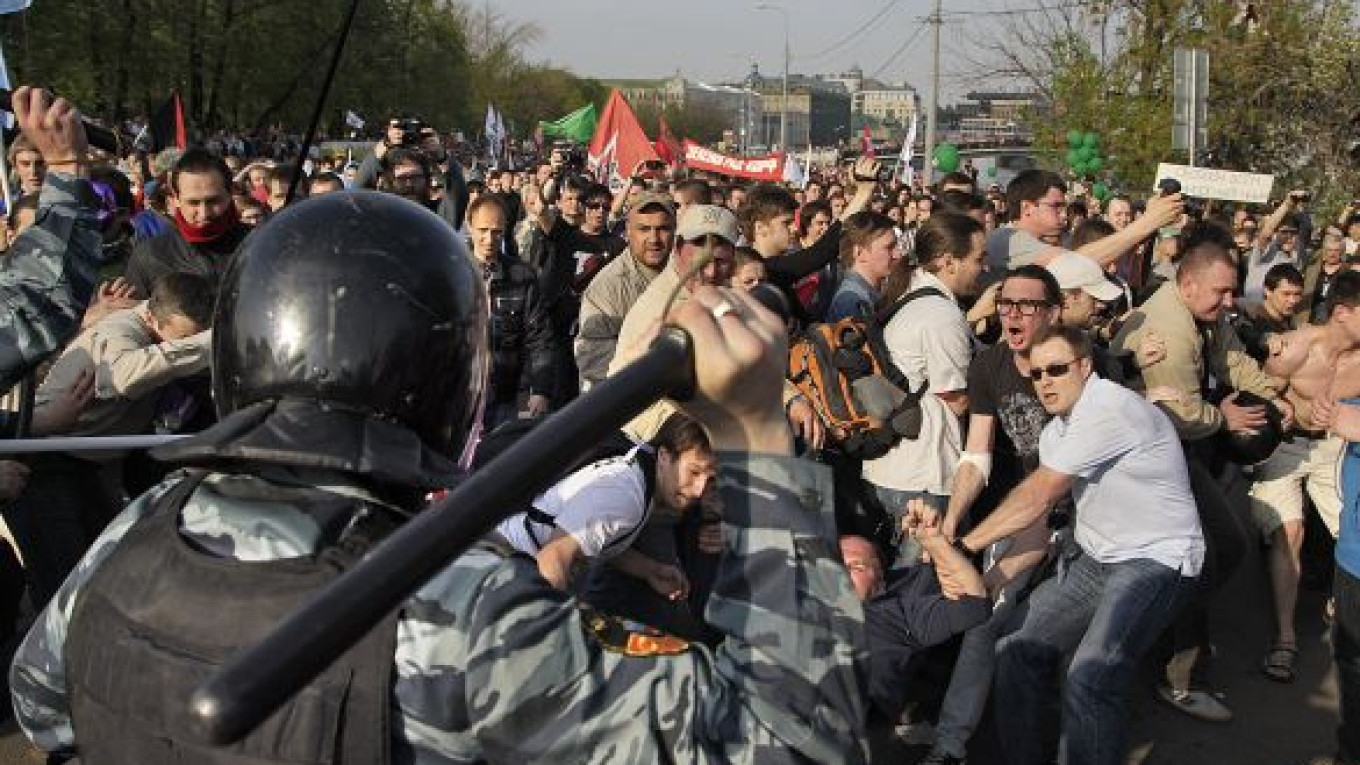
Hundreds of arrests and heavy rain showers couldn't stop the opposition from pulling off four days of round-the-clock protests against President Vladimir Putin in central Moscow.
But now they face perhaps their biggest challenge.
After Sunday's mass demonstration, opposition leaders acknowledge that the street protests could be squashed by the radicalization of some demonstrators, leading to internal divisions.
Analysts, meanwhile, predicted Wednesday that the protests, prompted by Putin's inauguration on Monday, would die down until a major event or perceived misstep by the authorities.
Questions also persist about whether the opposition has a wide enough base of support to sustain mass demonstrations.
But the opposition appears to have support in higher places than ever before, including from deputies in the State Duma, whose disputed election in December ignited the opposition protests. This suggests that the opposition —? at least for now —? is a force that the authorities will have to reckon with.
"The people don't fear detentions or riot police truncheons anymore," said Duma Deputy Dmitry Gudkov, of A Just Russia, who was detained at an opposition protest Tuesday.
"The police are only fanning the flames," he said, writing on his blog. "Very soon the people who are angry right now will really get pissed off. We will have passed the point of no return."
The middle-class Russians, who comprise the bulk of the protesters, said in interviews at rallies that they are acting out of a sense that moderates in the government have failed to win any reforms.
Former President Dmitry Medvedev's much-touted promises to reinstate direct elections for governors and make it easier to form political parties are seen as a half-hearted response to the winter's protests, the largest in almost 20 years.
Protesters' demands initially focused on free elections, but they've since branched out into broad democratic reforms and the resignation of newly inaugurated President Putin.
While opposition leaders are calling for unity, they say violence from radicalized elements within the opposition is all but inevitable if the government balks at further political liberalization.
"If you people behind the red wall don't realize [the need for reform], then the protesters with white ribbons and balloons will soon be completely replaced by ones with Molotov cocktails," prominent opposition backer and socialite Ksenia Sobchak on her blog.
A debate is raging over who was responsible for Sunday's violence, which resulted in hundreds of detentions and tarnished the gilded spectacle of Putin's inauguration the following day.
Moscow Times reporters at the opposition rally on Bolotnaya Ploshchad saw riot police roughly push protesters and strike them with batons. The protesters, in turn, hurled chunks of asphalt, poster poles, flares and at least one Molotov cocktail at riot police.
Gleb Pavlovsky, a one-time Kremlin insider, said the violence will forever be welded together in the public mind as a part of the inauguration. "Putin can't escape … the pointlessness of the crackdown, the sporadic savagery combined with absurdity," he said in comments published by Kommersant.
Putin and Prime Minister Dmitry Medvedev have not commented on this week's protests, but Putin's press secretary, Dmitry Peskov, angered the opposition by saying that riot police were too easy on the protesters.
On Tuesday, Mayor Sergei Sobyanin visited riot police injured at the weekend rally and said the violence was the result of a "planned provocation."
Opposition leader Boris Nemtsov wrote on his blog that government-hired provocateurs started the violence when they tried to break through police lines.
Duma Deputy Ilya Ponomaryov, of A Just Russia, blamed the police for provoking the violence by nearly creating a stampede. "What happened on Bolotnaya Ploshchad was an absolute outrage," he on his blog.
Iosif Diskin, a political analyst linked to United Russia, said violence would drive away ordinary people afraid of becoming victims of similar police crackdowns. But he warned that radicals within the opposition were bent on further confrontation.
"The radical part of the opposition understands perfectly well that an established dialogue between the authorities and the opposition leads to its own marginalization and political death," he said.
The authorities have threatened not to sanction future rallies, something that could further drive away moderates.
Alexei Makarkin, an analyst with the Center for Political Technologies, said older people were far less likely to attend an unsanctioned demonstration, which violates the Soviet-era mentality of deference to authority.
Makarkin contrasted this group with the smaller, younger and less obedient contingent that has participated in this week's nonstop protests.
The opposition, meanwhile, faces the challenge of mobilizing supporters and needs catalysts like the Russia Day holiday next month, planned utility price hikes, or a provocation by radicals within its or the government's ranks to fuel further protests, Makarkin said. Opposition slogans don't appeal to a wide enough spectrum of the population, he said.
A large demonstration can be expected on the June 12 Russia Day holiday, Makarkin said, adding that utility price hikes and other anticipated, unpopular policy moves will cause protests to start up again in the fall. "Unpopular measures will have to be undertaken," he said.
Some are already sounding the alarm bell of worse things to come.
"It's clear that a further escalation of the civil conflict in Russia is unavoidable, simply because society has outgrown being a semi-colonial, authoritarian, natural resource appendage to the developed world," opposition leader Yevgenia Chirikova said on her blog.
Diskin, the United Russia-connected analyst, painted an even darker picture, saying the protests will carry on until someone from the opposition "resorts to terror." He drew a parallel between the current radical elements within the opposition and the murder plotters of Tsars Alexander II and Alexander III in 19th-century Russia.
A Message from The Moscow Times:
Dear readers,
We are facing unprecedented challenges. Russia's Prosecutor General's Office has designated The Moscow Times as an "undesirable" organization, criminalizing our work and putting our staff at risk of prosecution. This follows our earlier unjust labeling as a "foreign agent."
These actions are direct attempts to silence independent journalism in Russia. The authorities claim our work "discredits the decisions of the Russian leadership." We see things differently: we strive to provide accurate, unbiased reporting on Russia.
We, the journalists of The Moscow Times, refuse to be silenced. But to continue our work, we need your help.
Your support, no matter how small, makes a world of difference. If you can, please support us monthly starting from just $2. It's quick to set up, and every contribution makes a significant impact.
By supporting The Moscow Times, you're defending open, independent journalism in the face of repression. Thank you for standing with us.

Remind me later.