

At a polling station in the Dagestani town of Kizilyurt, for example, more than 700 voters cast their ballots, but not a single one voted for President-elect Dmitry Medvedev, who captured more than 90 percent of the vote in the republic and more than 70 percent nationwide.
While one could imagine a neighborhood where antipathy toward Medvedev runs aberrantly deep, one blogger has crunched official election results and found strikingly anomalous voter behavior across the country.
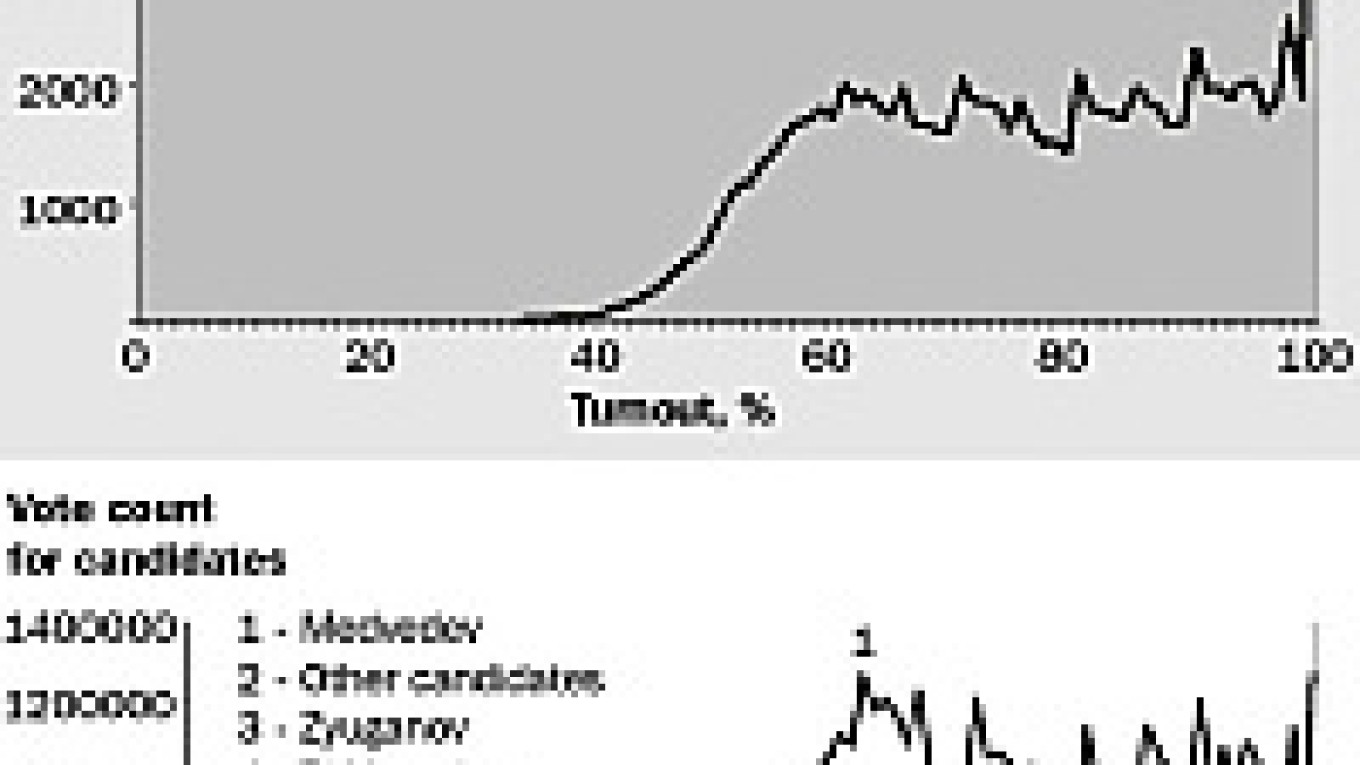
Analyzing official returns on the Central Elections Commitee web site, blogger Sergei Shpilkin has concluded that a disproportionate number of polling stations nationwide reported round numbers -- that is, numbers ending in zero and five -- both for voter turnout and for Medvedev's percentage of the vote.
The statistical anomalies offer mathematical evidence of election fraud in Medvedev's victory, math-savvy bloggers, election analysts and economists said.
"This is an unnatural distribution, and it points to blatant manipulation of numbers," said Andrei Buzin, who heads the Interregional Association of Voters and has a doctoral degree in math and physics.
In most elections, one would expect turnout and returns to follow a normal, or Gaussian, distribution -- meaning that a chart of the number of polling stations reporting a certain turnout or percentage of votes for a candidate would be shaped like a bell curve, with the top of the bell representing the average, median, and most popular value.
But according to Shpilkin's analysis, which he published on his LiveJournal blog, podmoskovnik.livejournal.com, the distribution both for turnout and Medvedev's percentage looks normal only until it hits 60 percent.
After that, it looks like sharks' teeth. The spikes on multiples of five indicate a much greater number of polling stations reporting a specific turnout than a normal distribution would predict.
A suspicious voter might say polling officials stuffed ballot boxes to achieve a nice, clean percentages like 65, 70, 75, 80 and so on.
The analysis and results mirror Shpilkin's study of the Dec. 2 State Duma elections, in which he found a similar predominance of round numbers both for voter turnout and for the percentage of the vote captured by pro-Kremlin party United Russia.
Local election officials were clearly thinking in round numbers while rigging turnout and Medvedev's percent of the vote, said economist Mikhail Delyagin, head of the Institute of Globalization Problems.
While the spikes on round numbers certainly reveal manipulations, they also demonstrate "an administrative demand" for a specific turnout to be reported to superiors, Shpilkin said in e-mailed comments.
Furthermore, according to Shpilkin's analysis, the higher the turnout, the higher Medvedev's percentage of the returns -- a correlation not seen in the returns of the other three candidates: Liberal Democratic Party leader Vladimir Zhirinovsky; Communist Party leader Gennady Zyuganov; and Andrei Bogdanov, who heads the tiny Democratic Party of Russia.
Buzin said this correlation clearly indicated ballot stuffing on a massive scale, though Shpilkin and Delyagin said it was feasible that where turnout was higher -- whether due to voter enthusiasm, coercion or herd mentality -- voters may have been more inclined to vote for Medvedev.
A written request to the Central Elections Commission for comment on the anomalies was not answered in time for publication. In February the commission would not comment on similar anomalies in the Duma elections.
Arkady Lyubarev, a researcher with Independent Institute of Elections, said he had tried on numerous occasions to discuss statistical anomalies in election results with commission officials but was repeatedly snubbed.
"They are not mathematicians, they are legal experts," Lyubarev said. "And from a legal perspective, you cannot use these anomalies to officially challenge the results of an election."
Given the similar anomalies in both the Duma and presidential elections, officials have either not learned how to manipulate returns to make them more plausible, do not care about public opinion, or both, said Sergei Shulgin, an analyst with the Institute of Open Economics who studies elections.
"The repetition of the anomalous spikes after they were reported in the media and widely discussed in the Russian blogosphere [after the Duma elections] confirms that there is no feedback between election officials and the public," Shulgin said.
Shulgin, who has crunched numbers for national elections dating back to the mid-1990s, said statistical distribution for voter turnout in Russian elections was becoming increasingly aberrant.
With each national election, the downward slope for turnout in what should be a bell curve rises higher and higher, Shulgin said. In Medvedev's victory, it became more or less a straight line peppered with spikes on round numbers.
This trend, Shulgin said, indicates that in areas where turnout is traditionally strong -- such as rural areas and ethnic republics -- more and more voters are showing up at polling stations with each new election.
This does not necessarily indicate ballot stuffing, Shulgin said. Intense efforts by officials to lure or coerce voters to polling stations could be an important factor as well, he said.
"In this presidential election, it looks like there was an order to get every voter out, and it worked," Shulgin said.
Meanwhile, what happened at Polling Station No. 682 in the Dagestani town of Kizilyurt remains unclear.
According to the Central Elections Commission web site, of the 766 ballots cast at the polling station, not one went to Medvedev. What's more, Bogdanov received 95 percent of the votes.
The numbers stand in stark contrast to those for all of Dagestan, where Bogdanov got 0.15 percent of the vote and Medvedev 91.92 percent. Nationwide, Bogdanov received 1.3 percent compared with 70.28 percent for Medvedev.
Buzin suggested that Dagestani election officials may have accidentally swapped Medvedev's and Bogdanov's figures as they filed their reports.
A spokesman for Dagestan's elections commission was incredulous when told of the results at the Kizilyurt polling station, despite the fact they are posted on the Central Elections Commission's web site.
"It is a provocation," he said without elaborating.
A Message from The Moscow Times:
Dear readers,
We are facing unprecedented challenges. Russia's Prosecutor General's Office has designated The Moscow Times as an "undesirable" organization, criminalizing our work and putting our staff at risk of prosecution. This follows our earlier unjust labeling as a "foreign agent."
These actions are direct attempts to silence independent journalism in Russia. The authorities claim our work "discredits the decisions of the Russian leadership." We see things differently: we strive to provide accurate, unbiased reporting on Russia.
We, the journalists of The Moscow Times, refuse to be silenced. But to continue our work, we need your help.
Your support, no matter how small, makes a world of difference. If you can, please support us monthly starting from just $2. It's quick to set up, and every contribution makes a significant impact.
By supporting The Moscow Times, you're defending open, independent journalism in the face of repression. Thank you for standing with us.

Remind me later.