

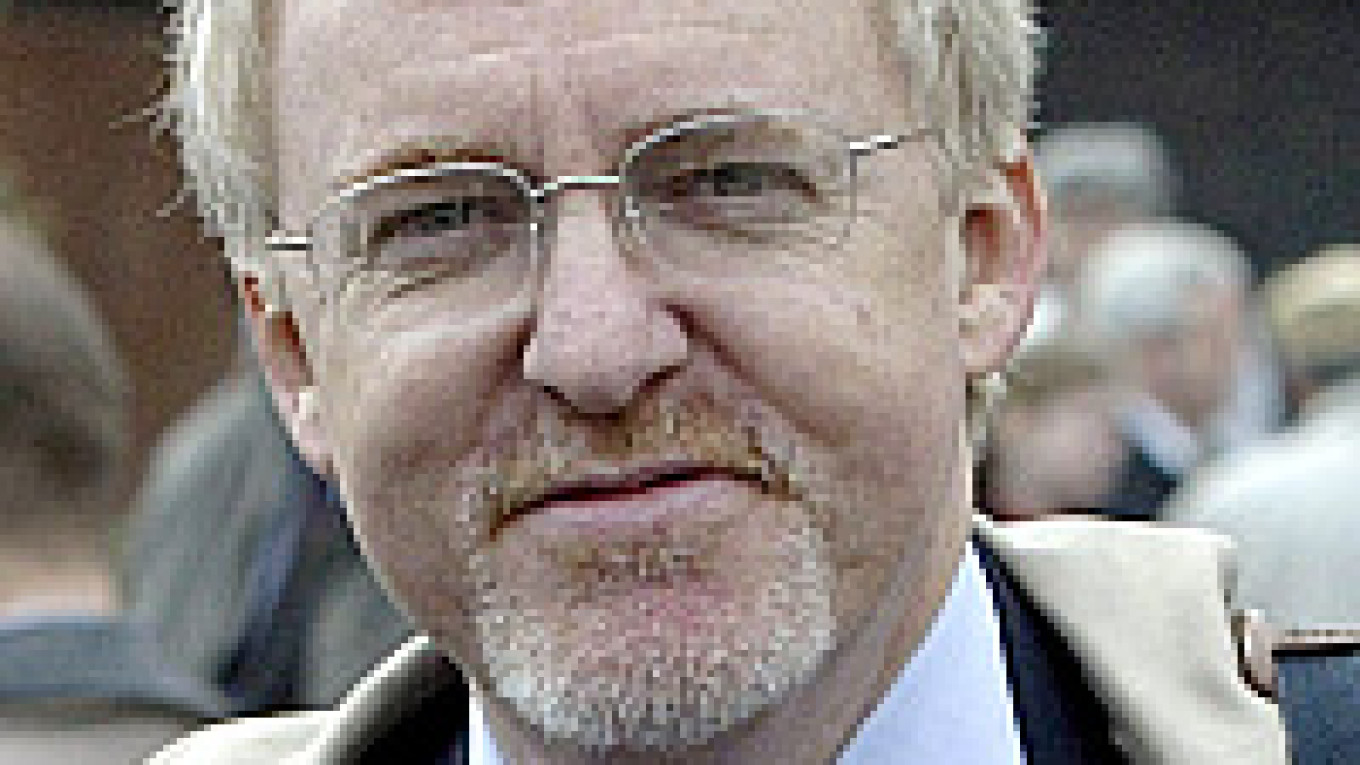
The most likely candidate to replace him, John Beyrle, is an old Russia hand, having served earlier as deputy chief of mission in Moscow. Beyrle is currently U.S. ambassador to Bulgaria.
The White House has nominated Burns as the replacement for his namesake, Nicholas Burns, as under secretary of state for political affairs when he steps down in March.
"Bill Burns has worked actively and successfully to advance a full range of important initiatives on the U.S.-Russia agenda," the U.S. presidential administration said in a statement Friday on its web site. "President Bush has every confidence that Ambassador Burns will approach his new duties with the same energy that he has demonstrated in Moscow and throughout his long and effective diplomatic career."
Nicholas Burns, 51, said he would retire to spend time with his family, the State Department said.
His is the latest in a series of resignations that have hit the department heading into the last year of George W. Bush's presidency, including three officials who left after criticism on issues related to the war in Iraq. One official resigned after a Washington call girl scandal.
William Burns is a career diplomat who previously served as assistant secretary of state for Near Eastern affairs as well as ambassador to Jordan. He has been U.S. ambassador in Moscow since 2005, when he replaced Alexander Vershbow, currently the United States ambassador in South Korea. Vershbow had served in the post for four years.
The two Burnses are not related.
Sources in the State Department were quoted as saying that it would nominate Beyrle for the post in Moscow, Western news agencies reported. The State Department refused to confirm that Beyrle was the likely candidate, but did say that it had "someone in mind," NTV television reported. The White House said it had yet to make a decision.
| Resume | ||||
Birthplace: Fort Bragg, North Carolina Date of Birth: April 4, 1956 Experience: Ambassador to Russia, 2005-present; assistant secretary of state for Bureau of Near Eastern Affairs, 2001-05; ambassador to Jordan, 1998-2001. At various posts since entering Foreign Service in 1982, including: executive secretary of the state and special assistant to secretary of state; minister-counselor for political affairs at U.S. Embassy in Moscow; acting director and principle deputy director of State Department's policy planning staff; special assistant to the president and senior director for Near East and South Asian Affairs, National Security Council staff Education: LaSalle University, Bachelor of Arts in History, 1978; Oxford University, master's and doctorate degrees in international relations, 1981 Family: Married, two children | ||||
| AP | ||||
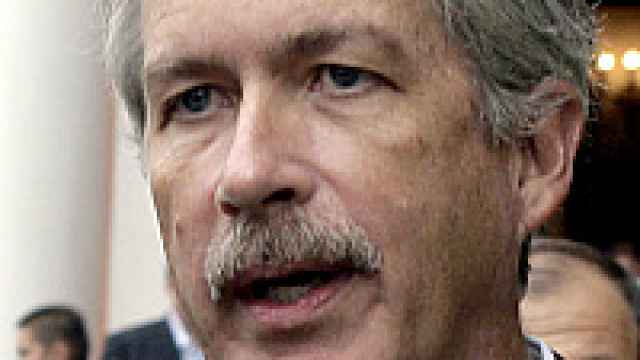

Russia's foreign policy is not expected to change drastically, as Putin is expected to retain significant influence after the almost certain election of his favored candidate, First Deputy Prime Minister Dmitry Medvedev. Changes in U.S. policy under a new administration are much more likely.
Two of the front-runners for the White House have been harshly critical of Putin. Last month, Senator Hillary Clinton, running for the Democratic Party nomination, said Putin had no soul, referring to a well-known remark that Bush made upon first meeting Putin in 2001 when he said, "I was able to get a sense of his soul." Republican candidate John McCain, who has regularly criticized Putin during his campaign, said that all he saw when he looked into Putin's eyes were three letters: "K.G.B."
A native of Muskegon, Michigan, Beyrle, 53, has specialized in Central and Eastern Europe in the state department. He has twice served in Moscow and was deputy chief of mission when named to the post in Bulgaria in 2005.
His father, Joseph Beyrle, was a decorated World War II Veteran, who was the only soldier in World War II to serve in both the U.S. and Soviet armies.
Beyrle served in the U.S. airborne forces and spent months in prisoner-of-war camps after being captured by the Germans. Surviving torture, he escaped and joined a Soviet tank brigade.
His unusual war service earned him medals from U.S. President Bill Clinton and President Boris Yeltsin on the 50th anniversary of D-Day in 1994.
One of John Beyrle's first experiences in Russia was as a student, when he studied for four months in Leningrad in 1976.
"I found a country so fascinating, a country so full of contradictions, a country so flawed," he told the Muskegon Chronicle in 2005, "In? many ways, the Soviet Union defined us as a country. ... It was fascinating."
He also worked as an exhibition guide in Ufa, Bashkortostan, 27 years ago, he told an audience in Magnitogorsk in 2004.
As an officer in the State Department, Beyrle traveled frequently to the former Soviet Union and was on hand for the historic meeting between Presidents Ronald Reagan and Mikhail Gorbachev in 1988.
He speaks fluent Russian, Bulgarian, Czech, French and German.
A Message from The Moscow Times:
Dear readers,
We are facing unprecedented challenges. Russia's Prosecutor General's Office has designated The Moscow Times as an "undesirable" organization, criminalizing our work and putting our staff at risk of prosecution. This follows our earlier unjust labeling as a "foreign agent."
These actions are direct attempts to silence independent journalism in Russia. The authorities claim our work "discredits the decisions of the Russian leadership." We see things differently: we strive to provide accurate, unbiased reporting on Russia.
We, the journalists of The Moscow Times, refuse to be silenced. But to continue our work, we need your help.
Your support, no matter how small, makes a world of difference. If you can, please support us monthly starting from just $2. It's quick to set up, and every contribution makes a significant impact.
By supporting The Moscow Times, you're defending open, independent journalism in the face of repression. Thank you for standing with us.

Remind me later.