

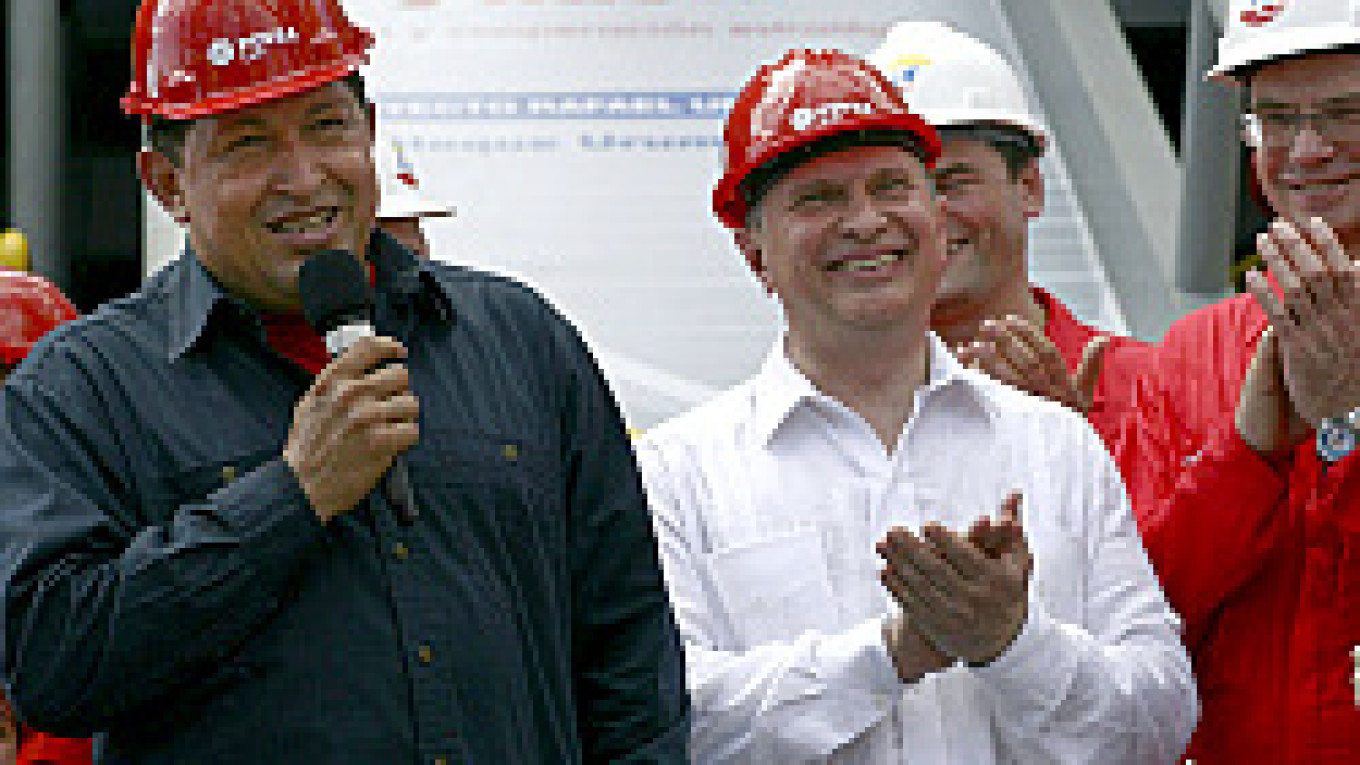
Officials from Gazprombank and state-owned Petroleos de Venezuela signed a memorandum of understanding between the two countries Saturday in Caracas, in a ceremony attended by Venezuelan President Hugo Chavez and Deputy Prime Minister Igor Sechin.
Venezuela, the biggest oil producer in South America, is seeking new funding sources as bonds and bank loans have become more difficult to arrange amid a lack of buyers for emerging market debt. The country formed a $12 billion development fund largely with Chinese loans that are being repaid in oil.
The fund will primarily finance economic development in Venezuela, Elias Jaua, Venezuela's minister of land and agriculture, said Saturday.
Rodriguez will look into making it possible to engage in trade using bolivars and rubles rather than dollars or euros, Chavez said. "We are also studying using the ruble as the reference for the international reserves," he said.
Chavez and Sechin on Friday mingled with workers from Petroleos de Venezuela and Gazprom and donned hard hats as exploration began at a Gulf of Venezuela drilling platform.
"Russia and Venezuela are establishing a strategic alliance," Chavez said on the platform. "We have freed ourselves from Yankee imperialism."
Venezuela has South America's largest natural gas reserves, which have remained largely untapped while the country has focused on oil production.
Gazprom won the contract to help develop two natural gas blocks in the gulf in 2005. The project is expected to start producing gas within five years.
United Company RusAl is continuing efforts to open an alumina mill in Venezuela, Chavez said. The country will find a way to provide the 4 gigawatts of electricity that the plant needs, Chavez said, possibly by building electric plants that burn coke, a carbon-rich byproduct of oil refining.
Rodolfo Sanz, Venezuela's minister of basic industries and mining, said the RusAl mill would process 1.4 million tons a year, double Venezuela's current output.
Venezuela also plans to enlist Russian help to build mines at its largest gold deposits, the mining minister said Thursday, apparently killing a yearslong bid by two Canadian companies to develop the projects.
An accord was to be signed on Friday with Russian-owned Rusoro to operate the Las Cristinas and Brisas projects with Venezuela, Sanz told a Russian delegation.
Las Cristinas, one of Latin America's largest gold projects, is currently operated by Canada's Crystallex, which waited in vain for years for an environmental license to start mining.
Nearby, Brisas is operated by Gold Reserve, which has a concession for the mainly gold project but was also waiting for environmental permits.
While it appeared that Sanz will replace Crystallex and Gold Reserve with Rusoro, he did not mention their names.
The statements came a day after Venezuela said it wanted to recover control over its gold to boost its reserves as a shield from global financial crisis.
Bloomberg, AP, Reuters
A Message from The Moscow Times:
Dear readers,
We are facing unprecedented challenges. Russia's Prosecutor General's Office has designated The Moscow Times as an "undesirable" organization, criminalizing our work and putting our staff at risk of prosecution. This follows our earlier unjust labeling as a "foreign agent."
These actions are direct attempts to silence independent journalism in Russia. The authorities claim our work "discredits the decisions of the Russian leadership." We see things differently: we strive to provide accurate, unbiased reporting on Russia.
We, the journalists of The Moscow Times, refuse to be silenced. But to continue our work, we need your help.
Your support, no matter how small, makes a world of difference. If you can, please support us monthly starting from just $2. It's quick to set up, and every contribution makes a significant impact.
By supporting The Moscow Times, you're defending open, independent journalism in the face of repression. Thank you for standing with us.

Remind me later.