

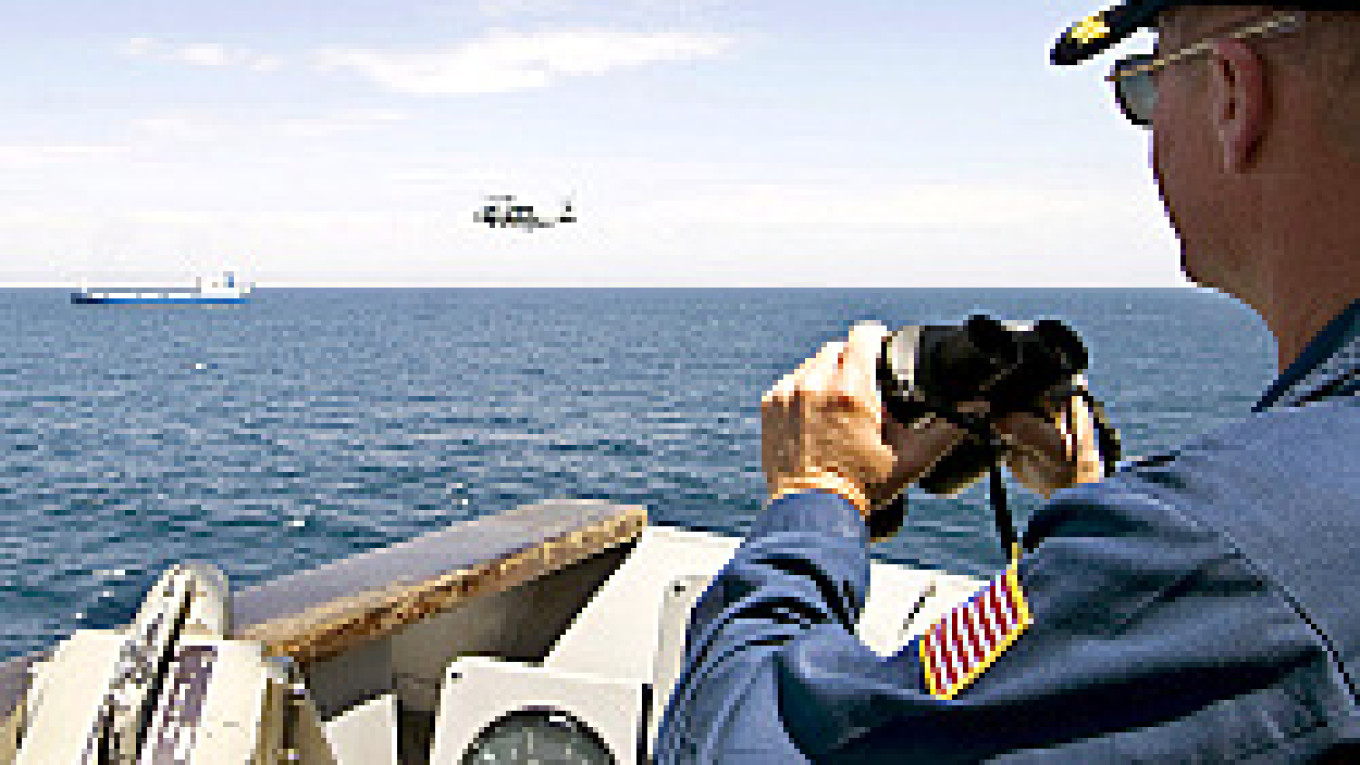
The Navy has said only that it ordered the guided-missile frigate Neustrashimy to the Indian Ocean to protect commercial shipping lanes and defend the lives of Russian citizens.
But there has been speculation that Russia could try to free the hostages aboard a Ukrainian ship, the Faina, that was seized by Somalia-based pirates last week. Russia has dealt harshly with hostage-takers in recent years.
The pirates have demanded $20 million for the release of the ship and its 20-man crew, which includes two Russians. Besides more than 30 battle tanks, the ship is loaded with armaments, and the pirates warn that they will fight to the death if attacked.
The seizure, analysts say, has given Russia another chance to display its might following its brief war with Georgia -- which the Kremlin justified, in part, as an effort to protect Russian citizens living in two breakaway regions.
"It's another show of the flag intended to demonstrate that Russia would protect its citizens wherever it deems it necessary," said Yevgeny Volk, the head of the Moscow office of the Heritage Foundation.
A hostage rescue would play well with the many Russians nostalgic for the superpower status of the Soviet Union.
Pavel Felgenhauer, an independent military analyst, said Russia might be tempted to use force against the pirates. "Neustrashimy is a well-armed frigate, which can do that," he said.
But there was no word of any forces being sent to the area besides the frigate. The ship is armed with cruise missiles, torpedoes and cannons and carries a helicopter for antisubmarine missions.
"It's a pure propaganda effort," Volk said, arguing that a single warship would be useless in the current situation and a special-forces mission would be needed.
President Dmitry Medvedev recently pledged to deploy Russian forces on regular maneuvers worldwide.
Earlier this month, a Navy squadron sailed for Venezuela in the first Russian deployment to the Western Hemisphere since the Cold War.
The deputy chief of the Russian Sailors Union, Alexander Ageyev, argued that one nation or another needed to use its navy to battle pirates who prey on shipping off Somalia's coast. "They feel impunity. And it will continue until navy ships, ours or others, use force," Ageyev said on Ekho Moskvy radio.
But others warned that there was little the Russian frigate could do without risking the lives of the Faina's mostly Ukrainian crew. "Any attempt to use force would lead to victims among the crew," said Mikhail Voitenko, the editor of the Maritime Bulletin-Sovfrakht web site, who has closely followed attacks by Somali pirates.
Voitenko said Ukraine should be negotiating with the pirates and warning other nations not to use force.
The Kremlin has not publicly offered help to Ukraine, and Ukrainian authorities have not publicly asked.
During the brief period of U.S.-Russia cooperation after Sept. 11, Washington and Moscow might have joined forces to free the crew. Not now.
Foreign Minister Sergei Lavrov said at the United Nations on Monday that an international effort was needed to fight Somali pirates. But Lavrov pointedly refrained from mentioning that U.S. warships were shadowing the Faina.
A Message from The Moscow Times:
Dear readers,
We are facing unprecedented challenges. Russia's Prosecutor General's Office has designated The Moscow Times as an "undesirable" organization, criminalizing our work and putting our staff at risk of prosecution. This follows our earlier unjust labeling as a "foreign agent."
These actions are direct attempts to silence independent journalism in Russia. The authorities claim our work "discredits the decisions of the Russian leadership." We see things differently: we strive to provide accurate, unbiased reporting on Russia.
We, the journalists of The Moscow Times, refuse to be silenced. But to continue our work, we need your help.
Your support, no matter how small, makes a world of difference. If you can, please support us monthly starting from just $2. It's quick to set up, and every contribution makes a significant impact.
By supporting The Moscow Times, you're defending open, independent journalism in the face of repression. Thank you for standing with us.

Remind me later.